
Ohne Titel
Folien in diesem Satz (6)
-
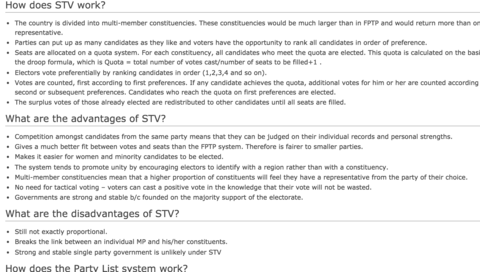
- Competition amongst candidates from the same party means that they can be judged on their individual records and personal strengths. Gives voters power that tey do not have with any other party.
- More proportional.Gives a much better fit between votes and seats than the FPTP system. Therefore fairer to smaller parties. UKIP won 27% vote, 24 MEP's
- Makes it easier for women and minorities to be elected.
- Tends to promote unity by encouraging electors to identify with a region rather than with a constituency
- Multi-member constituencies mean that a higher proportion of constituents will feel they have a representative from the party of their choice.
- No need for tactical voting- voters can cast a positive vote in the knowledge that their vote will not be wasted. votes are of equal value.
- Gov. are strong and stable b/c founded on the majority support of the electorate. more legitimate.
- Still not exactly proportional. Less accurate in translating votes than the list system
- Breaks the link between an individual MP and his/her constituents.
- unlikely to produce strong and stable single party
- Includes elements of chance- surplus votes just happen to be the last ones counted, the preferences expressed in the winning pile of votes might be different.
- Too much power to minority parties and extremist parties, for example, UKIP.
-
- Broadly proportional
- Each voter has a directly accountable single constituency representative
- Every voter has at least one effective vote- less wasted votes.
- Allows a voter to express personal support for a candidate, without having to worry about going against their party- allows electorate to make wider and more considered choices.
- Many representatives are accountable to the party leadership rather than the voters
- Having two different types of Representative creates animosity between them. Wales and Scotland- 'got in via the back door'.
- Gives rise to 'overhang' seats, where a party wins more seats via constituency vote that is is entitled to according to their proportionate vote. In germany, extra seats are allocated to the other parties to redress the balance. This can get complicated and lead to further bickering and aminosity.
- Complicated- people confused over exactly what their supposed to do with their 2 votes. Political apathy- low turnout rate.
- parties still remain under represented.
-
What difference would PR make?
- Conservatives 331 --> 250
- UKIP 1 --> 80
- UKIP required 100x more as many votes for its elected MP than the Tories did.
-
-
- Moving to proportional representation (PR) in the UK may offer would give minority parties and independent candidates a better chance of winning seats in Parliament. More people are represented: 70% of votes were not for winning party.
- The current First Past the Post electoral system is considered unrepresentative, as candidates can be elected with a very small share of the votes while all other votes cast in the constituency are wasted. 70% of all votes cast wasted.
- PR ensures that the parties would have to appeal to their core supporters, rather than a small number of so-called ‘swing voters’ in marginal seats.
- Under PR, fewer votes are ‘wasted’ as more people’s preferences are taken into account. PR may encourage turn-out and reduce apathy.
- PR potentially offers greater and more representative choice for voters.
- PR rarely produces an absolute majority for one party, however, it could be argued that PR ensures greater continuity of government and requires greater consensus in policy-making.
-
- Under FPTP, MPs serve the constituency they campaign in. This makes them more inclined to tackle important local issues.
- PR can potentially provide a route for extremists to force their way into the political mainstream: under an FPTP electoral system this would be unlikely to happen.
- Some would say that PR produces ‘weak’ coalition governments rather than ‘strong’ majority governments, which arguably can lead to indecision, compromise and even legislative paralysis.
- PR can also reduce accountability to voters as an ousted party of government can retain office by finding new coalition partners after an election.
- The adoption of PR list systems weakens the link between the elected representative and his or her constituency.
- The greater complexity and choice that PR allows can put voters off voting, by requiring them to have a greater knowledge of individual and party positions
Informationen
- Beschreibung
- Folienset am Ohne Titel, erstellt von Charlotte Hogarth am 25/11/2015.
- Erstellt von
- Charlotte Hogarth
- Aufrufe
- 0
- Bewertung