
Atmosphere
Folien in diesem Satz (4)
-
- The Global Heat Budget.
- Only half of the Earth's Isolation arriving at the edge of our atmosphere makes it to the surface of the Earth. It arrives as short wave radiation, like UV rays.
- 22% is reflected by clouds.
- 3% absorbed by clouds.
- 5% scattered/reflected by dust.
- 4% reflected by the surface.
- 20% absorbed by dust.
- Once the radiation has been absorbed, it is radiated out as long wave radiation, e.g. Infrared.
- 6% is radiated into space
- 94% is absorbed by water vapour and C02 in the atmosphere and re-radiated.
- REFLECTION: Insolation is reflected due to albedo. It is reflected by clouds in the atmosphere as they are white. The thicker the cloud the more reflection. Deserts and ice caps reflect the insolation too, whereas forests and grasslands absorb it and reflect less.
- SCATTERING: Insolation is dispersed throughout the atmosphere by tiny gas and dust particles, more scattering occurs when there is more dust in the atmosphere- after volcanic eruptions and in heavily urbanised areas.
- ABSORPTION: Darker areas absorb more than lighter areas. The oceans are the biggest absorber and they store the most energy.
-
- The Global Heat Balance.
- Due to the Curvature of the Earth...
- Because of the low angle of the Earth, insolation hits the poles and energy is spread over a larger are, so the temperature is a cool average.
- In polar regions there is a lot more atmosphere to pass through which means insolation is more likely to be reflected, absorbed or scattered.
- The Earth tilts on its axis: Polar regions are in darkness for part of the year and the tropics always receive maximum insolation.
- Ocean Circulation
- Currents set up circular loops or gyres in both the northern and southern hemispheres.In the northern hemisphere currents flow clockwise and in the southern they flow anticlockwise
- Currents flowing away from the equator are called warm currents, e.g. Gulf Stream. Currents flowing towards teh equator are called cold currents, e.g. Canary Current.
- - Oceans receive 70% of the Earth's insolation and absorbs it because it is a dark surface.
- - The prevailing winds on the surface of the water, create friction with the water setting up ocean current. The huge size of the Atlantic and the Pacific allow currents to form.
- - The coriolis effect deflects currents to the right in the northern hemisphere and left in the southern hemisphere.
- - Cold dense polar water sinks, then spread towards the equator where it pushes up the less dense warm waterwhich moves towards the polar areas.
- -Uneven heating produces density differences in the oceans
- -Land masses cause the currents to be deflected too.
-
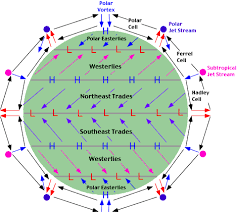
- Three Cell Circulation Model
- The sun heats at the equator, heat rises and creates an area of low pressure.
- In the upper atmosphere the air splits and moves towards the poles.
- It cools and sinks at the Tropics , creating an area of high pressure.
- It then moves back to the equatorial low completing the Hadley cell and creating the Trade Winds.
- Some air also moves north, this is know as the Westerlies, and it meets with incoming air from the poles call the Polar Easterlies. These meet at an area of low pressure and create the Ferrel Cell.
- When they meet warm air rises to from the Polar front.
- In the upper atmosphere, the air moves to the Poles where it sinks at an area of high pressure and creates the Polar Cell.
- The tilt of the Earth cause these wind bands to move north and south every year.
- The Doldrums are found along the equator and are associated with low pressure and calm winds.
- Jet streams are created by the differences in the temperature of polar air and sub-tropical air.
-
- ITCZ
- The area of low pressure produced by the combination of equatorial heating and the convergence of trade winds.
- Occurs at the Hadley Cells.
- The thermal equator migrates north and south due to changing positions.
- The ITCZ migrates north between March and July. And moves South in August to January.
- These bring two rainy seasons and the thermal equator receives maximum insolation.
- Air masses adopt characteristics of where they sit. For example the air over the Sahara is hot and dry whereas air over the Atlantic is cold and wet
- Tropical Continental Tropical Maritime
- Formed over the Sahara Formed over the Gulf of Guinea
- Little Evaporation High Evaporation
- Low humidity High Humidity
- maximum heating Maximum heating
- Stable air mass Unstable air mass
- Long dry sunny periods Intense rain and thunderstorms
- Hot dry summers Warm wet weather
Informationen
- Beschreibung
- Higher School Certificate(HSC ) Geography Folienset am Atmosphere, erstellt von Megan Campbell am 28/01/2016.
- Erstellt von
- Megan Campbell
- Aufrufe
- 6
- Bewertung