
Week 9
Folien in diesem Satz (7)
-
- the smallest structural and functional unit of an organism, which is typically microscopic and consists of cytoplasm and a nucleus enclosed in a membrane.
-
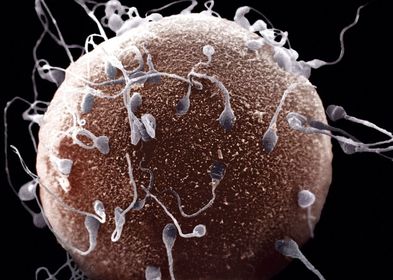
- Cells come in all shapes and sizes Oocyte - ameba
-
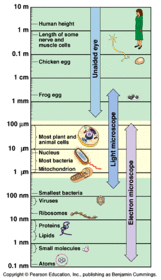
- Some cells are visible to the unaided eye. The smallest objects that the unaided human eye can see are about 0.1 mm long. That means that under the right conditions, you might be able to see an ameoba proteus, a human egg, and a paramecium without using magnification.
-
- 70% H2O
- 30% chemical
- 4% ions and small molecules
- 2% phospholipids
- 1% DNA
- 6% RNA
- 15% proteins
- 2% polysaccharids
-
- Human eye can only detect 2 changes
- in light,
- Change in AMPLITUDE.
- • How is this seen?
- Change in WAVELENGTH.
- • How is this seen?
-
- The size of an image is controlled by
- the angle light makes as it enters the
- eye.
- Objects producing a large angle
- appear bigger, we can therefore make
- an object appear larger by altering the
- angle of light entering the eye.
- This occurs when we get closer to an
- object and its size appears bigger.
- Example exam question
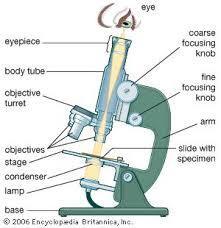
- A light microscope is able to magnify an object by which of the following
- mechanisms?
- Decreasing the angle of light from the object entering the eye.
- Increasing the angle of light from the object entering the eye.
- Using a system of concave lenses.
- Increasing the wavelength of light from the object.
- Decreasing the wavelength of light from the object.
-
- Advantages