
Coastal Dunes
Folien in diesem Satz (8)
-
- https://www.youtube.com/watch?v=t5Q5FFWRxCE (Einbetten)
- Bildunterschrift: https://youtu.be/t5Q5FFWRxCE
-
- For a sand
- dune to form there
- must be a reliable
- supply of sand, a
- means of transporting it (wind), and somewhere
- for it to be deposited more quickly than it is eroded.
- •The dry grains of
- sand can then be transported by the wind through a process of saltation. If the wind
- blows towards the land, sand will be transported up the beach and beyond the
- high tide mark. When the dry
- particles of sand reach the top of the beach they might be trapped by driftwood
- and rocks.
- If the sands
- is not eroded again, plants might start growing on it increasing the size and
- hence trapping more sand.
-
- Strong onshore
- winds
- Large
- expanses/area of dry sand ( spits, cuspate forelands, bays)
- Reliable
- supply of sand
- Large tidal
- range
- Vegetation to
- act as obstacles to limit/trap sand movement and deposition can occur –
- vegetation cause wind velocity to drop.
-
- Bildunterschrift: http://www.s-cool.co.uk/a-level/geography/coastal-processes/revise-it/coastal-deposition
-
Characteristics of a sand dune
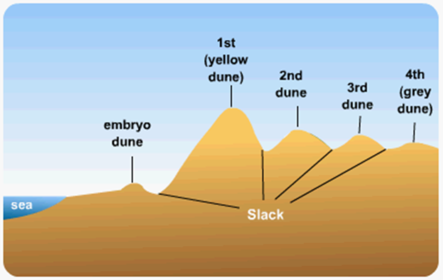
- Embryo – this is the
- first part of the dune to develop and are formed in sheltered areas. Once the
- pioneer plant species such as Lyme grass, sand couch grass and sea rocket
- stabilise, the sand is trapped and accumulated over time - the dune grows.
- Conditions in this dune are dry thus plants adapt by growing long roots and/or
- thorny leaves to reduce evapotranspiration. The early colonising plants will
- eventually die off and decompose. They
- add nutrients to the soil which makes the dunes more hospitable for new and
- larger plants to grow therefore giving them the capability trap more sand –
- larger dunes develop.
- Vegetation
- makes the dunes stable.
-
- Fore dune – They tend to
- be very yellow as they have limited vegetation so no real humus layers develop.
- Marram grass is the main coloniser and stabiliser.
- Yellow dune – The colour
- darkens as organic material add nutrients and humus to the soil. Sea couch and marram grass stabilise the
- dune.
- Grey dunes – Developing
- humus layers changes the colour of the dune form yellow to grey. Water retention is also increased
- (soil becomes damper and richer) due to more humus therefore more species of plants
- thrive e.g. Creeping willow, red fescue and dewberry. In time, the dune stops growing because the
- sheltered means that there is a lack of wind to blow the sand.
-
- Mature dunes –
- The dunes can
- sustain more plants such as thistle, evening primrose, bracken, bramble and
- heather because the humus layers grow more. Less than 10% of sand is exposed on
- these dunes.
- Dune slacks - are low lying
- depressions between the dunes. Plants in
- the dune slacks include wild strawberries, buttercup and violets with some flag iris and willow in the
- slacks at the rear of the main dune system. In the slacks, vegetation covers almost
- everything.
-
- It
- is key to remember that during the development of mature dunes, the embryo
- dunes are continually being formed at the base of the dune system consequently,
- the dune system is advancing seaward.