
Substances Summary
Folien in diesem Satz (5)
-
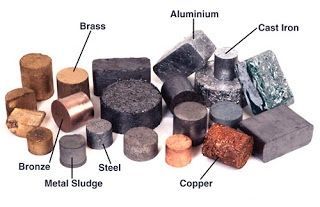
- Elements are substances that are made up of just one type of atom. Each element has a unique set of characteristics that scientists refer to as its properties. Elements can be classified into metallic and non-metallic elements. All metallic elements -:
- shiny
- solid at room temperatures(apart from mercury)
- good conductors of heat and electricitymalleable(bent and hammered into sheets)
- ductile(stretched into wires
- Non -metallic elements-:
- dull(not shiny)
- do not conduct heat or electricity)
- Break or crumble when you bend them(brittle)
- solid or gases at room temperature(apart from bromine)
- There are 118 elements, but only 91(92) occur naturally.
- Bildunterschrift: metallic elements
-
- The way atoms are arranged in Elements determines many of the physical properties of an element. Monatomic elemets are rare, with only 6 of the 92 naturally occurring elements being monatomic.
- These are -: Helium, Neon, Argon, Krypton, Xenon and Radon.
- Molecules are cluster of two or more atoms bonded together. In a molecular element, all the molecules are identical with the same shape, size, number and types of atoms.
- The atoms in metals don't form molecules, but instead form large grid-like structures known as crystal lattices. In metal lattices, the atoms are only weakly joined to each other. As a result, metals can be bent into wires.
- In non-metallic lattices, the atoms are strongly bonded to each other. This makes them hard and brittle.
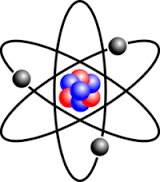
- Bildunterschrift: An atom
-
- Compounds are made up of more than one type of atom. Compounds have properties that are usually very different from the properties of elements.
- Each molecule is made by combining different numbers of the same elements, oxygen hydrogen etc. Scientists represent the molecules of compounds in a similar way to the molecules of an element. H2O indicates that there are 2 hydrogen atoms for every oxygen atom.
- Compounds can also form crystal lattices. In these lattices, the atoms are strongly bonded to each other so they tend to be very hard solids at room temperatures. In a lattice of sodium chloride, sodium and chloride atoms form a grid-like structure with one sodium atom for every chlorine atom.
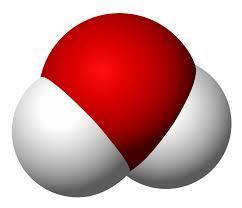
- Bildunterschrift: Water Molecule H2O

Informationen
- Beschreibung
- Folienset am Substances Summary, erstellt von Khalid Badaso am 23/06/2016.
- Erstellt von
- Khalid Badaso
- Aufrufe
- 1
- Bewertung