
Topic 2.1 Motion Lesson 1 Distance & Displacement; Speed & Velocity
Folien in diesem Satz (4)
-
Topic 2.1 Motion Lesson 1 [slide 1]
- Understandings:
- Distance and displacement
- Speed and velocity
- Applications and Skills:
- Sketching and interpreting distance-time and displacement-time graphs
- Determining instantaneous and average values for velocity and speed.
- NOTE CAREFULLY: This lesson must be completed by 7.30 am on --/--/2016.
-
Topic 2.1 Motion Lesson 1 [slide 2]
- Part A: Difference between Distance & Displacement:
- Motion involves moving some distance and usually results in a change in displacement.
- We will start by developing an understanding of the difference between the terms distance and displacement.
- 1. Click on the link below to explore a simple simulation that shows "distance" and "displacement".
- LINK FOR DISTANCE AND DISPLACEMENT SIMULATION
- 2. Explore the simulation carefully.
- 3.
-
Topic 2.1 Motion Lesson 1 [slide 3]
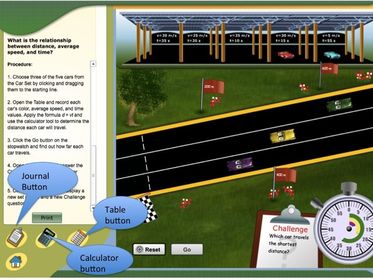
- This activity involves learning about the link between average speed, time and distance travelled.
- Use the link below to go to the simulation shown in the picture. It includes the instructions for what to do.
- LINK TO DISTANCE, AVERAGE SPEED & TIME SIMULATION
- When you have answered the Challenge Questions, you can select "Print", then "Save" as a PDF.
- Bildunterschrift: Distance, Average Speed & Time Simulation
-
Topic 2.1 Motion Lesson 1 [slide 4]
- OPTIONAL TASK FOR ADVANCED LEARNERS:
- On grid paper, make a map (to scale) from school to your home and use data from Google Maps to get the total distance and displacement vector. These will all be different for each person in class.
- TIPS:
- Be sure to:
- (i) define your scale, such as 1 cm on the map is equal to 100 metres, or 1 km, or whatever you want it to be for your map.
- (ii) orient your map with N (top), S (bottom), E (right side), W (left side), so you can calculate the angle of the displacement vector from school to your home!
- (iii) give the angle for the displacement vector in terms of how many degrees clockwise from North, which is the positive y-axis. Let the school be the origin (0,0) of your graph.
Informationen
- Beschreibung
- Lesson 1 for Sub-topic 2.1 Motion of IB Physics 2016 Topic 2 Mechanics
- Erstellt von
- Jeffrey Piggott
- Aufrufe
- 268
- Tags
- Bewertung