
Dijkstra's Shortest Path Algorithm
Folien in diesem Satz (7)
-
Dijkstra's Shortest Path Algorithm
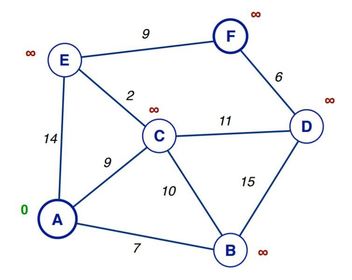
- In the following slides we want to find the shortest path from A to F considering that each edge is labelled with it's specific distance.
- We start with labelling the starting node A with 0, which stand for the total distance one has to travel from A to A. All other nodes are labelled with infinity.
-
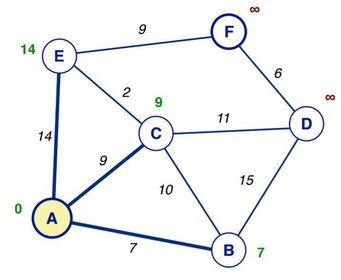
- In the first step we travel to all nodes which are reachable from A and are not yet visited. Then we update their distance to the minimum of their current distance and the distance travelled from A.
- Example: distance(E) = min{infinity, 14} = 14
- Since B, C, E had distance infinity beforehand, all of their distances will be updated.
- Now that we have visited node A, it gets marked as visited (yellow), so we don't visit it again.
-
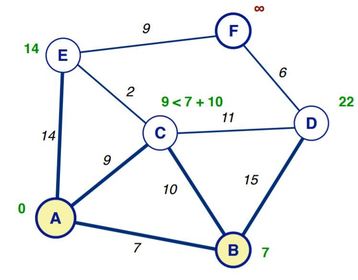
- We have already visited A, now we arbitrarily pick one of the nodes we have reached - in our case for example B. From B we can reach C and D (A is already visited).
- We see that the distance to C via B (10+7) is bigger than the current distance (9), so we do not update it's value.
- However the distance to D via B (7+15) is better than the current distance (infinity), so we update the value.
- As before, we now mark B as visited and continue with the algorithm.
-
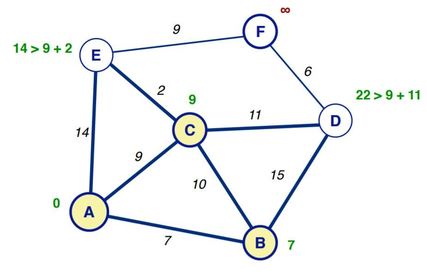
- Just as before, we pick an arbitrary node we have already reached and check, wheter we can reach the unvisited nodes in a more efficient way via the selected node.
- In our case we pick C and see, that the distance to E via C and the distance to D via C are reduced, so we update the values.
- As always, C is now marked as visited.
-
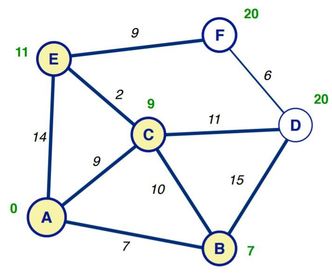
- We pick node E and observe, that we can reach F in distance 20 via the path ACEF.
- We mark E as visited.
-
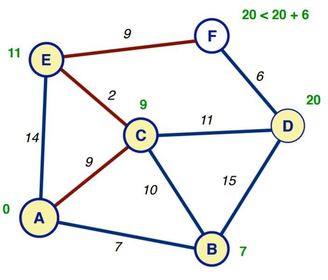
- At last we pick node D and discover, that path ACDF is longer than the current distance, so we don't update the value.
- Since all paths have been visited by now, we conclude that the shortes path from A to F is ACEF.
-

- These slides contain material that is licensed under the creative commons attribution-sharealike 4.0 international license.
- Therefore these slides are published under the same license.
- The material used in these slides are taken from the course "Einführung in die Informatik - Computational Thinking" and were created by Prof. O. Nierstrasz for classes at the University of Berne.
- Bildunterschrift: https://creativecommons.org/licenses/by-sa/4.0/
Informationen
- Beschreibung
- Bachelor Informatik (Einführung in die Informatik) Folienset am Dijkstra's Shortest Path Algorithm, erstellt von Luca Rolshoven am 28/12/2016.
- Erstellt von
- Luca Rolshoven
- Aufrufe
- 8
- Bewertung