
P1
Folien in diesem Satz (4)
-
- Thermal radiation is the transfer of thermal energy by electromagnetic waves. (No particles of matter are involved).
- All objects emit and absorb thermal radiation. the amount of thermal radiation given out or taken in by an object depends on its: surface, shape and dimensions.
- An object will emit or absorb energy faster if there is a big difference in temperature between it and its surroundings. the rate of heat transfer can be slowed down by the use of insulation, providing a barrier.
- In similar conditions different materials transfer heat at different rates. At the same temperature:
- Dark matt surfaces emit more radiation than light shiny surfaces
- Dark matt surfaces absorb more radiation than light shiny surfaces, because light shiny surfaces are good reflectors of infrared radiation.
-
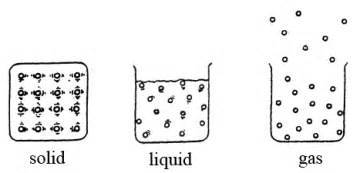
- The particles in solids, liquids and gases have different amounts of energy.
- In a solid the particles have the least amount of energy. they are not able to move, but do vibrate around a fixed point.
- Heating a solid gives the particles more energy to move around (although they can not move far apart) and it melts to become a liquid.
- Further heating gives the particles enough energy to move very quickly. they separate from each other and the liquid evaporates to become a gas.
- Bildunterschrift: states
-
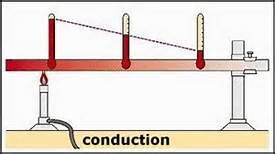
- Conduction is the transfer of heat energy without the substance itself moving.
- the structure of metals makes them good conductors of heat. As a metal becomes hotter, the tightly packed particles gain more kinetic energy and vibrate. this energy is transferred to cooler parts of the metal by delocalised electrons, which move freely through the metal, colliding with particles and other electrons.
- Conduction also occurs in non-metal solids because the particles can pass energy from one on to the next by vibrations. However, the lack of free electrons makes most non-metals poor conductors. Gases are poor conductors because the particles are so far apart.
-
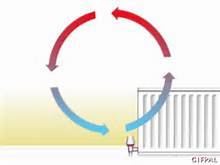
- Convection is the transfer of heat energy through movement. this occurs in liquids and gases and creates convection currents.
- In a liquid or gas the particles nearest the heat source move faster than the ones further away.
Informationen
- Beschreibung
- GCSE Physics (P1) Slide Set on P1, created by laura caneira on 18/04/2017.
- Erstellt von
- laura caneira
- Aufrufe
- 2
- Bewertung