
Karteikarten
Obstetrics Antepartum Haemorrhage
Karten in diesem Stapel (9)
- 1DefinitionBleeding from the genital tract after 20* weeks of pregnancy
<20weeks threatened miscarriage
* 20-24 weeks gestation is considered the time the baby is viable - 2APH causes:Vaginal bleeding may be due to:
• Haemorrhage from the placental site and uterine cavity
• Lesions of the vaginal or cervix
• Fetal bleeding from vasa praevia
The major causes of uteroplacental haemorrhage are:
• Placenta praevia
• Abrupto placentae or abruption
• Uterine rupture
• Unknown aetiology
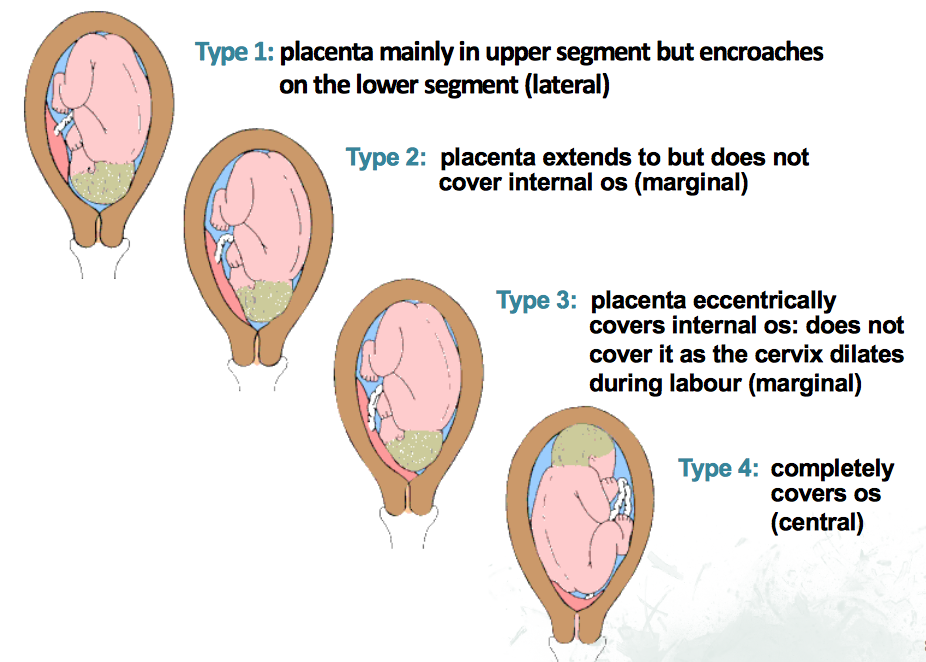
In almost half of the cases of PV bleeding the cause may not be confirmed - 3Placenta PraeviaPartial or complete implantation of placenta in lower segment of uterus.
From a management perspective there are three levels of severity
Lateral: The placental encroaches on the lower uterine segment but does not reach the internal cervical os
Marginal: The placental encroaches on or covers the internal cervical os before cervical dilatation occurs
Central: The placental completely covers the os even with cervical dilatation - 4Types
- 5Presentation• The key presentation is painless, causeless and recurrent vaginal bleeding
• Bleeding may start after intercourse or vaginal exam
• Occasionally, bleeding stops spontaneously and then recurs
with labour.
• Baby may be in an abnormal presentation
• Some cases also accompanied by some uterine activity but
generally uterus is not contracted - 6Risk factorsMultiparity
• Maternal age >35
• < 20 year old incidence of 1:1500
• > 35 years old incidence of 1:100
• Previous uterine surgery
• 1 cesarean incidence of 1.3:100
• ≥ 6 caesareans incidence of 3.4:100
• Multiple pregnancy 40% > singletons
• Previous placenta praevia
• Previous spontaneous abortion
• Smoking 200% increase in risk - 7Differential Diagnosis• Abruption
• Premature labour
• Premature SROM
• Infection
• Trauma (laceration)
• Vasa praevia
• Cervical cancer (<1:3000) - 8Vasa praevia• Fetal blood vessels traverse membranes
• Rarest cause of placental haemorrhage
• Abnormal insertion of fetal vessels into membranes rather than placenta
•Only cause of major obstetric haemorrhage in which blood loss is fetal
• High fetal mortality rate > 50% - 9Prehospital Management• History
• Gestation
• Scans with diagnosis of placenta praevia
• Previous placenta praevia or cesarean section
• Blood loss description - may not represent true picture
• Take soiled linen and pads with woman
• No PV examination
• IV access
• Position / warm
• Manage shock as necessary (consider blood) • Observations - compromise occurs late
• Load and GO
Informationen
- Beschreibung
- VIVA (Obstetrics) Karteikarten am Obstetrics Antepartum Haemorrhage, erstellt von Jonathan Cash am 20/10/2017.
- Erstellt von
- Jonathan Cash
- Aufrufe
- 16
- Bewertung