
Karteikarten
(Not needed) Unit 1: Atomic structure and the periodic table
Karten in diesem Stapel (61)
- 1What are elements?Elements are substances that cannot be broken down chemically.
- 2What are compounds?Compounds are substances that contain at least two different elements, chemically combined in fixed proportions.
- 3What is needed to make an element a compound?A chemical reaction.
- 4What are molecules?Molecules are two or more atoms that join together bey sharing their electrons.
- 5Give an example of a molecule?water and oxygen.
- 6Formula: balancing equations? (Of CaF2)Group 2 - Ca
Group 6 - F
Ration - 2:1 - 7What are mixtures?Mixtures are materials made up of 2 or more substances but are not chemically combined.
- 8How can mixtures be separated?Mixtures can be separated by filtration, crystallisation, distillation and chromatography.
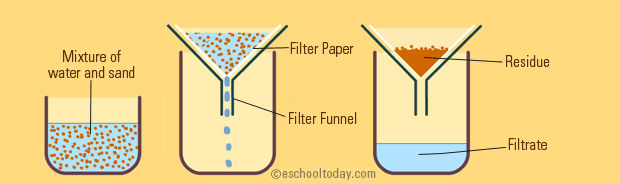
- 9What is filtration? Give an exampleFiltration is the action of filtering something
Eg. Acid+Mg(extra mg added so not everything reacts) and then filter. - 10What is crystallisation?Crystallisation is used to separate a solid that has dissolved in a liquid and made a solution.
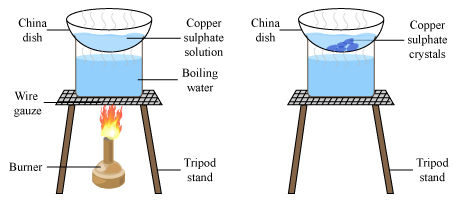
- 11What is distillation?Distillation is the action of purifying a liquid by a process of heating and cooling.
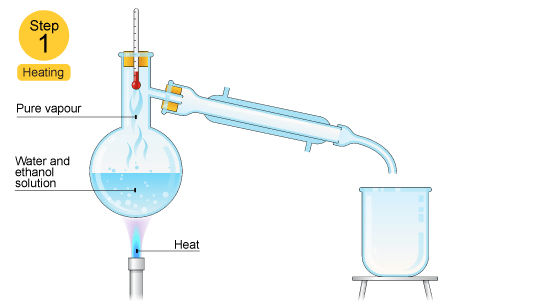
- 12What is chromatography?Chromatography is
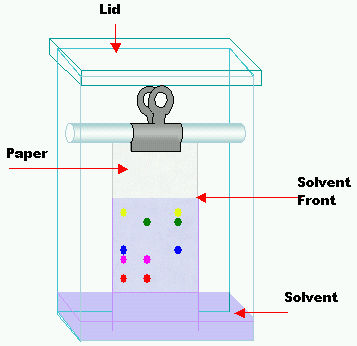
- 13What is fractional distillation?Fractional distillation is the separation of many different components by using different technics in sequence or by the same technique which includes various separations.
- 14What are atoms and who found out about them ?Atoms are small particles, they are made up of of electrons, situated in the outer shell of the atom and the protons and neutrons situated in the nucleus, every material is made of them. Democritus found out about them.
- 15What is an electron and who found out about them?An electron is a negative charge found in the outer shell of a atom. Thomson was the one to find about them.
- 16What are protons and who found out about them?Protons are particles found in the nucleus of the atoms. It was found by Thomson.
- 17What is the diameter of an atom?The diameter of an atom is of 10^-10.
- 18Relative charge in: -protons -neutrons -electronsRelative charge:
-proton: +
-neutron: o
-electron: - - 19Relative mass: -protons -neutrons -electronsRelativa mass:
-protons: 1
-neutrons: 1
-electrons: 1/2000 - 20What happens to an atom after it loses an electron?The atom becomes positive.
- 21What is the atomic number?The atomic number is the number that indicates how many protons and electrons the atom is made up of.
- 22What is the mass number?The mass number is the total of protons and neutrons that an atom has.
- 23What are isotopes?two or more forms of the same atom that contain equal numbers of protons but different numbers of neutrons in their nucleus.
- 24Give an example of a isotope?35
CL
17
37
Cl
17 - 25What is the equation of a isotope?(% of isotope 1 × mass of isotope 1) + (% of isotope 2 × mass of isotope 2) ÷ 100
- 26Group and periods in what direction does each go in the periodic table?
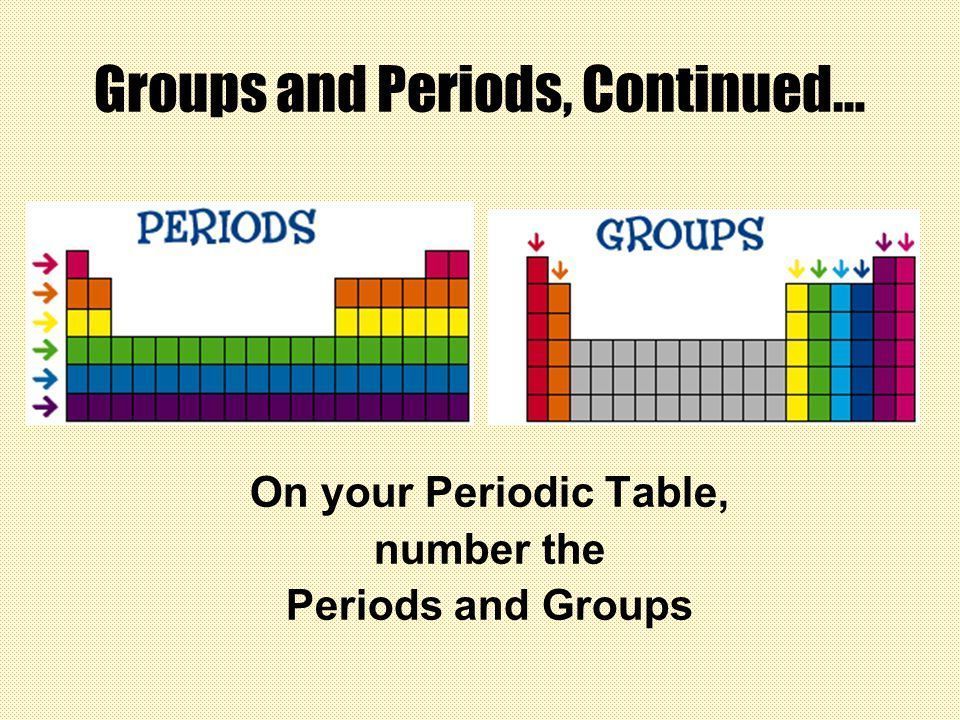
- 27What did Dobereiner notice in the year 1829? What where these called?He noticed that sometimes 3 elements had similar properties.
These were called 'Dobereiner triads'. - 28What did John Newlands notice in the year 1860? What where these called?John Newlands noticed that when he put the elements in atomic weight order there was often a pattern of similar properties every eight elements.
- 29What did Dmitri Mendeleev do in the 1869?He put the elements in order of their atomic weights. And he alsodiscovered 3 new elements.
- 30What happened in 1932?The order of elements in the modern periodic table needs to be by the number of protons.
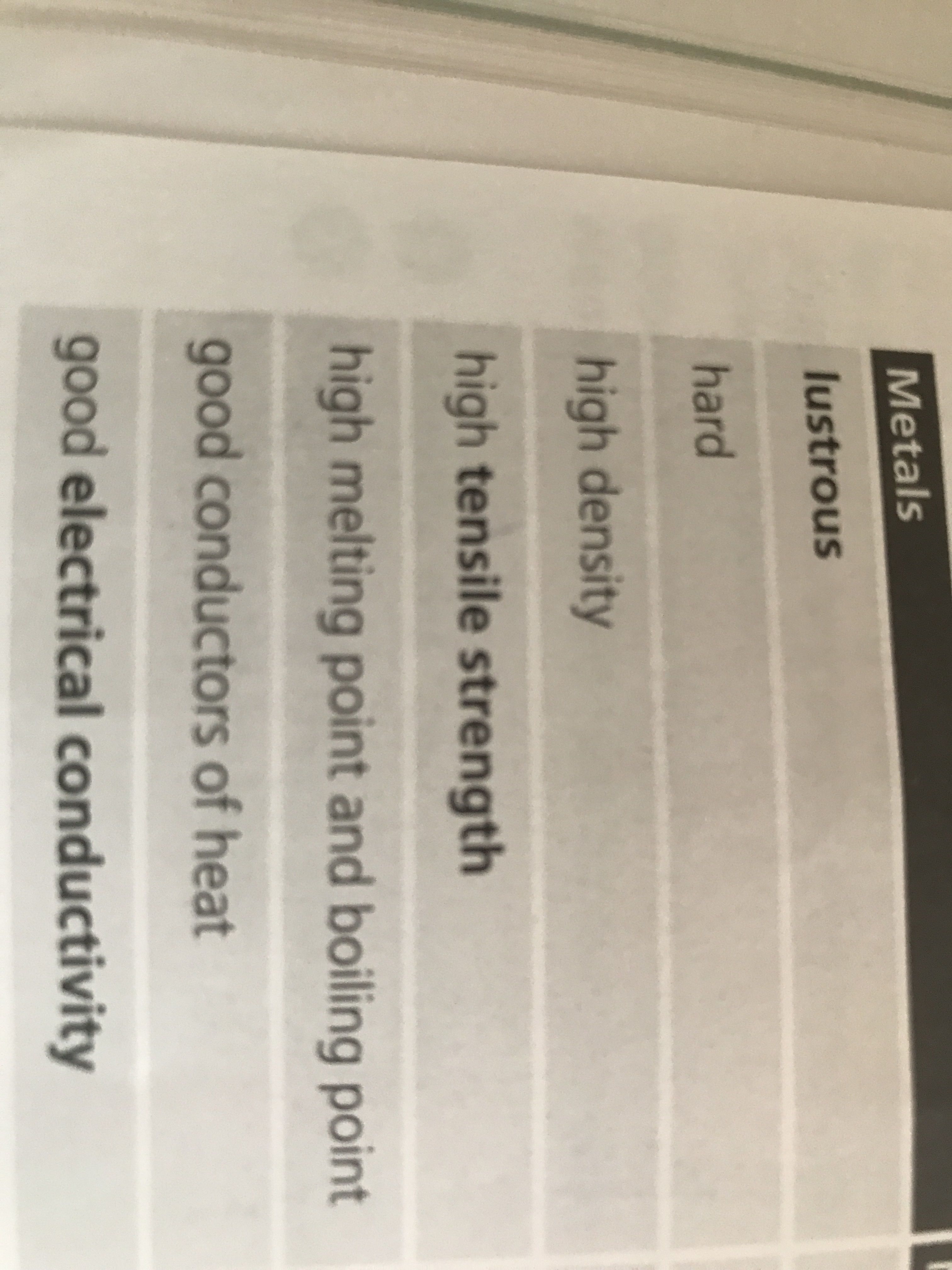
- 31Properties of metals?
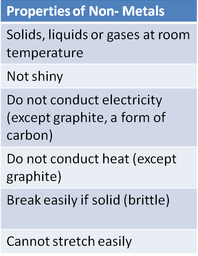
- 32Properties of non-metals?
- 33What are chemical properties? Why does metal react with oxygen? Why does metal react with acid?Chemical properties are the reactions of metals with oxygen and acid.
Metals react with oxygen to form oxides.
Metals also react with acid to form salts. - 34Example of a chemical reaction?Eg. Carbon + oxygen - carbon dioxide
Carbon dioxide dissolved in water to make a mildly acidic solution.
(This is what fizzy water contains). - 35What happens when a metal reacts with a gas?The metal loses electrons and the gas gains electrons from the metal. And so it forms ions ions.
- 36What happens when a non-metal reacts with a metal?The non-metal gains electrons from the metal. The non-metal does not form a positive ion.
- 37Why are the noble gases unreactive?This is because their outer shells contain 8 electrons. And so they don't tend to transfer their electrons.
- 38What happens when a gas in group 0 has a lower boiling point?This means the atom of the element keep moving rapidly at lower temperatures.
- 39what happens to the boiling points in group 0 as they go down?The boiling points increase.
- 40is it easier for the smaller atoms to move around quiker than the bigger atoms?Yes
- 41Do bigger atoms have a higher boiling point than smaller atoms?yes
- 42what group 1 elements are less dense than water?Lithium, sodium and potassium.
- 43what do group metals make when they react with water?they make hydrogen.
- 44Do metals also react with oxygen? If they do what do they form?Yes.
They form oxides. - 45What is also made when lithium, sodium and potassium react with water?An alkali is made.
- 46How many electrons do alkali metals need to lose to have a full outer shell? What does it then form?They need to lose 1 electron.
An ion forms. - 47what happens to the atom when it loses 1 electron? (Also for unit 4)It has 1 more positive charge in its nucleus than negative electrons surrounding it. So it I now a positive ion that carries a charge of +1
- 48How are group 7 elements known as?They are known as halogens.
- 49What are halogens? How do halogens exist as? Give an example?Halogens are non-metals.
Halogens exist as pairs of atoms.
eg. Cl2, F2, Br2 - 50What do halogens make when they react with metals? What do halogens make when they react with a non-metal?They make salts.
The make liquid or gases (like acids). - 51What happens to the reactivity of the halogens as you go down the group?The reactivity goes down.
- 52What are halides?Compound of a halogen with another element or group
- 53What are metal-halides?Metal halides are compounds between metals and halogens.
- 54What happens when halogens are bubbled through solutions of metal halides?There is no reaction or there is a displacement.
- 55What is a displacement reaction?Chemical reaction in which a more reactive element displaces a less reactive element from its compound
- 56Will barium be more reactive with diluted acid than magnesium? Why?Barium will react more because its lower down group 2 and so it will lose electron more easily.
- 57If bromine is bubbled through potassium chloride solution what reaction will there be?There will be no reaction because chlorine is more reactive than bromine and so will not be displaced:
- 58Do all transition metals have typical metallic properties?Yes
- 59Is the reactivity in transition metals the same as in group 1 metals?No, they are less reactive.
- 60What is a catalyst? Are you able to reuse a catalyst after a reaction?A catalyst is an element or a compound that changes the rate of a chemical reaction without taking part in the reaction
It can continue to act repeatedly. - 61What colour are the compound of group 1? What colour are the transition metals? What colour does copper become?They are white.
They are coloured.
It becomes blue.
Informationen
- Beschreibung
- 3º de ESO Física y Química ( Chemistry ) Karteikarten am (Not needed) Unit 1: Atomic structure and the periodic table, erstellt von lucia larrain am 25/04/2018.
- Erstellt von
- lucia larrain
- Aufrufe
- 34
- Bewertung