
17313451
Beschreibung

Karteikarten von AsimAli Rehman , aktualisiert more than 1 year ago

|
Erstellt von AsimAli Rehman
vor mehr als 7 Jahre
|
|
| Frage | Antworten |
| What is crude oil? | Crude oil is a fossil fuel made of a mixture of hydrocarbons. |
| What is a mixture? | A mixture consists of two elements and / or compounds which are not chemically bonded to each other. |
| What is a hydrocarbon? | Hydrocarbons are basically fuels such as petrol and diesel. A compound/moleucule made up of only hydrogen and carbon. |
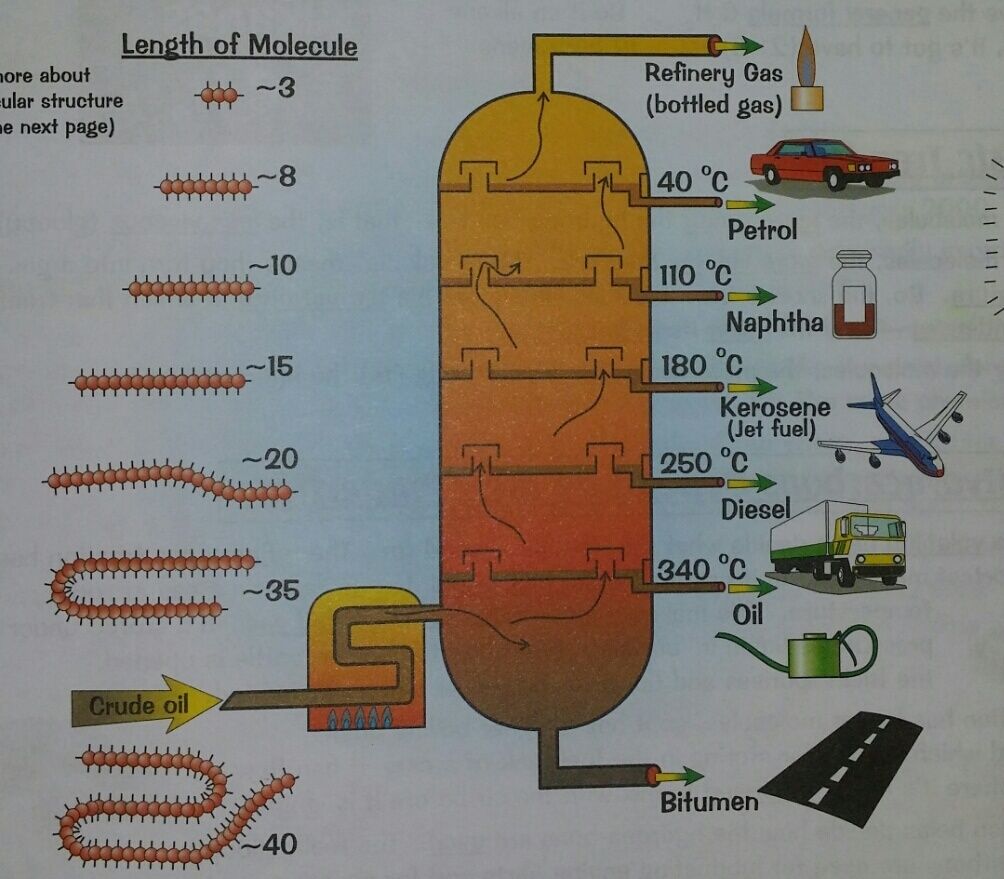
| A fractional distillation column. | |
| What is a fraction of crude oil? | A fraction of crude oil is a group of hydrocarbons that are a similar size so have similar properties. |
| Describe how crude oil is separated? | 1) This is a fractional distillation column. 2) Crude oil is heated and then vaporised into a gas. 3) Crude oil is separates into fractional of different hydrocarbons. 4) The length of the hydrocarbon affects its boiling point. 5) Short hydrocarbons have LOW boiling points because it takes a little amount of energy to break the bonds. These come off at the top. 6) Long hydrocarbons have HIGH boiling points because it takes a lot of energy to break the bonds. These come off at the bottom. |
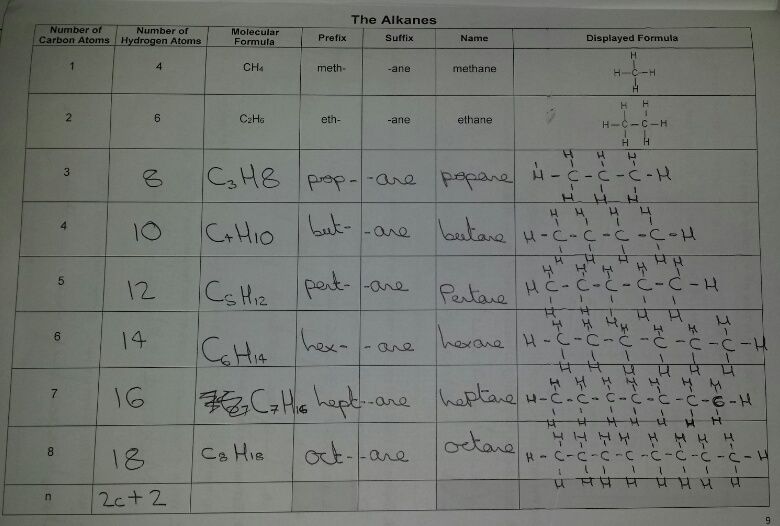
| What is an alkane (formula) and what is it made up of? | An alkane is a saturated hydrocarbon. It is made up of chains of carbon atoms surrounded by hydrogen atoms. CnH2n+2 |
| What does saturated mean? | That all the atoms are joined together by single covalent bonds. |
| What type of bonding holds atoms together in alkanes? | Covalent bonds. Each line on a diagram represents single covalent bonds (each line is one shared pair of electrons). |
| What does viscosity mean? | How easily a substance flows. Substances with a high viscosity (viscous substances) are thick and sticky, they do not flow very well. Substances with a low viscosity are thin and flow easily. The larger the molecule the higher the viscosity. |
| What does volatility mean? | How easily a liquid vapourises - turns into a gas. Volatile liquids turn into gases easily. The larger the molecules the less volatile they are. |
| What does flammability mean? | How well a substance burns. Highly flammable substances ignite easily and burn well. The larger the molecule the lower the flammability. |
| What are the properties of short chain alkanes? | They have a low boiling point and low viscosity. They are highly volatile and flammable. |
| What are the properties of long chain alkanes? | They have a high boiling point and are viscous. They are not very volatile or flammable. |
| The alkanes. | |
| Which of the alkanes are gases at room temperature (20°c)? | Methane ethane butane |
| Why does an increase in the number of carbon atoms increase the boiling point of an alkane? | The more the number of carbon atoms an alkane has the more intermolecular forces between molecules so therefore more energy is required to break bonds resulting in high boiling points. |
| What elements do fuels contain? | Carbon and hydrogen. |
| What does combustion mean? | Burning |
| What three elements is needed for combustion? | Fuel Heat oxygen |
| What type of chemical reaction is combustion? | Exothermic because heat energy is given out to the surroundings. Oxidation because the elements combine with oxygen. |
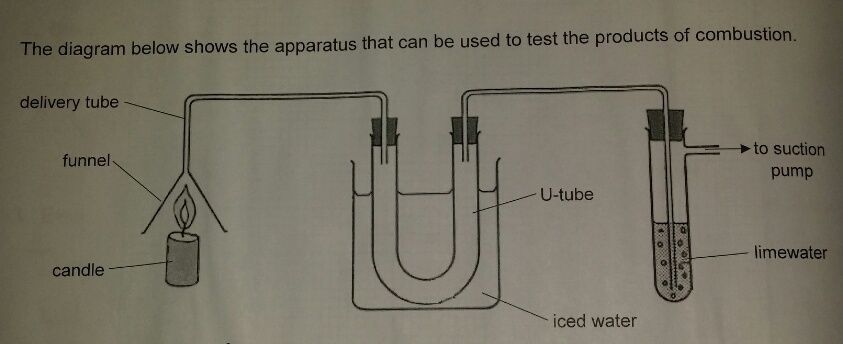
| The apparatus to test the products of combustion. | |
| What is the purpose of the upside down funnel? | Traps the products released by the candle. |
| What is the purpose of the suction pump? | Pulls the gases through the apparatus. |
| What is the purpose of the iced water? | To condense water vapour. |
| What is the purpose of the iced water? | To condense water vapour. |
| If the limewater goes cloudy what does this tell you? | Carbon dioxide was present. |
| If the limewater goes cloudy what does this tell you? | Carbon dioxide was present. |
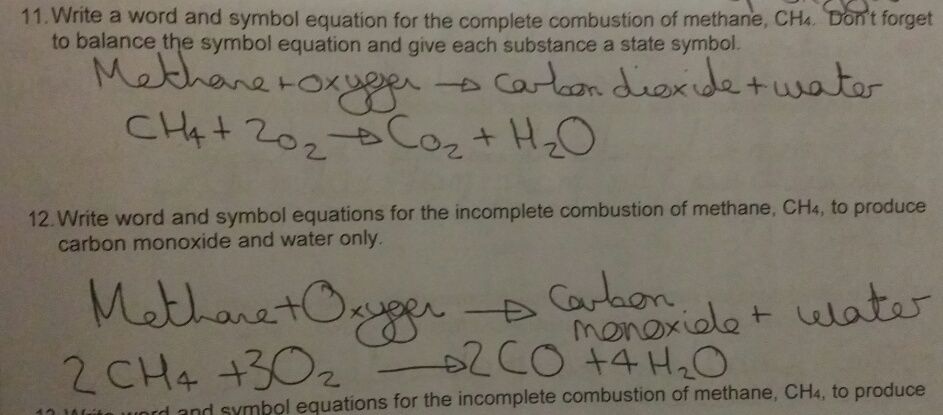
| When is there complete combustion? | Complete combustion is when a fuel burns in plenty oxygen so the carbon is fully oxidised to carbon dioxide. |
| When is there complete combustion? | Complete combustion is when a fuel burns in plenty oxygen so the carbon is fully oxidised to carbon dioxide. |
| What are the products of complete combustion? | Carbon dioxide and water. |
| When is the incomplete combustion? | Incomplete combustion is when fuel burns in limited (not enough) oxygen so the carbon is only partially oxidised to carbon monoxide or not oxidised at all so carbon particles (soot) could be produced. |
| What are the products of incomplete combustion? | Carbon monoxide/carbon particles and water. |
| Example questions on combustion with methane (CH4) | |
| Products of combustion. | A |
| How is carbon dioxide produced and what are the problems and solutions of it? | It is produced when there is complete combustion. The problems it causes are global warming and climate change. The solutions to this is converting carbon dioxide into hydrocarbons. Also iron seeding of oceans. |
| How is water (vapour) produced? | It is produced when there is incomplete and complete combustion. |
| How is carbon monoxide produced and what are the problems and solutions of it? | It is produced when there is incomplete combustion. The problems it causes is that it reduces the amount of oxygen that the haemoglobin part of the blood can carry around the body. It is a poisonous gas. Solutions to this are to ensure there is plenty of air. |
| How is solid carbon particles (soot) produced and what are the problems and solutions of it? | It is produced when there is incomplete combustion. The problems this causes is it blocks out sunlight and causes global dimming. The solutions are to ensure there is plenty of air. |
| How is solid particles of unburnt fuel produced and what are the problems and solutions of it? | It is produced when there is incomplete combustion. It causes global dimming. The solution is to ensure there is plenty of air. |
| How is sulphur dioxide produced and what are the problems and solutions of it? | It is produced when fuels that contain sulphur compounds burn. The problem it causes is acid rain (as it reacts with rain water). The solution to acid rain is to remove sulfur before fuel is burnt and to then use calcium oxide to neutralise SO2. |
| How is oxides of nitrogen produced and what are the problems and solutions of it? | It is produced when fuels that contain nitrogen compounds burn. The problems it causes are smog (causing difficulty in breathing) and acid rain (which kills plants and aquatic life). The solution is to use catalytic converters. |
| Nitrogen and oxygen are found naturally in the air and dont usually react together. Why do they react together in a car engine? | The tempreture in a car engine is very high (around 1000°c) so nitrogen (which is normally unreactive) can react with oxygen to form oxides of nitrogen. |
| Why is cracking of hydrocarbons carried out? | To break down large hydrocarbons into small ones which are more useful and in high demand. Long chain hydrocarbons are cracked because there is more supply than demand and they dont have as many uses as smaller molecules. |
| How are hydrocarbons cracked by catalytic cracking? | The molecules are heated to vaporise them, then the vapours are passed over a hot catalyst. |
| How are hydrocarbons cracked by steam? | The vapours are mixed with steam and heated to a very high tempreture. |
| What type of reaction is cracking Hydrocarbons? | Cracking is a thermal decomposition reaction. Breaking molecules down by heating them. |
| What are the products of cracking? what are they used for? | The products of cracking a short chain alkanes (used as fuels) and alkenes (used to make polymers and ethanol). Catalytic cracking produces more branched alkanes that are used in petrol. Steam cracking produces more alkenes, that are used to make polymers and other chemicals. |
| Why is heating needed to crack hydrocarbons? | To break the bonds by providing energy. |
| What does the flammability test indicate? | The length of the hydrocarbon. |
| What does the bromine water test indicate? | The test indicates the presence of double bonds (alkenes). |
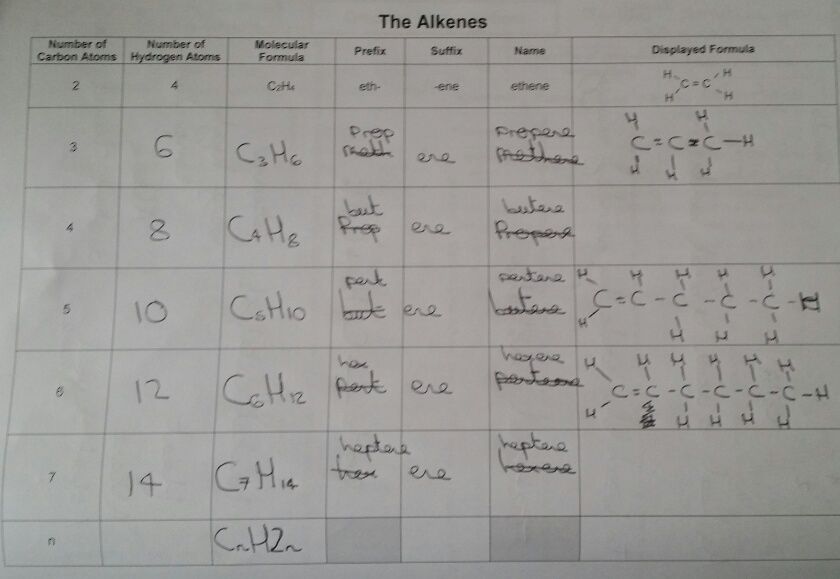
| The Alkenes | |
| The properties of Alkanes. | When bromine water is added to these hydrocarbons, it stays orange brown. They are saturated hydrocarbons. Burn cleanly producing carbon dioxide and water. Contain only single bonds, C-C. General formula is CnH2n+2.. |
| The properties of Alkenes. | These hydrocarbons decolourise bromine water to colourless. They are unsaturated hydrocarbons. Often burn with a sooty flame, producing soot (carbon particles) Can combine to form polymers. Contain a carbon-carbon double bond C=C. General formula is CnH2n. |
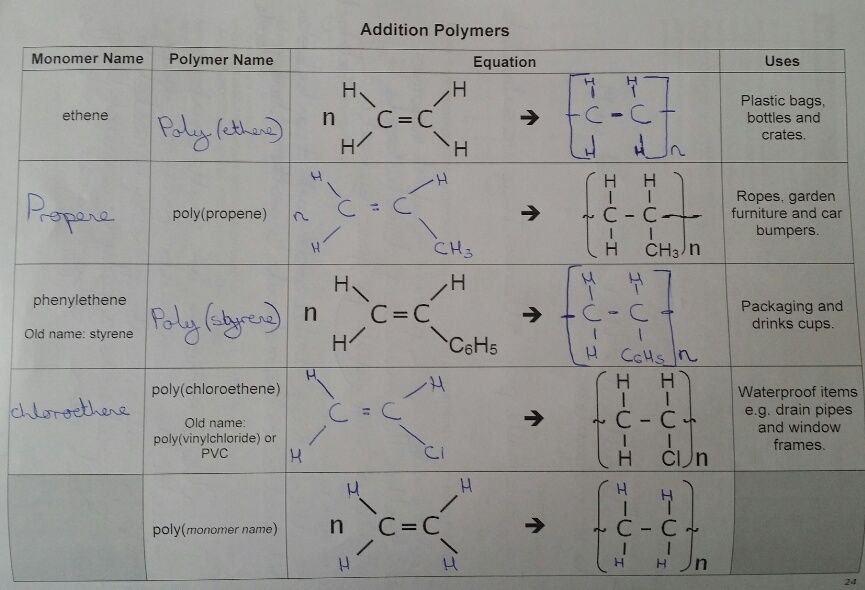
| Polymerisation. | A |
| What are polymers and what are they made from? | Polymers are large molecules made from lots of small molecules joined together. Many polymers are made from alkenes. They are saturated. |
| What is a monomer? | A monomer is a small alkene molecule. |
| How are monomers and polymers different? | Monomers are unsaturated (contain a double bond). Polymers are saturated (contain only single bonds). |
| Describe what happens in polymerisation. | Polymerisation is the process in which monomers join together. The breaking of double bonds to make a long polymer chain by heating and a catalyst. |
| Why can alkenes be used as monomers? | As alkenes have double bonds which can be broken and used to join the molecule to another alkene molecule. |
| Monomers are usually gases or liquids at room tempreture but polymers are solids. Explain why in terms of structure and bonding. | The alkene monomers are small covalent molecules, they are held together by weak intermolecular forces so only a small amount of energy is needed to break the forces so they have low melting and boiling points. Whereas a polymer is a much larger molecule which is held by stronger intermolecular forces so needs more energy to break the forces and they have a higher melting and boiling points. |
| Equations for additional polymers. | |
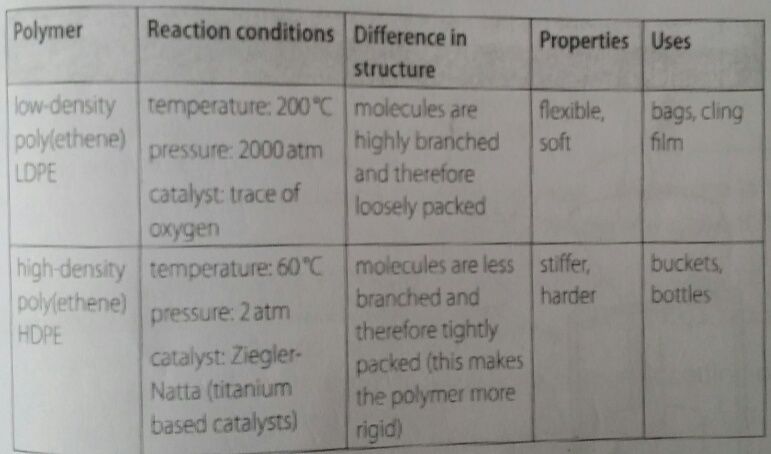
| What two things can be changed to make polymers with different properties? | Different conditions of tempreture & pressure and a different catalyst. |
| What are the differences between low/high density poly(ethene)? | |
| Why are plastic buckets not made from low density poly (ethene)? | As they would be too flexible and easily broken. |
| Why is cling film not made from high density poly (ethene)? | As it would be too stiff and hard to work with. |
| High and low density poly(ethene) are made from ethene monomers. Why do they have different properties? | As they have different reaction conditions. |
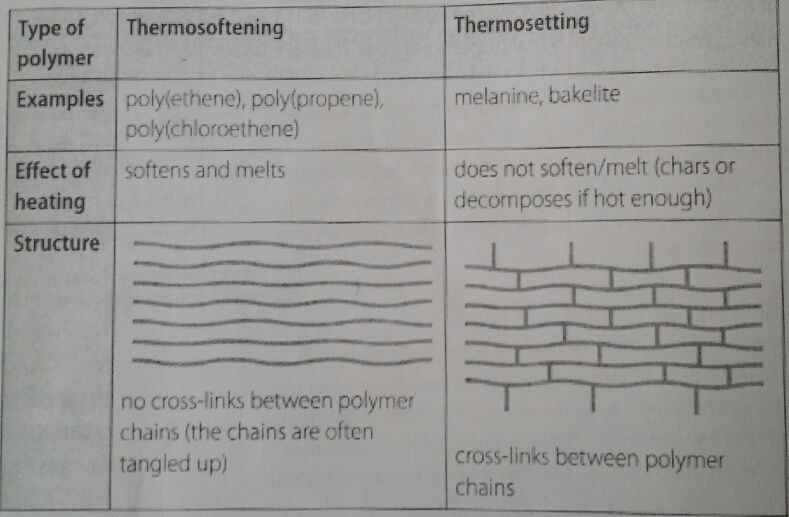
| Thermosoftening and thermosetting polymers. | |
| Thermosoftening polymers? | In most polymers the long polymer chains are not joined to each other. These polymers are called thermosoftening polymers. They soften and melt on heating because there are weak forces between the polymer chains. This means that such polymers can be recycled as they can be melted and remoulded. |
| Thermosetting polymers? | In thermosetting polymers the polymer chains are joined to each other by strong covalent bonds called cross-links. These polymers do not soften or melt on heating and so cannot be recycled. Thermosetting polymers are usually hard and rigid because of the cross-links. |
| How could you test a polymer to see if it is thermosetting or thermosoftening? | Heat it, if it melts it is thermosoftening and vice versa. |
| What does biodegradable mean? | Capable of being decomposed by bacteria or other living organisms to rot and thereby avoiding pollution. |
| What are biodegradable polymers? | They are polymers that can be naturally decomposed. |
Möchten Sie mit GoConqr kostenlos Ihre eigenen Karteikarten erstellen? Mehr erfahren.