
Karteikarten
Semantics
Karten in diesem Stapel (14)
- 1Levels of MeaningExpression Meaning: the actual meaning of a simple or complex expression in isolation
Utterance Meaning: meaning of an expression in a given CoU
Communicative Meaning: meaning of an utterance in a given social setting - 2Principle of Compositionalitywe can only understand a complex expression if we understand the meaning of its (1) lexical, (2) grammatical and (3) syntactical elements
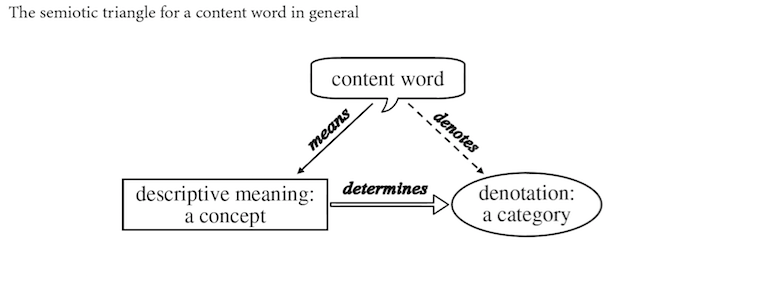
- 3Descriptive MeaningConcept that provides a mental description of a certain type of entities (with potential referents)
Descriptive Meaning of a Sentence:
Concept that provides a mental description of the kind of situation it potentially refers to - 4Semiotic Triangle
- 5Non descriptive meaningcannot be translated into other languages or be replaces with synonyms
Social Meaning:
meaning that conventially serves the indication of social relation e.g. "How are you?"
Expressive Meaning:
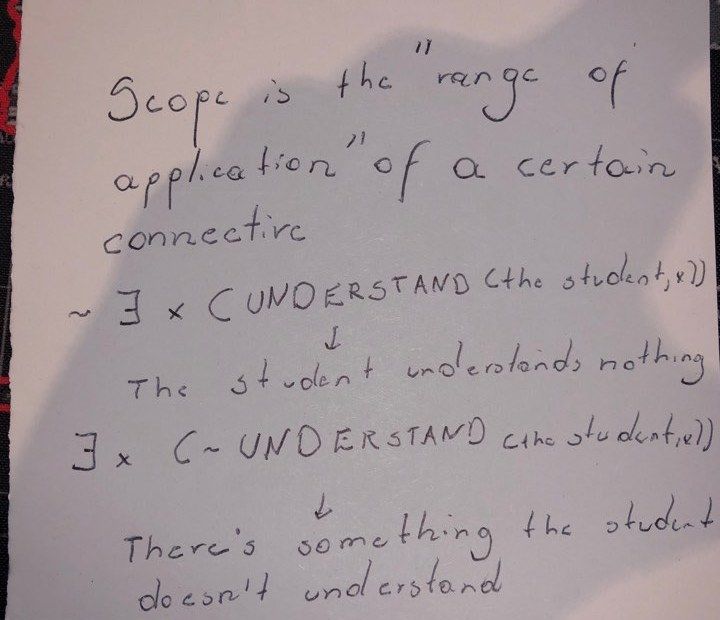
immediate expression of subjective sensations/emotions e.g. "Ouch!" - 6ScopeScope is the "range of application" of a certain connective
- 7Scopal Ambiguity
- 8Type Theory
- 9Thematic RolesAgent: The one doing something "Mary hit John"
Patient: The one affected (e.g. in this case John)
Experiencer: John saw Mary (John experiences something)
Theme: the one that does nothing (Mary in this case)
Location: The place where an action occurs
Goal: Destination of an event
Source: The origin
Instrument: used in an event
Recipient: Entity receiving something - 10AmbiguityA sentence, word or phrase is ambigious if it can be interpretated in more than one way
(1) Lexical Ambiguity
Homonymy: Lexemes with unrelated meanings, but same sound form
"light" as a noun or adjective
Polysemy: lexemes with different but related meanings
"fair"
(2) Structural Ambiguity
ambigious through the way a phrase is organized
"The woman saw the man with the telescope"
(3) Disambiguation
ambigious through a word
"John wrote a letter." A letter for the post office, or a letter of the alphabet?
(4) Compositional Ambiguity
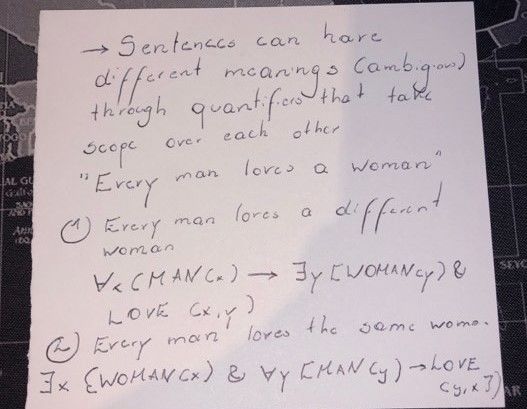
Scopal Ambiguity - 11Meaning Shifts(1) Metonymical Shift
"Tolkien is fun to read" Meaning shifts from Tolkien the author, to his work (f.e. Lord of the Rings)
(2) Metaphorical Shift
"My husband is a baby" He is not an actual baby, but behaves like one.
Through Differentiation context can be added to a phrase
"John did not understand Bill"
because it was simply too loud in there
because he did not get his point
... - 12EntailmentLexical Items are hardly ever alone
there are logical relations between them
(1) Equivalence
Two predicate terms (in given readings) are logically equivalent if they yield the same truth value for the same arguments
"This book is cheap" "This book is inexpensive"
(2) Subordination
A predicate term A is a logical subordinate of a predicate terms B
Subordinate "This is a duck" to: "This is a bird"
(3) Incompatibility
Two predicate Terms A and B are logically incompatible, if they cannot both be true
"This is a dog" "This is a cat"
(4) Complementarity
Two predicate terms A and B are logically complementary if they have opposite truth values
"He is dead" "He is alive" - 13Meaning relationsSynonymy: //
Hyponymy: An expression A is a hyponym of an expression B and B is a hyperonym of A
(A) Rose (B) Flower
Mereology: A mereology is an arrangment of parts into a whole
Holonym (whole) "Book" Meronym (part) "Page"
Oppositions: Antonymy two opposite extremes "young or old"
Complementary either or "dead or alive"
Directional opposites "above or below"
Converses same relationship with reversed roles "John is Erics father, Eric is Johns son"
Heteronyms alternatives of more than two possibilites
Monday / Tuesday - 14Lexical DisordersAphasia:
disorder of language and speech caused by an accident or stroke (had a normal state)
knowledge mostly selectively impaired
word finding problems, misname things
two characteristic type of errors
agrammatism: affects function words (articles, aux, compl., bound morphemes) (left hemisphere damage)
paraphasis: error in the use of content words but aware of semantic relations
Specific Language Impairment (SLI):
disorder in the normal acquisition of language, with no clear primary deficit
normal non verbal IQ, emotional or behavioural disturbances
never aquired language the normal way
genetically determined
Informationen
- Beschreibung
- Karteikarten am Semantics, erstellt von Elijah Salvatore am 04/02/2020.
- Erstellt von
- Elijah Salvatore
- Aufrufe
- 18
- Bewertung