
Karteikarten
Lecture Fifteen - Basal Ganglia
Karten in diesem Stapel (20)
- 1Objectives1. Identify and locate the components of the basal ganglia
2. Identify the neurotransmitters released from each nucleus in the basal ganglia
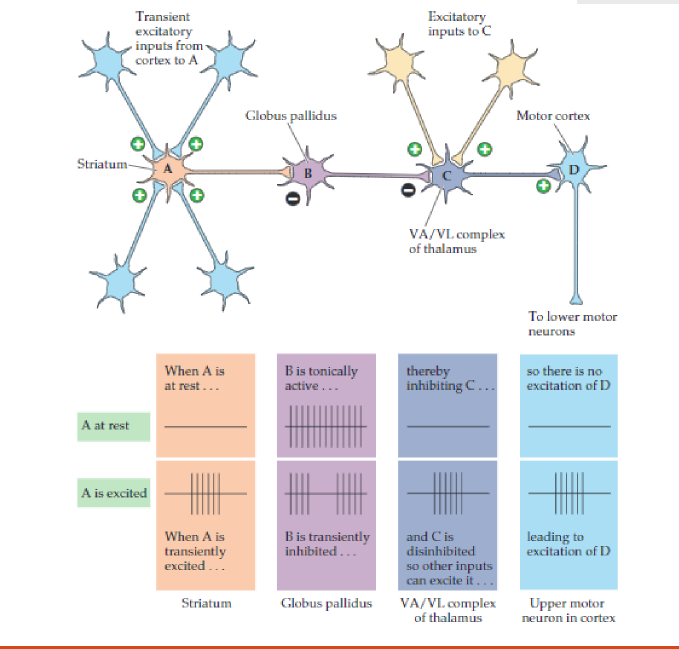
3. Understand the concept of 'disinhibition'
4. Learn the projection patterns of the cortico-striatal-thalamo-cortical loop
5. Understand the functions of the direct and indirect pathways in this loop - 2Basal ganglia 5 parts??1. Caudate nucleus
2. Putamen
3. Globus pallidus
4. Subthalamic nucleus
5. Substantia nigra - 3Basal ganglia •Feedback loop between subcortical nuclei, thalamus, brainstem, and cerebral cortex • Control of ____ motor movements (action selection) • ____ of movement • ___-___ of motor and premotor outputs • Smoothly switch between behaviorsvoluntary
Anticipation
Fine-tuning - 4Caudate nucleus •3 parts: ___, ___, __ • Head is continuous with the ____ • Tail terminates in the ___ Follows curvature of lateral ventricles •Dopaminergic inputs from ____ ___head, body, tail
putamen
amygdala
substantia nigra - 5Putamen •____ portion of the basal ganglia •Continuous with ___ nucleus • Connected by ___ ___ (fiber tract) •Caudate + Putamen = ___ ____Outermost
caudate
internal capsule
Dorsal Striatum - 6Striatal afferents (inputs) •____ fibers: excitatory inputs from PFC, premotor area, and primary motor cortex •_____ fibers: inputs from intralaminar nuclei •____ fibers: dopaminergic input from nigra •_____ fibers: limbic system inputCorticostriatal
Thalamostriatal
Nigrostriatal
Amygdalostriatal - 7Striatal neurons •___ ___ neurons: • Principal neurons of the striatum (95% of striatum) Express ___ receptors Output neurons • ____ (inhibitory) *These cells fire in ___ of movementMedium spiny
dopamine
GABAergic
anticipation - 8Globus pallidus •Internal (GPi) and external (GPe) segments • Separated by ___ ___ ____ •Putamen + globus pallidus (GPe and GPi) = ___ nucleusmedial medullary lamina
lenticular - 9Globus pallidus •Inputs from ____ •Sends outputs to the ___ •GABAergic • Tonically active to ___ unwanted movement at rest • Disinhibited by ___ ___ neurons Important for regulation of voluntary movementstriatum
thalamus
inhibit
medium spiny - 10Subthalamic nucleus •Located ventral to the ____ •Inputs from ___ •Outputs to ___ ___ • Glutamatergic (___) •Action selectionthalamus
GPe
globus pallidus
excitatory - 11Substantia nigra •Substantia nigra ("black substance") - dark appearance due to presence of ___ Pars compacta (SNc): • Releases ___ • Fine motor control •Axonal degeneration of SNc neurons = ___ disease Pars reticulata (SNr): • Releases ___ • ___ inhibition of motor outputsneuromelanin
dopamine
Parkinson's
GABA
Tonic - 12Substantia nigra •Inputs: ____ •Outputs: • SNr sends ____ outputs to the thalamus and brainstem • Primary output of basal ganglia for ___ movements • SNc sends dopaminergic outputs to the striatum • DI receptors: ____ • D2 receptors: ____ • Fine motor control and ____ processingStriatum
GABAergic
eye
excitatory
inhibitory
reward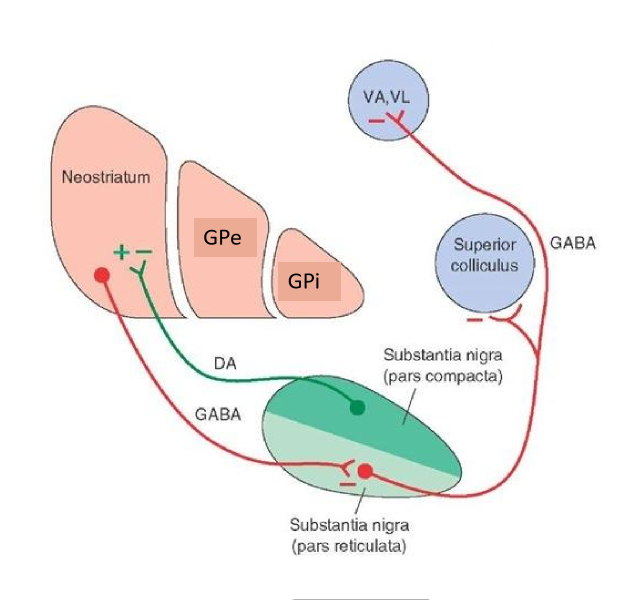
- 13Direct pathway Motor circuit for __-___ of muscle activity • Motor cortex (sends excitatory output to ___ in striatum) • Striatum (sends inhibitory output to ___ & ___) • Globus pallidus internal (becomes _____, so stops inhibiting thalamus) • SNr (sends inhibitory output to ____) • Thalamus (sends ___ output back to motor cortex)fine-tuning
MSNs
GPi & SNr
DISINHIBITED
thalamus
excitatory - 14—


- 15Indirect pathway • Motor circuit to prevent ____ muscle contractions from competing with voluntary movements Motor cortex (sends excitatory outputs to ___) Striatum (sends inhibitory outputs to __) Globus pallidus external (becomes ____ so stop inhibiting subthalamic nucleus) Subthalamic nucleus (sends excitatory outputs to ___) ___ of the inputs that GPi gets via the direct pathway Thalamus (sends ___ ___ outputs to motor cortex)unwanted
striatum
GPe
DISINHIBITED
GPi
Opposite
reduced excitatory - 16—


- 17Integration of the pathways Cortical activity signals onset of movement ___ pathway inhibits GPi and increases thalamic output (facilitation of cortically initiated movement) ___ pathway excites GPi and ___ thalamic output (suppression of antagonistic muscles/decreasing competing movements). **BOTH pathways are active at the __ timeDirect
**selects desired movement (action slection)
Indirect
**prevents the undesired or unwanted movement
decreases
same
- 18Parkinson's disease •Loss of ____ cells in SNc •Reciprocal input between SNc and striatum lost •Subthalamic nucleus becomes ____ (b/c GPe inhibition of STN is completely removed) •Increased excitatory outputs to __ •Greater inhibitory output from GPi to ____ •Thalamic output to the cortex is ____dopaminergic
hyperactive
GPi
thalamus
reduced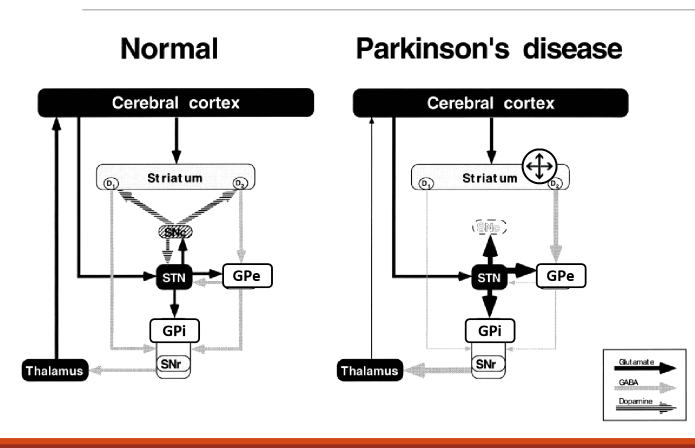
- 19Parkinson's disease •Loss of SNc dopaminergic neurons may be due to lesion, environmental toxin, or genetic causes •Rigidity may be caused by decreased control of ___ neurons that control motor neurons. Impaired ability to prevent ___ muscle activity. •____: reduced ability to initiate voluntary movement •____: involuntary movements (tremors, tics)inhibitory
competing
Bradykinesia
Dyskinesia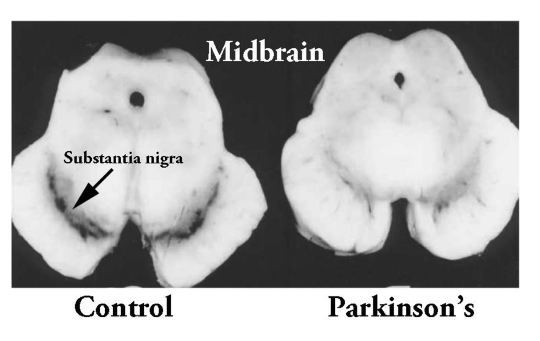
- 20Deep brain stimulation ____ implantation of electrode into basal ganglia structures: • subthalamic nucleus (STN) • Internal segment of globus pallidus (GPi) •Levodopa-___ Parkinsons's symptomsStereotactic
resistant