
2702104
Beschreibung

Karteikarten von lizzie ball, aktualisiert more than 1 year ago

|
Erstellt von lizzie ball
vor mehr als 11 Jahre
|
|
| Frage | Antworten |
| what is an atom? | the smallest part of an element that still behaves as the element. |
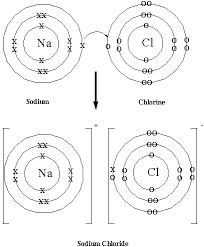
| what happens to the metal atom during ionic bonding? | the metal loses electrons. |
| complete the equation: metal + acid = | salt + hydrogen gas |
| list the neutralisation reactions? | metal carbonate + acid = salt + water + co2 acid + base = salt + water acid + metal oxide = salt + water |
| how do you draw ionic bonding? | *draw all electron shells *metal has a positive charge |
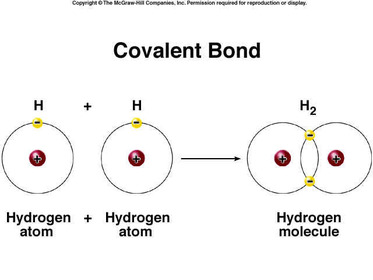
| what is covalent bonding? | a shared pair of electrons. |
| how do you draw a covalent bond? | *H=H *use dots and crosses *only draw outer electronic shells |
| what is distillation? | separating a solution. |
| what happend in a displacement reaction? | the more reactive metal displaces the less reactive metal. |
| what is the word equation for fermentation? | yeast glucose=ethanol + co2 |
| what happens in a decomposition reaction? | a compound is broken down into simpler substances. |
| what is the name for group 7 and 0? | halogens and noble gases. |
| in the periodic table what are the horizontal rows called? | periods. |
| the definition of an element- | a substance made of one type of atom. |
| where are the protons and neutrons found in an atom. | in the nucleus. |
| what does the mass number tell you? | how many protons and neutrons are in an atom. |
| how would you write the electronic configuration of a element in the third period? | e.g. 13 electrons = 2,8,3 |
| what is a property of a covalent compound? | very strong not soluble no electrical conductivity low melting + boiling point |
| why do elements become covalent compounds? | to be more stable. |
| what is an allotrope? | different forms of the same substance. |
| what does ionic bonding contain? | a metal + a non metal |
| what is a industrial use of co2? | fire extinguishers conducting ph levels creating the fizz in drinks |
| what is the definition of electrolysis? | the break down of a compound by electrical currents. |
| in electrolysis what moves to the positive electrode. | the non metals |
| in electrolysis which side is the negative electrode. | the right |
| what are liquids that mix together called? | miscible |
| what is the test for hydrogen? | the squeaky pop test |
| what is the definition of a base. | a substance that reacts with an acid to produce a salt and water. |
| what is the test for co2? | bubbles through limewater and if it goes cloudy it is present. |
| what is the solid left called after filtration? | residue. |
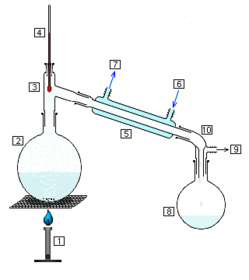
| what are you separating during distillation. | a solvent from a solution |
| what happens during distillation? | evaporation then condensing |
| how is equipment set up during distillation? | |
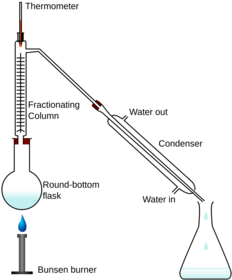
| what are you separating when you do fractional distillation? | two liquids mixed together. |
| how would you set up the equipment for fractional distillation. | |
| what happens in a exothermic reaction? | heat is given out. |
| what happens in a endothermic reaction? | heat rises because the products have more energy then the reactants. |
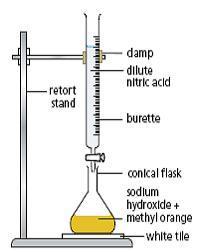
| how is a titration experiment set out? | |
| what are the three types of rock? | igneous, metamorphic and sedimentary. |
| how are igneous rocks formed? | from volcanoes. |
| what are the properties of an igneous rock? | dont contain fossils crystals random arrangement |
| what are the properties of a sedimentary rock? | have layers have fossils small grains are porus |
| what are the properties of a metamorphic rock? | layers of crystals hard and dense patterns in the rock |
| how do igneous rock make there way to the sea? | by weathering and deposition. |
Möchten Sie mit GoConqr kostenlos Ihre eigenen Karteikarten erstellen? Mehr erfahren.