
Karteikarten
Social Psychology Module 2
Karten in diesem Stapel (64)
- 1Social CognitionThe manner in which we interpret, analyse, remember, and use information about the social world
- 2Cognitive miserA term used to describe people’s reluctance to do much extra thinking
- 3Goals of thinking• The first and most obvious goal is that people want to find the right answer to some problem or question.
• The second goal of thinking is to confirm the desired answer to a problem.
• A third goal is to reach a pretty good answer or decision quickly. - 4SchemasMental frameworks centering on a specific theme that help us to organize social information
- 5Schemas influence three basic processesAttention (They affect what is noticed.)
Encoding (They affect what is stored in memory.)
Retrieval (They affect what is recovered from memory.) - 6cognitive loadIn cognitive psychology, cognitive load refers to the used amount of working memory resources.
- 7Cognitive Load Theorybecause short-term memory is limited, learning experiences should be designed to reduce working memory ‘load’ in order to promote schema acquisition
- 8The use of schemas as a basic concept was first used bya British psychologist named Frederic Bartlett
- 9Who popularised the concept of schemas?Jean Piaget
- 10Object schemasone type of schema that focuses on what an inanimate object is and how it works
- 11Person schemasfocused on specific individuals
- 12Social schemasSocial schemas include general knowledge about how people behave in certain social situations.
- 13Self-schemasSelf-schemas are focused on your knowledge about yourself.
- 14Event schemas (Scripts)Event schemas are focused on patterns of behavior that should be followed for certain events. This acts much like a script informing you of what you should do, how you should act, and what you should say in a particular situation.
- 15Schemas influence what we pay attention toPeople are more likely to pay attention to things that fit in with their current schemas.
- 16Schemas also impact how quickly people learnPeople also learn information more readily when it fits in with the existing schemas.
- 17Schemas help simplify the worldSchemas can often make it easier for people to learn about the world around them. New information could be classified and categorized by comparing new experiences to existing schemas.
- 18Schemas allow us to think quicklyEven under conditions when things are rapidly changing our new information is coming in quickly, people do not usually have to spend a great deal of time interpreting it. Because of the existing schemas, people are able to assimilate this new information quickly and automatically.
- 19Schemas can also change how we interpret incoming informationWhen learning new information that does not fit with existing schemas, people sometimes distort or alter the new information to make it fit with what they already know.
- 20Schemas can also be remarkably difficult to changePeople often cling to their existing schemas even in the face of contradictory information.
- 21Perseverance effect (Schema persistence)Belief perseverance is maintaining a belief despite new information that firmly contradicts it.
- 22Primingpriming is a technique in which the introduction of one stimulus influences how people respond to a subsequent stimulus
For example, exposing someone to the word "yellow" will evoke a faster response to the word "banana" than it would to unrelated words like "television." - 23Self-fulfilling Prophecypredictions that, in a sense, make themselves come true
- 24Pygmalion EffectThe Pygmalion effect, or Rosenthal effect, is a psychological phenomenon wherein high expectations lead to improved performance in a given area.
- 25information overloadInformation overload is the difficulty in understanding an issue and effectively making decisions when one has too much information about that issue
- 26HeuristicsSimple rules for making complex decisions or drawing inferences in a rapid manner and seemingly effortless manner
mental shortcuts that provide quick estimates about the likelihood of uncertain events - 27Representativeness heuristicA strategy for making judgments based on the extent to which current stimuli or events resemble other stimuli or categories
- 28prototypeSummary of the common attributes possessed by members of a category
- 29Example of representativeness heuristic• When you are trying to decide if someone is trustworthy, you might compare aspects of the individual to other mental examples you hold. A sweet older woman might remind you of your grandmother, so you might immediately assume that she is kind, gentle and trustworthy.
- 30Availability heuristicA strategy for making judgments on the basis of how easily specific kinds of information can be brought to mind. This heuristic is related to Priming.
- 31Example of availability heuristic• After reading an article about lottery winners, you start to overestimate your own likelihood of winning the jackpot. You start spending more money than you should each week on lottery tickets.
- 32Anchoring and adjustment heuristicthe tendency to judge the frequency or likelihood of an event by using a starting point (called an anchor) and then making adjustments up or down
- 33Example of anchoring and adjustment heuristic• Masako asked two friends to estimate the number of people living in Tokyo. The correct answer, according to the 2000 census, was just over 12 million. She asked the first friend whether it was more or less than 8 million. She asked the second friend whether it was more or less than 16 million. The first friend guessed 9 million people, whereas the second friend guessed 15 million people.
- 34Affect heuristicThe affect heuristic is a heuristic, a mental shortcut that allows people to make decisions and solve problems quickly and efficiently, in which current emotion—fear, pleasure, surprise, etc. —influences decisions.
- 35Example of affect heuristicFor example, research has shown that people are more likely to see decisions as having benefits and lower risks when they are in a positive mood. Negative emotions, on the other hand, lead people to focus on the potential downsides of a decision rather than the possible benefits.
- 36anchoring biasAnchoring bias is a cognitive bias that causes us to rely too heavily on the first piece of information we are given about a topic.
- 37Negativity Biaspeople show greater sensitivity to negative information than to positive information
People are faster and more accurate at identifying threatening facial expressions than positive facial expressions - 38Optimistic BiasOptimism bias (or the optimistic bias) is a cognitive bias that causes someone to believe that they themselves are less likely to experience a negative event.
- 39Overconfidence BarrierOverconfidence barrier : the barrier that results when people have too much confidence in the accuracy of their judgements; people's judgements are usually not as correct as they think they are.
- 40Planning Fallacytendency to make optimistic predictions about how long it will take to complete a task
- 41Counterfactual thinkingCounterfactual thinking is a concept in psychology that involves the human tendency to create possible alternatives to life events that have already occurred; something that is contrary to what actually happened.
- 42Thought suppressionThought suppression is a type of motivated forgetting when an individual consciously attempts to stop thinking about a particular thought.
- 43rebound effect of thought suppressionresearchers demonstrated that the suppression of a particular thought often resulted in the subsequent increased return of the unwanted thought, a phenomenon termed the 'rebound effect'
- 44Magical thinkingMagical thinking, or superstitious thinking, is the belief that unrelated events are causally connected despite the absence of any plausible causal link between them, particularly as a result of supernatural effects. For example: "I got up on the left side of the bed today; therefore it will rain."
- 45The Influence of Affect on CognitionMoods affect how new stimuli are perceived.
Happy moods can increase creativity.
Happy moods can make people more susceptible to social influence.
Information that evokes emotional reactions may be processed differently than other kinds of information.
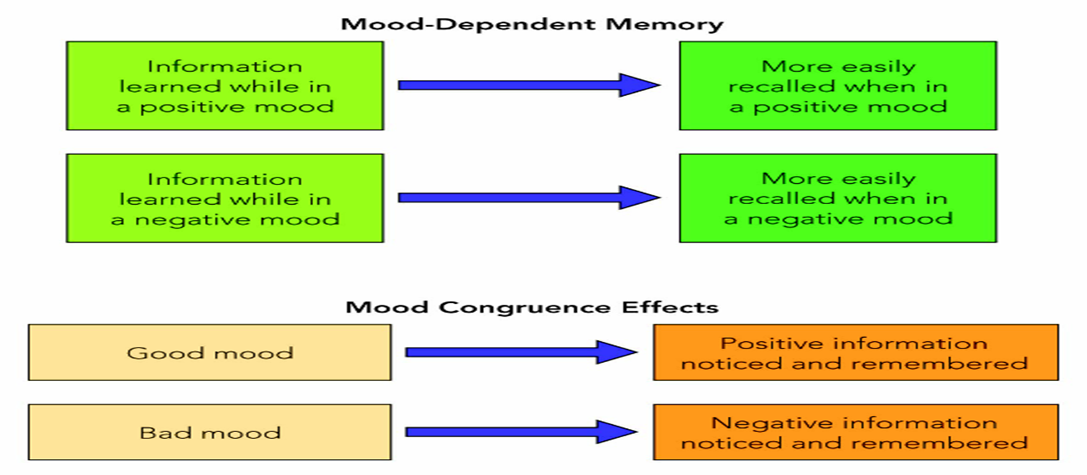
Bad moods lead to more systematic thinking, while good moods lead to more heuristic thinking. - 46mood-dependent memorymood-dependent memory occurs when one's current mood resembles their mood at the time of memory storage, which helps to recall the memory. Thus, the likelihood of remembering an event is higher when encoding and recall moods match up.
- 47Mood congruence effectThe mood congruency effect is a psychological phenomenon in which a person tends to remember information that is consistent with their particular mood. People also tend to recall memories that coincide with the mood they are experiencing at a certain time. In simpler terms, if you're in a happy mood, you are more likely to recall happy memories, whereas, if you're sad, you are more likely to remember sad and depressing events.
- 48Affect and Cognition
- 49Two-factor theory of emotionThe two-factor theory of emotion states that emotion is based on two factors: physiological arousal and cognitive label. The theory was created by researchers Stanley Schachter and Jerome E. Singer.
- 50Automatic Processingbrain functions that do not require us to pay attention or deliberately attempt to control events
- 51Controlled processingControlled processing requires us to pay attention and deliberately put in effort.
- 52SatisficingSatisficing is a decision-making strategy in which the first option that satisfies certain criteria is selected, even if other, better options may exist.
- 53What topic do people spend the greatest amount of time thinking about?PEOPLE
- 54Primacy effectIn simplest terms, the primacy effect refers to the tendency to recall information presented at the start of a list better than information at the middle or end.
- 55recency effectthe recency effect refers to the tendency for people to more easily recall items that are presented last in a list. In the case of the recency effect, this is likely due to those items being the most recent and therefore still being held in your short-term memory.
- 56Framing effectThe framing effect is a cognitive bias where people decide on options based on whether the options are presented with positive or negative connotations; e.g. as a loss or as a gain. People tend to avoid risk when a positive frame is presented but seek risks when a negative frame is presented.
- 57Stroop effectThe finding that it takes longer to say the color of ink used to print a word if the word and ink color don’t match (e.g., the word RED is printed in blue ink) than if they do match (e.g., the word BLUE is printed in blue ink) is called the Stroop effect.
- 58four elements that distinguish automatic from controlled processesintention, control, effort, and efficiency
- 59intentionIt may just happen whether you intend it to or not.
- 60control• Automatic thoughts are not subject to deliberate control, so it can be difficult or even impossible to avoid having certain thoughts that have been cued.
- 61effort• Automatic thoughts do not involve effort, whereas controlled thoughts often involve mental exertion and can feel taxing and tiring.
- 62efficientautomatic thoughts are highly efficient, unlike controlled thoughts (which are often slow and cumbersome)
- 63Automatic thinking involves little effort because it relies on knowledge structures.Knowledge structures are organized packets of information that are stored in memory. These knowledge structures form when a set of related concepts is frequently brought to mind, or activated.
- 64Schema and Heuristic are two different thingsSchema and Heuristic are two different things- not really related to one another, so I'm not sure asking for the difference between the two makes sense. That said-
A Schema is a cognitive framework for storing information and relating it together. Schemas form the basis for knowledge in the head.
A Heuristic is a mechanism for solving problems.
Therefore, a schema is more associated with what topics a person might make decisions upon, whereas a heuristic is more associated with how a person makes those decisions. Heuristic methods very well may depend upon existing schema; however, schema do not necessarily require the existence of a heuristic method.
Informationen
- Beschreibung
- Social psychology mod 2
- Erstellt von
- Priya Kapoor · Nov 2020
- Aktualisiert
- 1 Nov 2020
- Aufrufe
- 113
- Tags
- Bewertung