
Karteikarten
1 ~ The Economic Problem
Karten in diesem Stapel (55)
- 1What is the ceteris paribus assumption?all other factors remaining constant
- 2Define scarcitya lack of supply of factors of prodction
- 3What are trade-offs and choices?a trade off means that choosing more of one thing can only be achieved by giving up something else in exchange
- 4Explain the cost benefit principlewhere people consider costs and benefits of their actions
- 5Explain the 'marginal' ideathe costs and benefits of consuming a little extra of a product
- 6What do rational decision-makers do?attempt to weigh the marginal benefit received from an option with it's marginal cost (including the opportunity cost)
- 7What do people usually aim to do with their welfare?maximise it
- 8How do people maximise their welfare?by allocating their limited income in a way that gives them maximum total satisfaction
- 9What are the effects of incomplete information on welfare?causes a loss of welfare
- 10Define Opportunity Costthe cost of any choice in terms of the next best alternative forgone
- 11How does a free market economy work?markets allocate resources through the price mechanism
there is limited role for the government (protecting property rights and the value of money) - 12Define Rationinga way of allocating scarce goods and services when market demand exceed the available supply
- 13How does market price link with rationing?in a market system, the price mechanism plays a key role in rationing demand
the market price determines which consumers have the effective demand to purchase and who doesn't - 14What are problems with rationing? (2)discrimination
issues of equity and fairness - 15What are options for rationing resources? (8)by market price
consumer income
assessment of need
household postcode
education level
age
gender
nationality - 16What are the four main factors of production?land
labour
capital
enterprise - 17What is land?all natural physical resources
e.g. fertile farmland
renewable energy - 18What is labour?human input into production
e.g. supply of works available and their productivity
is key if growth is to be achieved - 19What is K?capital goods are used to produce other consumer goods and services in the future
- 20What is fixed K? (5)includes machinery
equipment
new tech
factories
other buildings - 21What is working K?stocks of finished and semi-finished goods that will be consumed in the near future or made into consumer goods
- 22What is enterprise?regarded as a specialised form of labour
- 23What is an entrepreneur?someone who supplies products to a market to make profit
usually invests their own financial capital in a business and takes on the risks
their main reward is the profit - 24What are non-renewable resources?in finite supply
e.g. coal, gas, oil
have no mechanism to replenish them
the rate of extraction depends on the market price - 25What are renewable resources?replaceable over time (providing the rate of extraction is less than the natural rate as which is renews itself)
e.g. solar energy, oxygen, biomass - 26What are free goods?do not use up any factor inputs
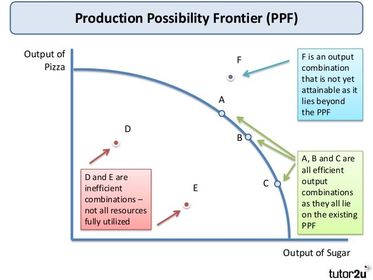
have a 0 opportunity cost (marginal cost of supplying an extra unit is 0) - 27What does a PPF show?the maximum possible output combinations of two goods or services an economy can achieve when all resources are fully and efficiently employed
- 28What does a PPF look like and how do the points work?
- 29The points on a PPF inside the curve are?unemployed or inefficiently used
- 30The points beyond the PPF are?unattainable
- 31How would a country attain those points? (3)an increase in factor resources
increase in productivity
improvement in technology - 32What is the effect of producing more of both goods?an improvement in allocative efficiency
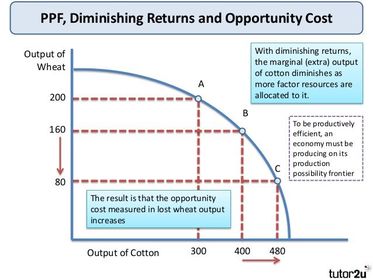
- 33What does reallocating scarce resources from one product to another involve?an opportunity cost
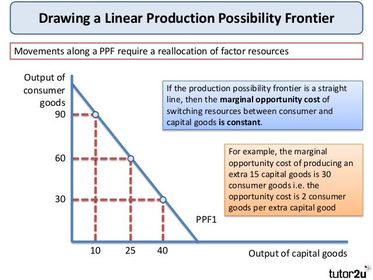
- 34When will a PPF be a straight line?
- 35When will the PPF shift outwards?improvements in productivity and efficiency from new tech or advances in the techniques of production
more factors of production being available and used
discovery of new natural resources
better management of factor outputs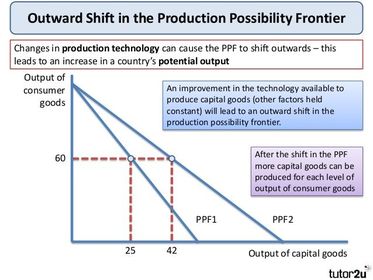
- 36When will a PPF shift inwards? (4)rarely:
damaging effects of natural disasters
economic damage of war and conflict
large scale net migration of people out of a country
long term fall in productivity of labour - 37What is resource depreciation?when factor inputs are used in supplying goods and services and, over time, they deteriorate and become harder and more costly to maintain
can result in a fall in productivity - 38What is resource depletion?when the stock of available resources actually declines
e.g. amount of forestry can be permanently damaged by excessive tree logging/deforestation - 39What are positive statements?objective statements
can be tested, amended or rejected by referring to available evidence - 40What is an example of positive statement?a fall in incomes will lead to a rise in demand for own-label supermarket foods
- 41What are normative statements?subjective statements
carry value judgements - 42What is an example of a normative statement?pollution is the most serious economic problem
- 43What is specialisation?when you concentrate on a product or task
- 44What are some possible gains of specialisation? (3)higher output
variety
a bigger market - 45What is the division of labour?where production is broken down into separate tasks
it raises the output per person
bc people become better through constant repetition - 46What are some limitations of division of labour? (4)unrewarding repetitive work that require little skill lowers motivation and productivity
creates the problem of high worker turnover
workers can suffer from structural employment
mass-produced standardised goods lack variety for sonsumers - 47What does factor immobility cause?market failure
- 48What are the two types of factor immobility?occupational
geographical - 49When does occupational immobility occur?when there are barriers to the mobility of factors of production between different sectors of the economy
- 50When and why do people experience occupational immobility?in the form of structural unemployment
as they may have specific skills that are not needed in growing industries and this causes a mismatch between skills required and skills possessed - 51When does geographical immobility occur?when there are barriers that stop people moving from one area to another to find work
- 52What are some causes of geographical unemployment? (5)family and social ties
financial costs of moving
regional variations in prices (e.g. London)
migration controls
cultural and language barriers - 53What does factor immobility cause?inefficient allocation of resources
- 54What are policies to improve occupational immobility? (2)investment in training schemes to book human K
subsidisation of the provision of vocational training by private sector firms - 55What are policies to improve geographical immobility? (3)reforms to the housing market to improve S and reduce P
specific subsidies of moving to areas where there are shortages of labour
relaxation of migration caps
Informationen
- Beschreibung
- AS - Level Economics (Microeconomics) Karteikarten am 1 ~ The Economic Problem, erstellt von Tara Pugal am 14/01/2016.
- Erstellt von
- Tara Pugal
- Aufrufe
- 97
- Bewertung