
Karteikarten
Bonding
Karten in diesem Stapel (49)
- 1Define ionic bondingAn ionic bond is the electrostatic force of attraction between oppositely charged ion formed by electron transfer
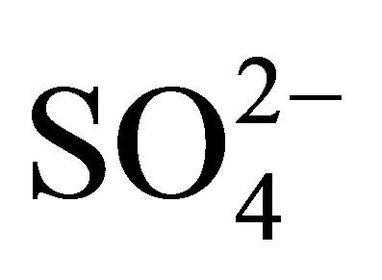
- 2Give the formula of the sulphate ion
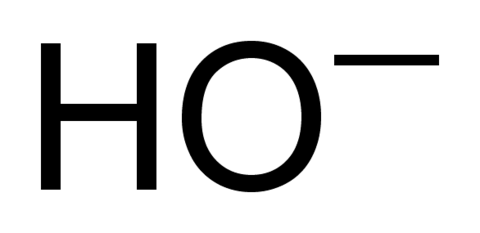
- 3Give the formula of the hydroxide ion
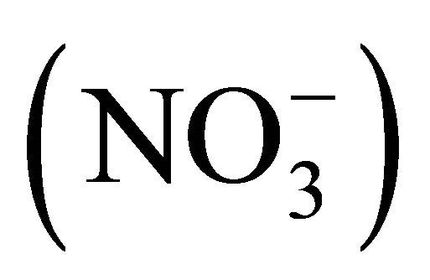
- 4Give the formula of the nitrate ion
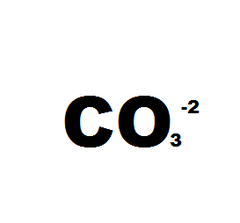
- 5Give the formula of the carbonate ion
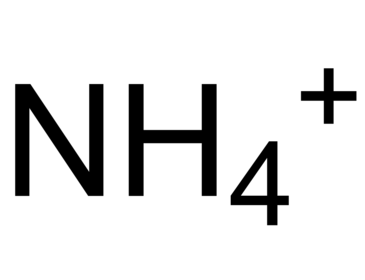
- 6Give the formula of the ammonium ion
- 7Write out the electronic structure of Mg and Mg2+Mg goes from 1s2 2s2 2p63s2
to Mg2+ 1s2 2s2 2p6 - 8Write out the electronic structure of O and O2-O goes from 1s2 2s2 2p4
to
O2- 1s2 2s2 2p6 - 9When is ionic bonding strongest?When the atom is
1) Smaller
2) Greater charge - 10Define a covalent bondA single covalent bond is a shared pair of electrons
- 11What are multiple covalent bonds?Multiple pairs of shard electrons
- 12What is a dative covalent bondA shared pair of electrons where both of them are from the same atom
- 13What are three common examples of compounds containing dative covalent bonds?H3O+ , NH4+ and NH3BH3
- 14Show how NH3BH3 is formed
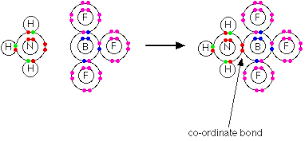
- 15A dative covalent bond is shown using an...arrow
- 16Define a metallic bondThe electrostatic forced of attraction between positive metal ions and and the sea of delocalised electrons
- 17What 3 factors determine the strength of a metallic bond?1) The number of protons (more = more attraction)
2) Number of delocalised electrons per atom (more = more attraction)
3) Size of the atom (smaller = stronger attraction) - 18Why does Mg have a higher melting point than Na?*Mg has stronger metallic bonding than Na and hence a higher melting point.
*The Metallic bonding gets stronger because in Mg there are more electrons in the outer shell that are released to the sea of electrons.
*The Mg ion is also smaller and has one more proton. There is therefore a stronger electrostatic attraction between the positive metal ions and the delocalised electrons and higher energy is needed to break bonds. - 19What are the four types of crystal structure?1) Ionic
2) Macromolecular (Gaint covalent)
3) Metallic
4) Molecular - 20Name the name and angle of the shape for 2 bp and 0 lplinear, 180
- 21name and angle for 3 bp and 0 lptrigonal planar, 120
- 22name and angle for 3 bp and 1 lptrigonal pyramidal, 107
- 23name and angle for 4 bp and 0 lptetrahedal, 109.5
- 24name and angle for 2 bp and 2 lpbent, 104.5
- 25name and angle for 5 bp and 0 lptrigonal bupyramidal , 120 and 90
- 26name and angle for 6 bp and 0 lpoctahedral, 90
- 27give an example of a linear moleculeCO2, CS2
, HCN,
BeF2 - 28example of a trigonal planarBF3
, AlCl3
, SO3
, NO3^-, CO3^2- - 29example of a tetrahedralSiCl4, CH4, NH4+
- 30example of trigonal pyramidalNH3, NCl3, PF3, ClO3
- 31example of bentH2O, Cl2O, H2S
- 32example of trigonal bipyrramidalPF5, PCl5
- 33THE example of octahedralSF6
- 34Define electronegativityThe power of an atom to attract the pair of electrons in A COVALENT bond towards itself
- 35Which are the most electronegative elements?N, O, F
- 36What happens to electronegativity as you go along a period?Increases as number of protons increases and no increase in shielding so outer electrons shells are pulled in more -> decrease in atomic radius
- 37What happens to electronegativity as you go down a group?Decreases as atoms get larger so distance between nucleus and outer electrons increases and the shielding effect due to inner electrons increases
- 38What is a polar covalent bond?When electron distribution in a covalent bond is unequal due to differences in electronegativites between the different element sharing the electrons.
- 39What does a polar covalent bond cause a molecule to have?A permanent dipole
- 40Why are some molecules, which contain polar bonds within it, not a permanent dipole?Because they are symmetrical so the individual dipoles cancel each other out so there is no NET dipole moment, the molecule is NON POLAR
- 41What types of substances do van der Waals occur in?All molecular substances and noble gases but NOT in ionic substances
- 42Why do van der Waals occur?Because electron density in a molecule is constantly moving randomly, so some parts become more negative than others, ie a small temporary dipole. This then induces dipoles in neighbouring molecules.
- 43What is the main factor affecting the size of the van der Waals?the size of the molecules. Bigger molecule = more electron = more likely for a dipole to form = stronger van der Waals = higher boiling points
- 44Why does the boiling point of halogens increase as you go down the group?Molecules get bigger = more electrons = more van der Waals = higher bp
(this is why Cl2 is a gas and I2 is a solid) - 45How does shape of a molecule affect the size of the van der Waals?Long chain alkanes have a larger surface area of contact between molecules for van der waals to form than compared to spherical shaped branched alkanes and so have stronger van der waals
- 46When do permanent dipole-dipole forces occur?Between polar molecules.
Polar molecules have a permanent dipole and are asymmetrical and have a bond where there is a significant difference in electronegativities - 47When does a hydrogen bond occur?When H is attached to one of the three most electronegative elements (NOF) and this electronegative atom must have an available lone pair. {remember to include lone pairs on diagrams}
- 48Explain the trend and anomalies in the boiling points of the various hydridesThe anomalously high boiling points of H2O, NH3 and HF are caused by the hydrogen bonding between the molecules The general increase in boiling point from H2S to H2Te is caused by increasing van der Waals forces between molecules due to an increasing number of electrons.
- 49—
Informationen
- Beschreibung
- A level Chemistry (Physical Chemistry) Karteikarten am Bonding, erstellt von Anushka John am 28/02/2017.
- Erstellt von
- Anushka John
- Aufrufe
- 25
- Tags
- Bewertung