
34285323
Description

Flashcards by TEJEDA ROSALES JENNIFER AMERICA, updated more than 1 year ago

|
Created by TEJEDA ROSALES JENNIFER AMERICA
almost 5 years ago
|
|
| Question | Answer |
| Is an economy that does not interact with other economies in the world? | Answer: Closed economy |
| Is an economy that interacts freely with other economies around the world? | Answer: Open economy |
| They are key macroeconomic variables that describe an open economy’s interactions in world markets: | Answer: -exports, -imports, - the trade balance - exchange rates |
| An open economy interacts with other economies in two ways: | Answer: It buys and sells goods and services in world product markets, and it buys and sells capital assets such as stocks and bonds in world financial markets. |
| Are goods and services produced domestically and sold abroad: | Answer: exports |
| Are goods and services produced abroad and sold domestically: | Answer: Imports |
| Is the value of a nation’s exports minus the value of its imports; also called the trade balance? | Answer: net exports |
| Is the value of a nation’s exports minus the value of its imports; also called net exports? | Answer: trade balance |
| Is an excess of exports over imports: | Answer: trade surplus |
| Is an excess of imports over exports | Answer: trade deficit |
| Is a situation in which exports equal imports | Answer: balanced trade |
| They are factors that might influence a country’s exports, imports, and net exports | Answer: • Consumer tastes for domestic and foreign goods • The prices of goods at home and abroad • The exchange rates at which people can use domestic currency to buy foreign currencies • The incomes of consumers at home and abroad • The cost of transporting goods from country to country • Government policies toward international trade |
| Refers to the purchase of foreign assets by domestic residents minus the purchase of domestic assets by foreigners | Answer: net capital outflow |
| The net capital outflow sometimes is called? | Answer: Net foreign investment |
| When the net capital outflowit is positive? | Answer: When domestic residents are buying more foreign assets than foreigners are buying domestic assets, and capital is said to be flowing out of the country |
| When is the net capital outflow negative? | Answer: When domestic residents are buying fewer foreign assets than foreigners are buying domestic assets, and capital is said to be flowing into the country. |
| They are important variables that influence net capital outflow: | Answer: • The real interest rates paid on foreign assets • The real interest rates paid on domestic assets • The perceived economic and political risks of holding assets abroad • The government policies that affect foreign ownership of domestic assetss |
| An open economy interacts with the rest of the world in two ways. What are those two ways? | Answer: in world markets for goods and services and in world financial markets. |
| What mesures the net exports? | Answer: It measure an imbalance between a country’s exports and its imports. |
| What mesures Net capital outflow? | Answer: measures an imbalance between the amount of foreign assets bought by domestic residents and the amount of domestic assets bought by foreigners. |
| net capital outflow (NCO) must always equal net exports (NX): | Answer: Formula NCO =N 5 X. |
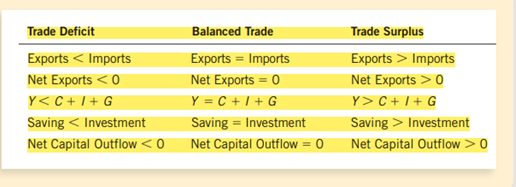
| International Flows of Goods and Capital: Summary This table shows the three possible outcomes for an open economy | |
| The rate at which a person can trade the currency of one country for the currency of another | Answer: nominal exchange rate |
| An increase in the value of a currency as measured by the amount of foreign currency it can buy | Answer: appreciation |
| A decrease in the value of a currency as measured by the amount of foreign currency it can buy | Answer: depreciation |
| The rate at which a person can trade the goods and services of one country for the goods and services of another | Answer: real exchange rate |
| Is a key determinant of how much a country exports and imports | Answer: real exchange rate |
| What to macroeconomists use to measure the real exchange rate? | Answer: They use price indexes, such as the consumer price index, which measure the price of a basket of goods and services |
| What does the real exchange rate measures? | Answer: the price of a basket of goods and services available domestically relative to a basket of goods and services available abroad |
| Is a theory of exchange rates whereby a unit of any given currency should be able to buy the same quantity of goods in all countries | Answer: purchasing-power parity |
| refers to the value of money in terms of the quantity of goods it can buy | Answer: purchasing power |
| states that a unit of a currency must have the same real value in every country. | Answer. Purchasing-power parity |
Want to create your own Flashcards for free with GoConqr? Learn more.