
5601178
Description

Flashcards by Corley Webb, updated more than 1 year ago

|
Created by Corley Webb
over 10 years ago
|
|
| Question | Answer |
| Homeostasis | Constant internal Environment |
| Evolution | involves modifications of characteristics in pre-existing populations |
| Vertical descent with modification | accumulation of mutations |
| Horizontal gene transfer | Genetic exchange between different species Examples: antibiotic resistance Mitochondria and chloroplast through endosymbiotic origins of eukaryotes |
| why are domains a better representation of life? | It did not reflect the relationship between kingdoms |
| Three domains? | 1. Eubacteria (monerans, prokaryotic) 2. Archaea (prokarotic) 3. Eukarya (plantea, fungi, Protista) |
| Hierarchies | cell, tissue, organs, organisms, populations, communities, ecosystems |
| Genome | The complete genetic makeup of an organism |
| Proteomes | The complete complement of proteins that a cell or organism can make Proteomes are encoded by genes = genome |
| Metabolism | all the chemical reactions of life |
| Hypothesis | Proposed explanation for a natural phenomenon Proposition based on previous observations or experimental studies A hypothesis is never really proven |
| Theory | Broad explanation of some aspect of the natural world that is substantiated by a large body of evidence Allows us to make many predictions Also can never be proved true |
| Five stages to scientific method | 1. Observation 2. hypothesis 3. experimentation 4. data is analyzed 5. hypothesis is accepted or rejected |
| Atomic number | Number of protons distinguishes one element from another Also equal to the number of electrons in the atom so that the net charge is zero |
| Mass number | protons, neutrons |
| Avagadro’s number | mole: Measure of solute concentration defined as its molecular weight in grams 1 mole of any element contains the same number of atoms—6.022 x 10²³ |
| Ions | more or less electrons than protons |
| Isotopes | Multiple forms of an element that differ in the number of neutrons EXAMPLE 12C contains 6 protons and 6 neutrons 14C contains 6 protons and 8 neutrons |
| Orbitals | Electrons travel within regions surrounding the nucleus (orbitals) in which the probability is high of finding that electron |
| CHONPS reactive? | Outer shells are not full so they create bonds to form molecules |
| Noble gasses stable? | The only have one electron in it's orbital. There's no room for sharing |
| orbitals shells | 1st shell - 1 spherical orbital (1s) - holds 2 electrons 2nd shell - 1 spherical orbital (2s) and 3 dumbbell-shaped orbitals (2p) – can hold 4 pairs of electrons |
| Weight | gravitational pull on a given mass |
| mass | same in all locations |
| Compound | Molecule composed of 2 or more elements |
| Covalent bonds | shared pairs of electrons attracted to protons of both atoms -To fill outer valence shells, first 2 then 8 thereafter -To gain stability |
| Polar covalent | different electronegativity of atoms involved, leads to formation of: Hydrogen bonds, between polar molecules Ionic bonds, more or less electrons, opposites attract |
| Double bonds | two pairs of electrons shared |
| WATER | Polar molecule: hydrogen bonds High heat of vaporization = sweat cools High specific heat |
| PH | Acids are molecules that release hydrogen ions in solution A strong acid releases more H+ than a weak acid Bases lower the H+ concentration Some release OH- Others bind H+ pH = log10 [H+] |
| PH cont' | Acidic solutions are pH 6 or below pH 7 is neutral Alkaline solutions are pH 8 or above |
| The pH of a solution can affect | The shapes and functions of molecules The rates of many chemical reactions The ability of two molecules to bind to each other The ability of ions or molecules to dissolve in water |
| Buffers | Organisms usually tolerate only small changes in pH Buffers help to keep a constant pH An acid-base buffer system can shift to generate or release H+ to adjust for changes in pH |
| Solvent | liquid |
| Solutes | Substances dissolved in solvent |
| Aqueous solution | water is the solvent |
| Ions and molecules that contain polar covalent bonds | will dissolve in water |
| Hydrophillic | “water-loving” Readily dissolve in water Molecules that contain ionic and/or polar covalent bonds |
| Hydrophobic | “water-fearing” Do not readily dissolve in water Nonpolar molecules like hydrocarbon |
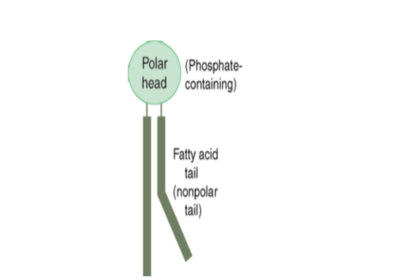
| Amphipathic molecule | Have both polar/ionized and nonpolar regions May form micelles in water |
| Temperature at which a solution freezes influenced by | amounts of dissolved solutes |
| Macromolecules | large, complex organic molecules |
| Carbon | Carbon has 4 electrons in its outer shell Needs 4 more electrons to fill the shell It can make up to 4 bonds Usually single or double bonds Carbon can form nonpolar and polar bonds |
| Functional Groups | Groups of atoms with special chemical features that are functionally important Each type of functional group exhibits the same properties in all molecules in which it occurs |
| Isomers | Two structures with an identical molecular formula but different structures and characteristics |
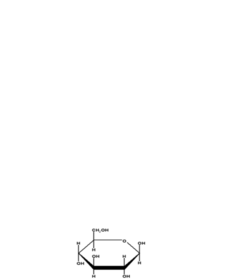
| Structural isomers | contain the same atoms but in different bonding relationships EXAMPLES Glucose and galactose = Hydroxyl group of carbon 1 above or below ring |
| Stereoisomers | identical bonding relationships, but the spatial positioning of the atoms differs in the two isomers EXAMPLES α- and β-glucose |
| Four major types of organic molecules and macromolecules | Carbohydrates Lipids Proteins Nucleic acids |
| Carbohydrates | Composed of carbon, hydrogen, and oxygen atoms Cn(H2O)n Most of the carbon atoms in a carbohydrate are linked to a hydrogen atom and a hydroxyl group |
| Monosaccharides | Simplest sugars Most common are 5 or 6 carbons Pentoses- ribose (C5H10O5), deoxyribose (C5H10O4) Hexose- glucose (C6H12O6) Ring or linear |
| Polysaccharides | largest of macromolecules Energy storage Starch: less branched Glycogen: highly branched Structural Cellulose:plants Chitin: arthropods, fungi Peptidoglycans: Bacteria |
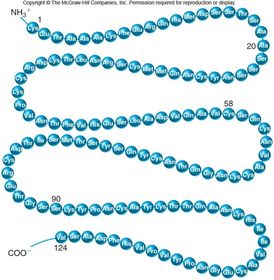
| Proteins | polypeptides Chains of aminoacids with peptide bonds Composed of carbon, hydrogen, oxygen, nitrogen, and small amounts of other elements, notably sulfur |
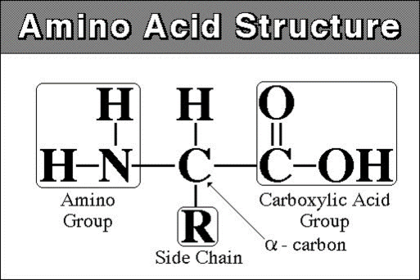
| Proteins Cont' | Amino acids are the monomers Common structure with variable R-group 20 amino acids Side-chain determines structure and function |
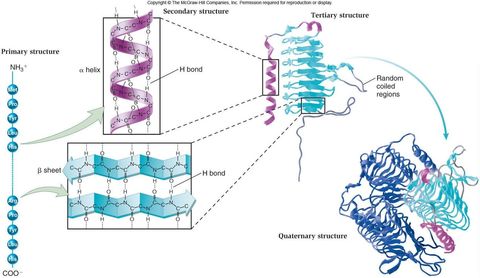
| Protein Structure | Primary Secondary Tertiary Quaternary |
| Primary structure | Amino acid sequence Determined by genes |
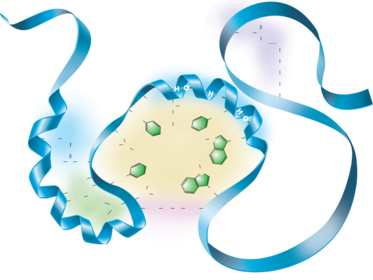
| Secondary Structure | Chemical and physical interactions cause folding Repeating patterns α helices and β pleated sheets Key determinants of a protein’s characteristics “Random coiled regions” Not α helix or β pleated sheet Shape is specific and important to function |
| Tertiary structure | Folding gives complex three-dimensional shape Final level of structure for single polypeptide chain |
| Quaternary structure | Made up of 2 or more polypeptides -Protein subunits – individual polypeptides -Multimeric proteins – proteins with multiple parts |
| 5 factors promoting protein folding and stability | Hydrogen bonds Ionic bonds and other polar interactions Hydrophobic effects Van der Waals forces Disulfide bridges |
| Amino functional group | N terminus |
| Carboxyl functional group | C terminus |
| R groups | 20 different functional groups |
| Denaturation | to destroy a protein |
| Nucleic Acids | Responsible for the storage, expression, and transmission of genetic information |
| 2 stages of Nucleic Acids | Deoxyribonucleic acid (DNA) Ribonucleic acid (RNA) |
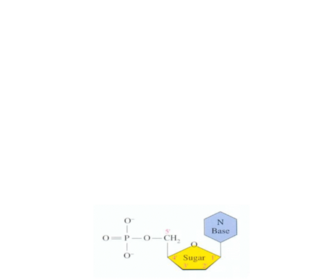
| Nucleotide monomers | 5-C sugar, nitrogenous base and phosphate group |
| Deoxyribonucleic acid (DNA) | Store genetic information coded in the sequence of their monomer building blocks |
| Ribonucleic acid (RNA) | Involved in decoding this information into instructions for linking together a specific sequence of amino acids to form a polypeptide chain |
| DNA | Deoxyribonucleic acid Deoxyribose Thymine (T) 2 strands- double helix 1 form |
| RNA | C Ribose Uracil (U) Single strand Several forms |
| both | Adenine (A), guanine (G), cytosine (C) |
| Fatty acid tail | |
| Amino fatty acid | |
| Nucleotide | |
| Carbohydrate | |
| lipids | Hydrocarbons: nonpolar, high energy oils and fats, generally hydrophobic Saturated (with hydrogen atoms, solid at room temp., animal fats) and unsaturated (with double bonds, liquid at room temp., vegetable oils) |
| Lipids: Steroids | hormones, cholesterol: amphipathic Phospholipids: hydrophilic phosphate head, hydrophobic fatty acid tails |
Want to create your own Flashcards for free with GoConqr? Learn more.