
7961331
Description

Flashcards by Christine Luk, updated more than 1 year ago

|
Created by Christine Luk
over 9 years ago
|
|
| Question | Answer |
| Fingerjoint | Silicone rubber |
| Breast Implant | Silicones |
| Heart Valve | Polyester Stainless Steel |
| Hip Joint | Titanium |
| Artificial Heart | Polyurethane Metal |
| Intraocular Lens (IOL) | Poly(methyl methacrylate) |
| Applications of Biomaterials: Sutures Name 5 advantages | AMAGE (town in France) - Any tissue - Minimal tissue reaction - Absorbable - Good knot security - Easy to handle |
| Intraocular Lens - name a) materials b) 3 properties | a) Poly(methyl methacrylate) PMMA b) 1) high refractive index (n) 2) easily processed 3) environmentally stable (relatively inert) |
| Name as many medical device examples as you can. There are 12 on the slides | Sutures, Catheters, Blood Bags Contact Lenses, IOL, Knee & Hip, Breast Prostheses Dental implants, Renal dialyzers Oxygenators, CPB (cardiopulmonary bypass system) Vascular grafts, pacemakers |
| Which are Biomaterials? why? a) contact lens b) splinter c) vascular graft d) clutches | a) & c) A biomaterial must interface with the biological system directly. When used, nothing between the device and person using it. The splinter and clutches can be held through gloves or other things. |
| Biomaterial | material interface w biological system to treat/evaluate/augment/replace tissues/organs/bodily functions |
| Biomaterials Science | study of biomaterials and their interactions with biological environment, includes 1) Materials Science 2) Biological topics: immunology, toxicology, wound healing process |
| biocompatibility | ability of a material to perform w an apropriate host response in a specific application |
| Reasoning Biocompatibility | Protein & cellular response to material which determines overall success of the implant. Arises from differences between living and non-living materials |
| Biocompatibility responses: 1) temporal 2) other | temporal response: redness, swelling, warmth, pain around implant other: activation of immune system, localized blood clotting, infection, tumor formation |
| Bioimplants trigger.... | Inflammation & Foreign body response(FBR) |
| biocompatibility testing | in vitro: lab environment in vivo: biomaterial implantation in a living system (animal, rat) |
| biocompatibility testing agencies | ASTM International International Organisation for Standardization (ISO) |
| biocompatibility testing steps | Not all products all steps 1) in vitro 2) in vivo healthy 3) in vivo sick (inject disease, then drug) 4) controlled clinical trials |
| New testing required for a) new devices b) new materials c) both new devices and materials | a) new devices FDA approves Devices not Materials. |
| amount of testing depends on | perceived danger intended use (device class) |
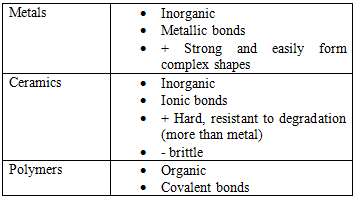
| Types of biomaterials | |
| Cobalt-chromium alloys: Co-Cr Applications (3) | artificial heart valves dental prostheses artificial joint components |
| Au, Pt Gold & Platinum | Dental fillings, electrodes for cochlear implants |
| Silver-tin-copper alloys Ag-Sn-Cu | dental amalgrams |
| Stainless steel | dental prosthesis vascular stents |
| Titanium alloys | artificial heart valve artificial joint components pacemaker cases |
| Ceramics: aluminum oxide Al2O3 | Orthopedic joint replacement components |
| Ceramics: Bioactive glasses | Bone graft substitute materials, dental implants |
| Ceramics: Calcium Phosphates | bone graft substitute materials, dental implants, bone cements |
| Natural Polymers | Can be derived from sources w/in body (collagen, fibrin) or outside the body (chitosan [from seafood shells], alginate) Collagen: Collagen type I & II Fibrin: protein-based, blood clotting factors = fibrinogen + thrombin chitosan = chitin derived from the shells of crabs, shrimps |
| Collagen | long, fibrous, extremely strong protein inside connective tissue. keeps skin elastic |
| Fibrin | repairs cartilage defects, other orthopedic applications |
| Chitosan | commonly sold as tablet "fat attracter" - attract fat and expel from body for weight loss. |
| Synthetic polymers | Elastomers: -highly elastic, w/stand large deformation at low stress and rebound. - good for cardiovascular applications, wherever tissue elasticity is requried - EXAMPLE: polydimethylsiloxane (PDMS) Hydrogels: -swell in water, retain water in structure - suitable for soft tissue applications - polyethylene glycol (PEG) |
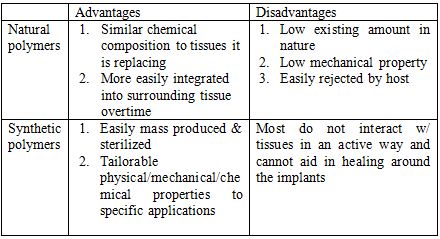
| Natural vs. Synthetic Polymers | |
| Which class(es) of biomaterials for an artificial tendon? why? [hint: a tissue that must sustain substantial deformation at low forces and return rapidly to its original dimensions upon release of stress] a) metals b) ceramics c) polymers | C) Polymers especially elastomers because of elasticity (ability to withstand large deformations at low stress and rebound) |
| Important properties of biomaterials: The selection of biomaterials for a given application is determined by: (3) | 1) degradative 2) surface properties 3) bulk properties |
| Biodegradable | ability to break down safely, reliable, and relatively quickly can be undesired/desired, time before failure important to check biocompatibility during degradation too |
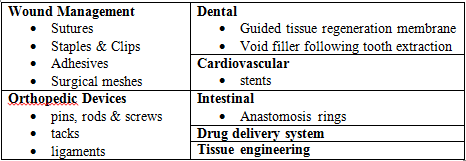
| Medical Applications of Biodegradable Poolymers | |
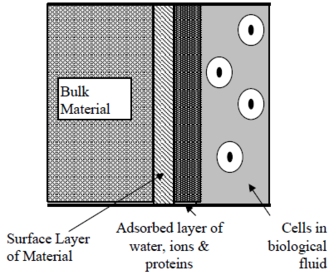
| What are the 4 layers of a biomaterial interfacing with a biological system? | |
| Importance: Surface properties | - a few atomic layers of the exterior - determines biological response - determines protein absorption - surface properties can be different from the bulk properties (due to surface modification/special surface processing) |
| chemical vs physical characteristics (surface property) | chemical: hydophobicity/hydrophilicity physical: surface roughness (increases cell adhesion) |
| Would a hydrophobic or hydrophilic polymer be more appropriate for a contact lens application? Why? Would a melting temperature of the polymer above or below 37 degrees be better? why? | Hydrophilic - eye is a watery environment above - you don't want it to melt |
| importance: Bulk properties | smaller role than surface characteristics but have a long term impact |
| mechanical, physical, chemical properties (bulk property) | mechanical properties: - strength, stiffness -anisotropy: different mechanical properties in different directions fatigue physical: crystallinity, thermal transitions chemical: hdyrophobicity |
| spectroscopy | measures how compounds absorb different types of energy |
| chromatography | physically separates molecules based on chemical characteristics (i.e., charge or size) |
Want to create your own Flashcards for free with GoConqr? Learn more.