
7978795
Description

Flashcards by Christine Luk, updated more than 1 year ago

|
Created by Christine Luk
over 9 years ago
|
|
| Question | Answer |
| Biomaterials Surface - Physics Key concepts | 1. bonding 2. surface tension/ adhesion & cohesion 3. hydrophobicity |
| ionic bond | (metal + nonmetal) High BP, high MP solid - insulator e- molten/aqueous - conductor e- HARD, BRITTLE |
| Covalent bonding | (nonmetal + nonmetal) s, l, g at room Temp s, l, g, poor conductor low MP, low BP Soft, brittle, cleaves non electrolyte |
| Metallic bonding | delocalized electrons/bonds good e- and thermal conductor opaque relatively ductile contain 1 to 3 electrons outer shell |
| Van der Waals Bond | weak attractive/repulsive force betw molecules partial dipoles occur to some extent in all materials, important for polymers |
| Polymers - important bonds | covalent + van der waals covalent: STRONG - carbon back bone, strong, rupture only in extreme conditions. key for thermosetting van der waals: WEAK allow sliding, rupture. Key for thermoplastics thermoplastics: head breaks van deer Waal forces thermosetting: 3D network of covalent bonds, don't break easily |
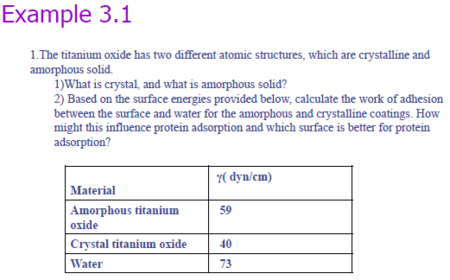
| Amorphous Solid | random supercooled liquids nio long range periodicity e.g., glass (SiO2 cooled rapidly to prevent crystallization |
| Crystalline solids | >90% of solids ares crystalline more stable, minimized intermolecular energy regular arrangements |
| Surface properties influencing protein and cell adhesion (3) | surface hydrophobicity (proteins like) surface roughness (cells like) surface charge (determined by peptide sequence) |
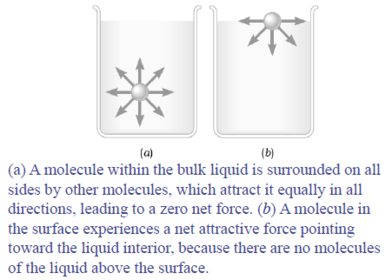
| Cohesive force | attraction betw SAME molecules |
| Adhesive force | attraction betw DIFFERENT molecules adhesive tape: sticks two different things together. |
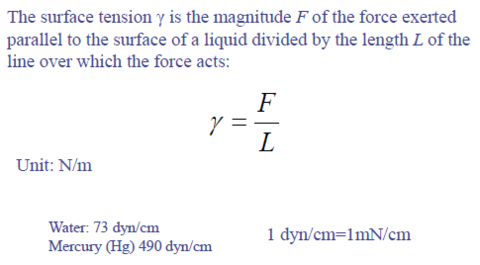
| Surface tension (T or gamma) | tendency of molecules on the surface of a liquid to go into the liquid |
| Surface tension formula | |
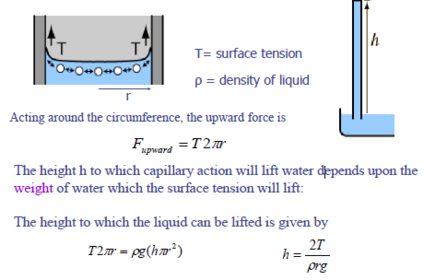
| Capillary action | adhesion to walls > cohesion liquid upward force raising liquid forms miniscus T holds surface intact height dependent on T |
| Capillary action: Force Upward formula | |
| high surface tension (T) materials | metals carbides oxides (strong bonds, metallic & covalent bonds) |
| low surface tension (T) materials | polymers, organics (van der waals bonded) |
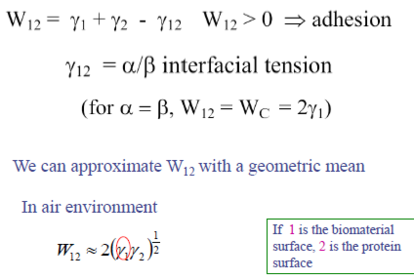
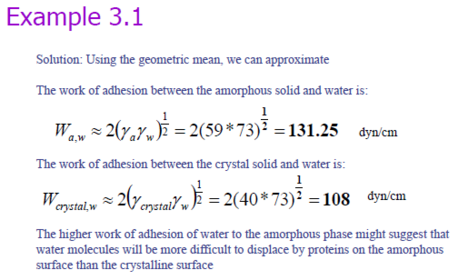
| Work of Cohesion | Surface tension is a measure of degree of cohesion |
| Work of Adhesion | Work required to separate a unit area of interface between to phases |
| Protein resistance by work of adhesion | W12 = 0 higher work adhesion of water, water will be harder to displace by protein, protein resistance is good |
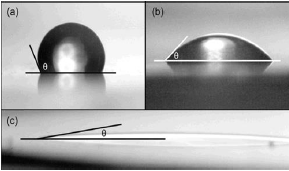
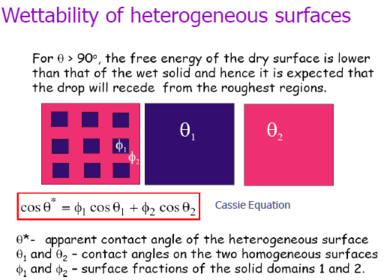
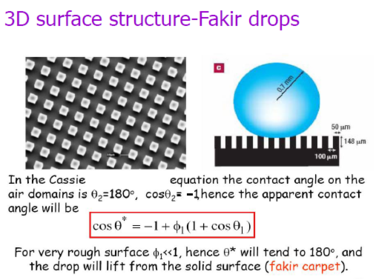
| (a) >90 = non wetting = hydrophobic (b) <90, partial = hydrophillic >150 is superhydrophobic/ ultraphobic | |
| Cassie's equation | |
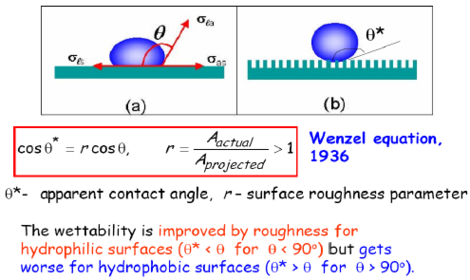
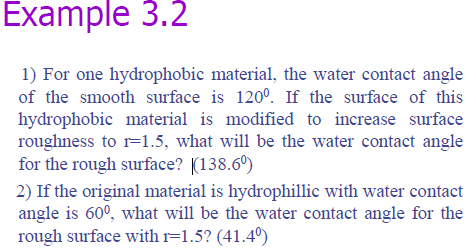
| Wenzel equation | |
| use wenzel's equation cos(pheta)* = rcos(pheta) pheta*= arccos(rcos(pheta)) | |


Want to create your own Flashcards for free with GoConqr? Learn more.