
23373178
Description

Mind Map by Ime Umoabasi, updated more than 1 year ago
|
|
Created by Ime Umoabasi
over 6 years ago
|
|
The Impact of Urbanisation on
Hydrological Processes Mind Map
- Water Pollution
- Water coming in contact with urban surfaces such as
roads, roofs and footpaths becomes contaminated by
the oils, metals, litter and other pollutants on these
surfaces. When this polluted water reaches rivers and
streams it can damage ecosystem in several ways
that affect the hydrological cycle.
- Water coming in contact with urban surfaces such as
roads, roofs and footpaths becomes contaminated by
the oils, metals, litter and other pollutants on these
surfaces. When this polluted water reaches rivers and
streams it can damage ecosystem in several ways
that affect the hydrological cycle.
- Alters Stores of Water in the Hydrological Cycle
- The spread of urbanisation results in key players and decision makers having
to interfere with the natural hydrological cycle. This being done means that
fluxes, flows and stores of water in the hydrological cycle are altered because
of urbanisation. Urban rivers tend to be channelised with embankments,
dredged or straightened or have bridges, that act as dams, are built over
them. These things can be done in attempt to increase a river's capacity but
can end up restricting channel flow, increasing water pressure in the river and
increasing the risk of floods having more devastating effects in an urban area.
- High Building Density
- As areas are urbanised, the
increased density of
buildings affects the
hydrological cycle. The
number of buildings means
that lots of precipitation is
collected on roofs and
therefore, the water's
natural flow is interrupted.
- As areas are urbanised, the
increased density of
buildings affects the
hydrological cycle. The
number of buildings means
that lots of precipitation is
collected on roofs and
therefore, the water's
natural flow is interrupted.
- Building Process
- When building begins a lot of
destruction is done to the
natural environment - and
sometimes this is done in the
form of deforestation. The
clearing of vegetation exposes
soil and increases rates of soil
erosion which impacts the
hydrological cycle.
- When building begins a lot of
destruction is done to the
natural environment - and
sometimes this is done in the
form of deforestation. The
clearing of vegetation exposes
soil and increases rates of soil
erosion which impacts the
hydrological cycle.
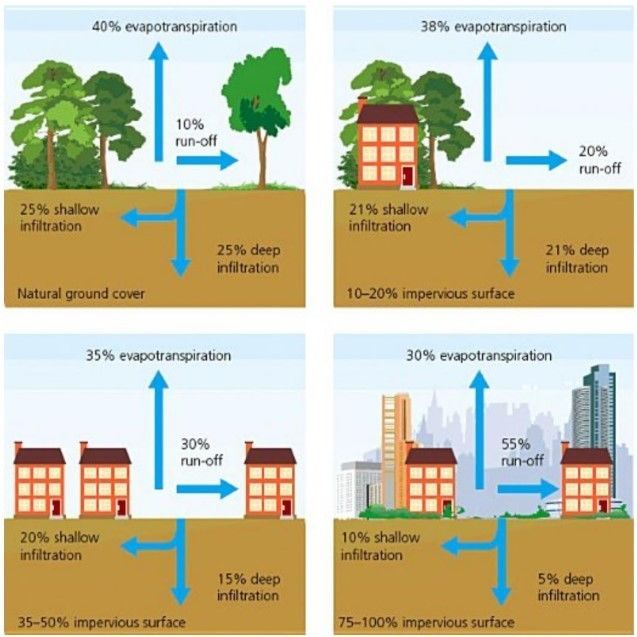
- Impervious Surfaces
- Urbanisation leads to the natural ground cover of an
area being covered by impermeable surfaces. These
impermeable surfaces, such as concrete and tarmac,
alter the natural flow of water through the
hydrological cycle by preventing water from
infiltrating into and percolating within the topsoil.
Instead, these surfaces force water to accumulate,
increase the likelihood of flooding, accelerate runoff
and cause water availability to decline as less
groundwater is stored.
- Reduced Lag Time
- As urbanisation occurs in an
area, drainage and sewage
systems are built. Part of the
reason these systems exist is to
reduce the distance that water
has to travel before reaching a
river and this is made possible
as they produce less friction
than the natural pathways that
water would flow through in a
rural environment. This means
that the water's velocity
increases, the lag time (time
between peak rainfall and peak
discharge) is reduced, but there
is also an increased risk of flash
floods.
- Increased Water Demands
- Urbanisation also affects
hydrological processes by
increasing water demands
and consumption.
- Urbanisation also affects
hydrological processes by
increasing water demands
and consumption.
Media attachments
Want to create your own Mind Maps for free with GoConqr? Learn more.