
26368083


1.1.1 The Operation of the Coast as a System
- Sediment cells
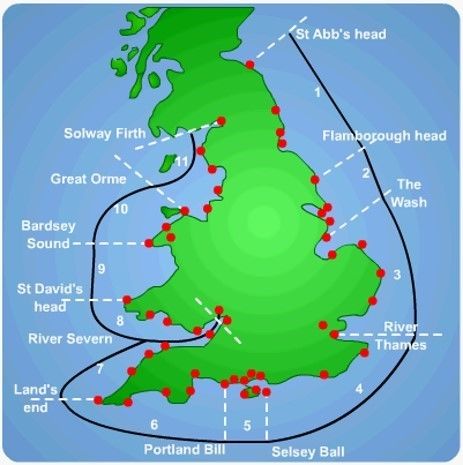
- 11 largely self contained cells around England and Wales
- Coastal system as a whole can be identified within this area
- Usually confined by morphology of the coast e.g. between two headlands
- Sediment brought from terrestrial (land) sources via watershed run-off and hillside erosion
- Material can be lost from the cell via a submarine canyon
- Cells are connected therefore if one cell is disrupted, neighbouring cells can be affected
- Aka Littoral cells
- 11 largely self contained cells around England and Wales
- The Process Response Method
- The morphology of the coastal landforms are the result of the processes operating at the coast
- Morphology = shape of coastline
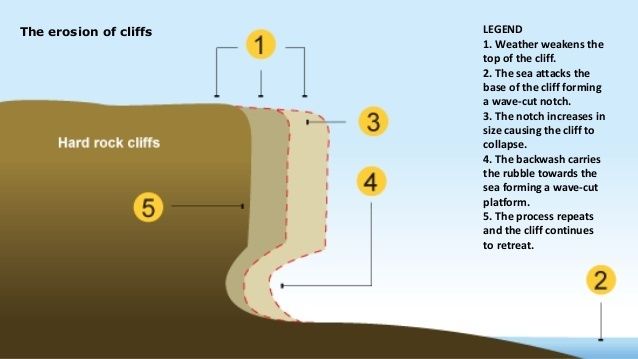
- e.g. Cliff retreat - the main process is erosion from destructive waves --> erosion of cliff
base --> collapse --> changed the shape of the coastline
- Morphology = shape of coastline
- The morphology of the coastal landforms are the result of the processes operating at the coast
- System feedback
- Positive feedback
- Amplifies the initial input
- e.g. storm erodes at a beach and cause MORE erosion to occur at the back
- e.g. storm erodes at a beach and cause MORE erosion to occur at the back
- Amplifies the initial input
- Negative feedback
- Mitigates the initial input
- e.g. Eroded material can be moved offshore, reducing
the energy of oncoming waves --> deposition --> LESS
erosion occurs
- e.g. Eroded material can be moved offshore, reducing
the energy of oncoming waves --> deposition --> LESS
erosion occurs
- Mitigates the initial input
- Positive feedback
- Dynamic equilibrium
- A state of balance within an ever changing system
- A state of balance within an ever changing system
- There are two coastal subsystems
- Beach
- Aeolian transportation
- Waves bringing in material
- LSD moving sediment
- Sediment budget
- Aeolian transportation
- Cliff
- Subaerial weathering
- Chemical e.g. solution
- Physical e.g. freeze-thaw
- Biological e.g. plant roots exposing
weaknesses in rock
- Chemical e.g. solution
- Mass movement e.g. rockfall,
slumping, rock toppling
- Subaerial weathering
- Beach
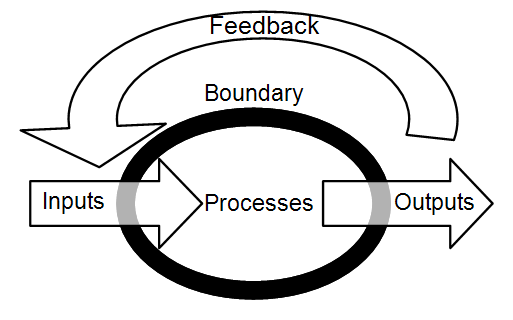
- The coastal system is a Dynamic Open system
- Dynamic = constantly changing
- Open system = material and energy can enter and leave
- Dynamic = constantly changing
- System is made up of components
- Inputs
- LSD in
- Tides, waves and wind bringing in energy and sediment
- Constructive waves
- LSD in
- Transfers
- Saltation
- LSD moving material
- Saltation
- Stores
- Beaches
- Beaches
- Outputs
- Dredging
- Destructive waves
- Dredging
- Inputs
- Exam Question
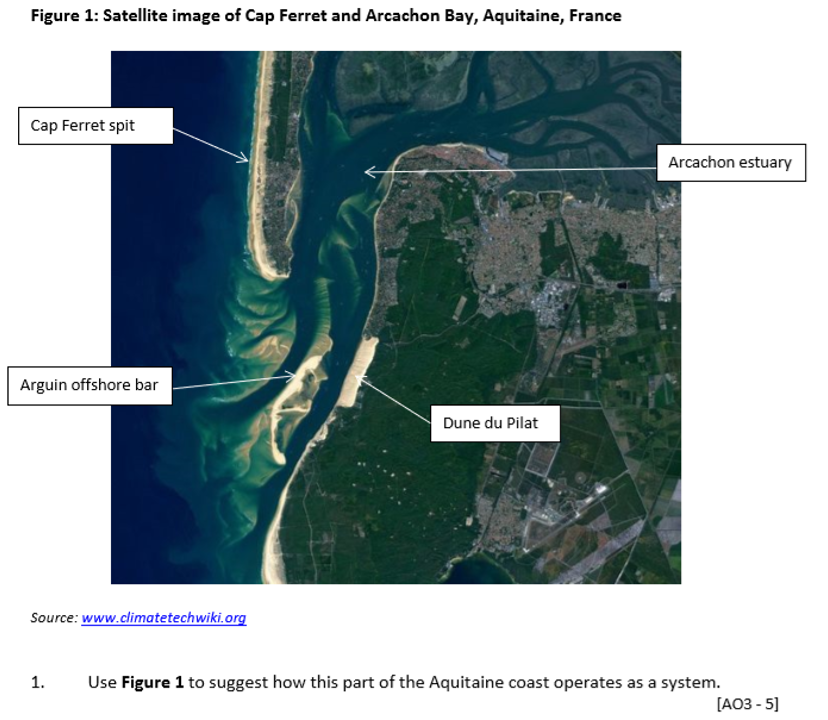
- A system is a collection of interrelated components that together form a
working unit with inputs, outputs, transfers, and stores. Figure 1 shows a
sub-sediment cell. Firstly, sediment is inputted from Arcachon estuary and
sediment is also brought to the beach from offshore currents powered by
prevailing winds. Figure 1 also shows the presence of Cap Ferret spit
implying that there has been strong longshore drift which transfers
sediment to Arguin offshore bar where it is deposited and held as a store.
Beach sediment blown inland by the wind to form Dune du Pilat where
sediment is outputted resulting in dynamic equilibrium.
- A system is a collection of interrelated components that together form a
working unit with inputs, outputs, transfers, and stores. Figure 1 shows a
sub-sediment cell. Firstly, sediment is inputted from Arcachon estuary and
sediment is also brought to the beach from offshore currents powered by
prevailing winds. Figure 1 also shows the presence of Cap Ferret spit
implying that there has been strong longshore drift which transfers
sediment to Arguin offshore bar where it is deposited and held as a store.
Beach sediment blown inland by the wind to form Dune du Pilat where
sediment is outputted resulting in dynamic equilibrium.
Media attachments

Want to create your own Mind Maps for free with GoConqr? Learn more.