
469419
Description

Mind Map by younje2011, updated more than 1 year ago

|
Created by younje2011
about 12 years ago
|
|
Metal extraction
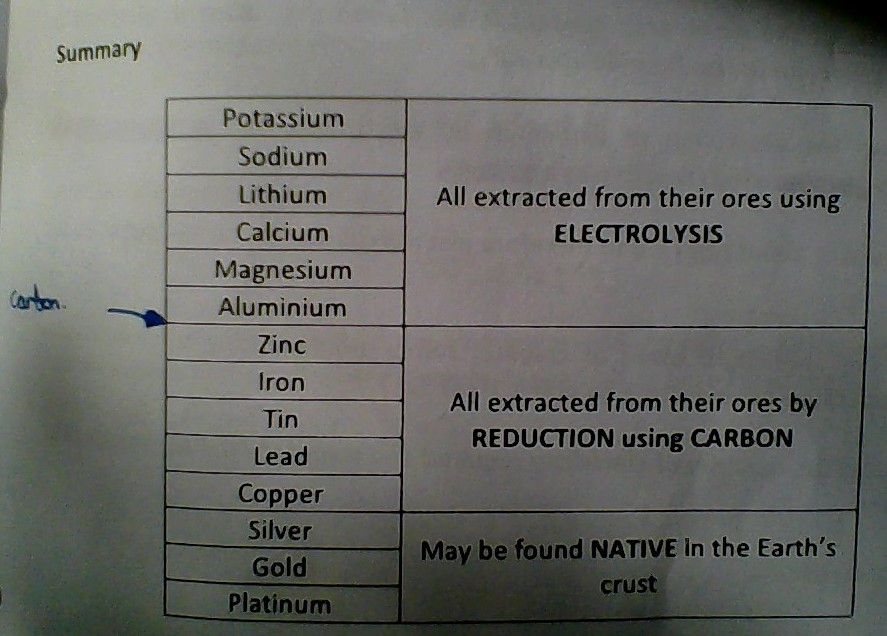
- a metal above carbon in the reactivity
series will be extracted by electrolysis
- a metal below carbon in the reactivity
series (zinc to silver) will be extracted
fromits ore by heating with carbon
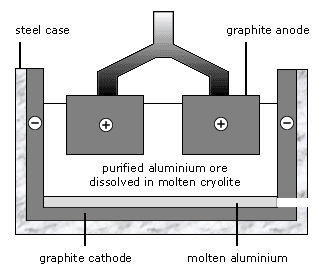
- Extraction of Aluminium
- Al is more reactive than C so electrolysis is used
- Aluminium ore is
called BAUXITE
- Contains aluminium oxide, water, iron
oxide, and other impurities. The purified
dry ore is aluminium oxide, Al2O3
- must be molten for
electrolysis to work,
so that ions are free
to move
- Melting point of 2040
degrees celcius
- Al can be dissolved in
cryolite acts as a solvent
- Cryolite metls at about 900 degrees
celcius meaning that electrolysis can
occour at 950 degrees celcius
- this reduces the cost of
electricity wich reduces
the cost of the process
- equations
- 1/2 equations
- at the anode
- 2O2- -> O2 + 4e-
- 2O2- -> O2 + 4e-
- at the cathode
- Al 3+ + 3e- -> Al
- Al 3+ + 3e- -> Al
- at the anode
- overall reaction
- aluminium oxide -> aluminium + oxygen
- 2Al2O3 -> 4Al + 3O2
- 2Al2O3 -> 4Al + 3O2
- aluminium oxide -> aluminium + oxygen
- the anode
- carbon + oxygen -> carbon dioxide
- C + O2 -> CO2
- C + O2 -> CO2
- carbon + oxygen -> carbon dioxide
- 1/2 equations
- equations
- this reduces the cost of
electricity wich reduces
the cost of the process
- Cryolite metls at about 900 degrees
celcius meaning that electrolysis can
occour at 950 degrees celcius
- Al can be dissolved in
cryolite acts as a solvent
- Melting point of 2040
degrees celcius
- must be molten for
electrolysis to work,
so that ions are free
to move
- Contains aluminium oxide, water, iron
oxide, and other impurities. The purified
dry ore is aluminium oxide, Al2O3
- Aluminium ore is
called BAUXITE
- Uses of Al
- overhead
cables
- low density (light)
- ductile and conducts electricity
- low density (light)
- aircraft bodies
- low density (light)
- corrosion resistant
- low density (light)
- overhead
cables
- Al is more reactive than C so electrolysis is used
- Extraction of Iron
- Fe is LESS REACTIVE THAN C
so is extracted from its
ore by REDUCTION USING C
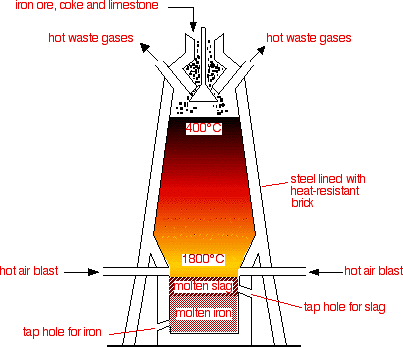
- using the BLAST FURNACE
- main or in Fe
is HAEMATITE
- impure Fe2O3
- contains mainly
SILICA/sand (SiO2)
- LIMESTONE is added which reacts
with the silica to form molten
calcium silicate (slag) in the blast furnace
- Slag FLOATS on top of the liquid iron
- as Fe is bellow C in the R.S.
Fe ions int the Iron ore are
REDUCED to Iron metal by
HEATING WITH CARBON
(coke- purified form of coal)
- NOTE it is actually CARBON MONOXIDE
that dose the reducing in the blast furnace
- the temperature were reduction takes
places is 1500 degrees celcius
- Fe falls to the bottom of the furnace were
the temperature is 2000 degrees celcius
- Fe is liquid at this temperature and is tapped off periodically
- Fe is liquid at this temperature and is tapped off periodically
- Fe falls to the bottom of the furnace were
the temperature is 2000 degrees celcius
- the temperature were reduction takes
places is 1500 degrees celcius
- NOTE it is actually CARBON MONOXIDE
that dose the reducing in the blast furnace
- as Fe is bellow C in the R.S.
Fe ions int the Iron ore are
REDUCED to Iron metal by
HEATING WITH CARBON
(coke- purified form of coal)
- Slag FLOATS on top of the liquid iron
- impure Fe2O3
- Equations
- Carbon (C) + Oxygen (O) -> Carbon Dioxide (CO2)
- Carbon Dioxide (CO2) + Carbon (C) -> Carbon Monoxide (2CO)
- Iron (lll) oxide (Fe2O3) + Carbon Monoxide (3CO) -> Iron (2Fe) + Carbon Dioxide (3CO2)
- Iron (lll) oxide (Fe2O3) + Carbon Monoxide (3CO) -> Iron (2Fe) + Carbon Dioxide (3CO2)
- Carbon Dioxide (CO2) + Carbon (C) -> Carbon Monoxide (2CO)
- Carbon (C) + Oxygen (O) -> Carbon Dioxide (CO2)
- main or in Fe
is HAEMATITE
- using the BLAST FURNACE
- Fe is LESS REACTIVE THAN C
so is extracted from its
ore by REDUCTION USING C
Media attachments
Want to create your own Mind Maps for free with GoConqr? Learn more.