
17293623
Description

Quiz by Alison Coffey, updated more than 1 year ago

|
Created by Alison Coffey
almost 7 years ago
|
|
Question 1
Question
The nurse is caring for a patient who is taking phenytoin (Dilantin). Which medication, if ordered by the physician, should the nurse question?
Answer
-
Captopril
-
Ondansetron
-
Cimetidine
-
Pantoprazole
Question 2
Question
Most anticonvulsant medications have a narrow therapeutic range and require serum levels to be monitored?
Answer
- True
- False
Question 3
Question
Most anticonvulsant medications are Cytochrome P450 Enzyme "Inducers"?
Answer
- True
- False
Question 4
Question
Most Anticonvulsant medications will increase the effectiveness of birth control pills, thus making pregnancy difficult while taking them.
Answer
- True
- False
Question 5
Question
Patients can be instructed to take the anticonvulsant medications on a PRN schedule. When they feel an aura, they should take the medications.
Answer
- True
- False
Question 6
Question
Phenytoin (Dilantin) is approved by the FDA in the treatment of Absence Seizures.
Answer
- True
- False
Question 7
Question
Phenytoin (Dilantin) can be used to treat certain cardiac dysrhythmias.
Answer
- True
- False
Question 8
Question
A recommended serum phenytoin (Dilantin) level is [blank_start]10-20[blank_end] mcg/mL.
Answer
-
10-20
Question 9
Question
Phenytoin (Dilantin) is considered...
Answer
-
CNS Stimulant
-
CNS Depressant
Question 10
Question
[blank_start]Fosphenytoin[blank_end] is a parenteral medication which is a prodrug and is converted to [blank_start]phenytoin[blank_end] when metabolized.
Answer
-
Fosphenytoin
-
phenytoin
Question 11
Question
Carbamazepine (Tegretol) is effective against which of the following types of seizures? Select all that apply.
Answer
-
Absence
-
Tonic-Clonic
-
Partial
Question 12
Question
A 28 year old female patient is newly prescribed Carbamazepine (Tegretol). Which of the following are important to include when teaching her about the medication? Select all that apply.
Answer
-
A Complete Blood Count (CBC) will be monitored throughout therapy
-
The patient should report symptoms such as sore throat and bruising.
-
Grapefruit juice will assist in absorption of the medication and is encouraged each morning.
-
Carbamazepine is a safe drug to take in pregnancy and with breast feeding.
Question 13
Question
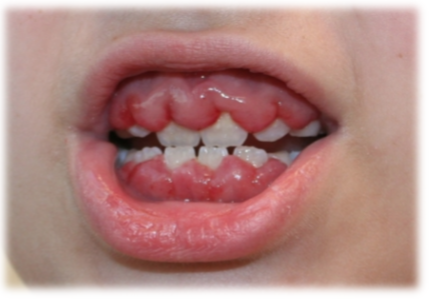
This adverse effect may most likely be seen with which one of the following antiepileptic agents?
Answer
-
Carbamazepine
-
Oxcarbazepine
-
Phenytoin
-
Phenobarbital
Question 14
Question
[blank_start]Phenobarbital[blank_end] is the oldest antiseizure drug, but with significant adverse effects. [blank_start]Gabapentin (Neurontin)[blank_end] is commonly prescribed for uses other than seizures, including neuropathic pain and fibromyalgia. [blank_start]Lorazepam (Ativan)[blank_end] is administered via IV for the treatment of status epilepticus. There is a risk of hyponatremia with [blank_start]Oxcarbazepine (Trileptal)[blank_end] if administered along with any other drug that wastes sodium. [blank_start]Ethosuximide (Zarontin)[blank_end] is approved to treat absence seizures only.
Answer
-
Phenobarbital
-
Gabapentin (Neurontin)
-
Lorazepam (Ativan)
-
Oxcarbazepine (Trileptal)
-
Ethosuximide (Zarontin)
Question 15
Question
A 15-year-old male hits his finger while hammering a nail. Which of the following best describes the type of pain he would feel?
Answer
-
Visceral pain
-
Somatic pain
-
Peripheral pain
-
Neuropathic pain
Question 16
Question
A patient has morphine prescribed for post-op pain. Which of the following assessments is the PRIORITY assessment prior to administration of this medication?
Answer
-
Respiratory Rate
-
Heart Rate
-
Pain level
-
Constipation
Question 17
Question
What is the mechanism that may lead to increased ICP while a patient receives opioids?
Answer
-
Increased HR with pain will cause increased CO2 and increased ICP
-
There is no increase in ICP related to the use of opioids
-
Increased respiratory rate will cause increased CO2 and may cause increased ICP
-
Decreased respiratory rate will cause increased CO2 and might result in increased ICP
Question 18
Question
In which case might the nurse avoid a pain medication with combined opioid and acetaminophen? (i.e. vicodin)
Answer
-
Patient states pain of 9 on 0-10 scale
-
Patient was admitted for cellulitis
-
Patient was admitted for suicidal ideation
-
Patient was admitted for HF
Question 19
Question
Which of the following patient populations would be more sensitive to morphine-induced respiratory depression? Select all that apply.
Answer
-
Elderly
-
Infants
-
Adolescents
-
Women
-
Men
Question 20
Question
A patient will begin to use a non-selective COX inhibitor; what information will the nurse provide in medication education?
Answer
-
S/S of peptic ulcer disease
-
This medication does nothing for pain
-
S/S of a blood clot
-
This medication will aggravate any inflammation
Question 21
Question
A patient wants to know how a COX inhibitor has anything to do with prevention of a heart attack. What is the nurse's best response?
Answer
-
"Non-selective COX inhibitors work by keeping your kidneys healthy, which protects your heart"
-
"Non-selective COX inhibitors are given to prevent clots"
-
"Non-selective COX inhibitors are not to be used in cardiac patients"
-
"Non-selective COX inhibitors are great for the pain, including cardiac chest pain"
Question 22
Question
A 64 year old patient has a second alcohol-related fall within six months and now has shoulder and knee pain. He reports 3-6 drinks/day. With the patient's alcohol consumption, can he use acetaminophen to treat his pain related to the fall?
Answer
-
Yes, only up to 3 grams per day
-
Yes, only 1 gram every 4 hours
-
No, given the patient's history of alcohol use it is not safe to provide acetaminophen
-
Yes, but not to exceed 2 grams per day
Question 23
Question
Which of the following patients might be at risk for acetaminophen toxicity?
Answer
-
Patient with liver disease
-
Patient with BMI of 32
-
Patient who is undernourished
-
Patient with recent H.pylori ulcer
Question 24
Question
A post-op patient reports pain of 7 on 0-10 scale, but explains that morphine makes him feel "loopy" and would rather not have it. What NSAID might you recommend with the same effectiveness of morphine?
Answer
-
Aspirin
-
Ibuprofen
-
Ketorolac
-
Acetaminophen
Question 25
Question
Which of the following clotting factors are Vitamin K dependent for synthesis?
Answer
-
VII, IX, X, and prothrombin II
-
VII, VIII, IX, and X
-
Prothrombin II, VII, X, and XII
-
VIII, IX, and X
Question 26
Question
Once there is no need for clot, what final substance degrades the fibrin mesh?
Answer
-
Plasminogen
-
Thrombin
-
Plasmin
-
Collagen
Question 27
Question
A patient is placed on heparin for DVT prophylaxis after open reduction and internal fixation (ORIF) of a tibia fracture. Which S/S would be of greatest concern to the nurse after beginning his therapy?
Answer
-
Bruising at injection site
-
Headache and confusion
-
Pain and body temp of 37.8 C (100F)
-
Pink saliva after brushing teeth
Question 28
Question
A patient has been on long-term high dose heparin therapy and will continue to use at home. What would the nurse include in discharge education to prevent common adverse effects of this drug?
Answer
-
Avoid large crowds
-
Increase fluid and fiber in diet
-
Avoid contact sports or vigorous exercise
-
Add a small aspirin daily to enhance effectiveness of heparin
Question 29
Question
A nurse is caring for a patient admitted through the ED after a MVC. The patient is scheduled for orthopedic internal fixation late tomorrow evening. What would be the priority to report to the provider if the patient is prescribed enoxaparin (Lovenox)?
Answer
-
Warfarin is also ordered to start in 3 days
-
K+ level of 3.4 with PO supplements timed for this evening
-
INR of 1.2
-
Spinal anesthesia is recommended for surgery tomorrow
Question 30
Question
Which patient does the nurse identify as most likely needing an increased dose of warfarin (Coumadin) to have the same anticoagulant effect?
Answer
-
Patient taking acetaminophen (Tylenol) for back pain
-
Patient starting cimetidine (Tagamet) to prevent gastric ulcers
-
Patient starting prednisone (Deltasone) for rheumatoid arthritis
-
Patient starting an oral contraceptives to prevent pregnancy
Question 31
Question
What is the antidote for heparin?
Answer
-
Vitamin K
-
Protamine Sulphate
-
Magnesium sulfate
-
Aminocaproic acid
Question 32
Question
During administration of alteplase (Activase), the patient's IV site starts to ooze blood around the catheter. Which action by the nurse is most appropriate?
Answer
-
Discontinue the infusion of alteplase
-
Assess the patient's vital signs
-
Apply direct pressure over the puncture site.
-
Administer aminocaproic acid (Amicar)
Question 33
Question
Monoamine Oxidase (MAO)...
Answer
-
Inactivates norepinephrine and serotonin. Breaks down dietary Tyramine.
-
Inactivates Dopamine
Want to create your own Quizzes for free with GoConqr? Learn more.