
4092262
Description

Quiz by Leah Firmstone, updated more than 1 year ago
|
|
Created by Leah Firmstone
almost 11 years ago
|
|
Question 1
Question
What is 'Organic Chemistry'?
Answer
-
The study of carbon-based molecules
-
The study of naturally-occurring molecules
-
The study of synthesised molecules
Question 2
Question
What two elements make up a hydrocarbon?
Answer
-
Carbon
-
Oxygen
-
Nitrogen
-
Hydrogen
Question 3
Question
The general formula for alkanes is CnH2n
Answer
- True
- False
Question 4
Question
Looking at the chemical formulae of these compounds, which is an alkane?
Answer
-
C3H8
-
C2H4
-
C5H10
Question 5
Question
Alkanes are [blank_start]saturated[blank_end] hydrocarbons. This means that their [blank_start]carbon[blank_end] atoms are joined to each other by [blank_start]single[blank_end] bonds. This makes them relatively [blank_start]unreactive[blank_end], apart from their reaction with [blank_start]oxygen[blank_end] in the air - which we call burning or [blank_start]combustion[blank_end].
Answer
-
saturated
-
single
-
unreactive
-
carbon
-
oxygen
-
combustion
Question 6
Question
Which of the following is not true for alkanes?
Answer
-
The longer the molecule the higher the boiling point.
-
The shorter the chain length the less viscous the alkane
-
The longer the chain the more likely to be liquids or gases
-
They are immiscible
Question 7
Question
Which alkane is represented by this structural formula?
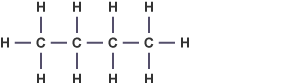
Answer
-
methane
-
butane
-
heptane
Question 8
Question
Balance the following equation:
[blank_start]2[blank_end]C2H6 + [blank_start]7[blank_end]O2 -> [blank_start]4[blank_end]CO2 + [blank_start]6[blank_end]H2O
Answer
-
2
-
7
-
4
-
6
Question 9
Question
Alkenes are unsaturated molecules.
Answer
- True
- False
Question 10
Question
Alkenes contain a carbon-[blank_start]carbon[blank_end] double bond. This bond is why the alkenes are [blank_start]more[blank_end] reactive than the alkanes. The number of [blank_start]hydrogen[blank_end] atoms in an alkene is [blank_start]double[blank_end] the number of carbon atoms, so they have the general formula Equation C[blank_start]n[blank_end]H[blank_start]2n[blank_end].
Answer
-
carbon
-
hydrogen
-
more
-
double
-
2n
-
n
Question 11
Question
The presence of the C=C double bond allows alkenes to react in ways that alkanes cannot. This allows us to tell alkenes apart from alkanes using a simple chemical test. What is the test for an alkene?
Answer
-
They turn universal indicator purple
-
They turn bromine water colourless
-
They turn limewater cloudy
Question 12
Question
Alcohols all contain the [blank_start]hydroxyl[blank_end] functional group –[blank_start]OH[blank_end], which is responsible for the [blank_start]properties[blank_end] of alcohols.
The names of alcohols end ‘-[blank_start]anol[blank_end]’, eg ethanol.
The first three alcohols in the series are methanol, ethanol and [blank_start]propanol[blank_end]. They are highly flammable, making them useful as fuels. They are also used as [blank_start]solvents[blank_end] in marker pens, medicines, and cosmetics (such as deodorants and perfumes). Ethanol is mixed with [blank_start]petrol[blank_end] for use as a fuel.
Answer
-
hydroxyl
-
properties
-
anol
-
OH
-
propanol
-
solvents
-
petrol
Question 13
Question
Alcohols have similar intermolecular bonding to water.
Answer
- True
- False
Question 14
Question
Which of the following are uses of methanol?
Answer
-
fuel
-
solvent
-
chemical feedstock
-
manufacture of cosmetics
-
to make bread
Question 15
Question
Ethanol is used as a fuel, and as a solvent in marker pens, for example.
Answer
- True
- False
Question 16
Question
What three methods can be used to produce ethanol?
Answer
-
Fermentation
-
Biotechnology
-
Chemical Synthesis
-
Filtration
-
Combustion
-
Fractional Distillation
Question 17
Question
The following statements are positive components of which method of producing ethanol?
- High yields of ethanol (95%)
- Theoretical atom economy of 100%
- Efficient process
Answer
-
'Synthetic' ethanol
-
Yeast fermentation
-
Bacterial fermentation
Question 18
Question
The feedstock for 'synthetic' ethanol includes....
Answer
-
ethene and water
-
purpose grown crops
-
biomass
Question 19
Question
What type of bacterium is genetically engineered and used in fermentation to produce ethanol?
Answer
-
Penicillium
-
E.coli
-
Salmonella
Question 20
Question
The concentration of ethanol produced by the fermentation of micro-organisms must be kept low as otherwise the alcohol would poison the enzymes which are used to catalyse the reaction.
Answer
- True
- False
Question 21
Question
Complete the table by putting a cross (x) in the correct boxes to show what happens in each reaction.
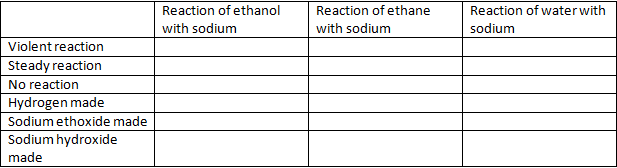
Answer
-
x
-
-
-
x
-
-
-
x
-
-
-
x
-
-
-
x
-
-
-
x
-
-
-
x
-
-
-
x
-
-
-
x
-
-
-
x
-
-
-
x
-
-
-
x
-
-
-
x
-
-
-
x
-
-
-
x
-
-
-
x
-
-
-
x
-
-
-
x
-
-
Question 22
Question
A carboxylic acid is characterised by which functional group?
Answer
-
-COOH
-
-OH
-
-OOH
-
C=C
Question 23
Question
Carboxylic (organic) acids are weak acids which are less likely to ionise, or disassociate, in solution.
Answer
- True
- False
Question 24
Question
What type of organic chemicals do you need to mix together to make an ester?
Answer
-
alcohol
-
carboxylic acid
-
acid catalyst
-
enzyme catalyst
-
alkane
-
alkene
Want to create your own Quizzes for free with GoConqr? Learn more.