
6162811


Question 1
Question
[blank_start]Themes[blank_end] of Biology
1) [blank_start]DNA[blank_end] is genetic material that is the foundation of life.
2) [blank_start]Form[blank_end] fits [blank_start]function[blank_end].
3) Organisms interact with both [blank_start]biotic[blank_end] (living) and [blank_start]abiotic[blank_end] (non-living) creatures in their environment. They are [blank_start]open[blank_end] systems.
4) [blank_start]Diversity[blank_end] makes each species and even each individual unique. However, there is a sense of [blank_start]unity[blank_end] between all organisms as they all arose and evolved from one thing. They also have a universal genetic code.
5) Darwin stated that [blank_start]evolution[blank_end] was the reason for this vast biological diversity. He also said that [blank_start]natural selection[blank_end] was done by nature to create the best traits for organisms.
Answer
-
Themes
-
DNA
-
biotic
-
abiotic
-
Form
-
function
-
open
-
closed
-
RNA
-
Diversity
-
unity
-
evolution
-
natural selection
Question 2
Question
Domain
[blank_start]Kingdom[blank_end]
[blank_start]Phylum[blank_end]
Class
[blank_start]Older[blank_end]
[blank_start]Family[blank_end]
Genus
[blank_start]Species[blank_end]
Answer
-
Kingdom
-
Phylum
-
Family
-
Species
-
Order
Question 3
Question
Which of these are one of the three domains?
Answer
-
Eubacteria
-
Bacteria
-
Eukarya
-
Prokarya
-
Archaeabacteria
-
Archaea
Question 4
Question
Which of these kingdoms fall under the domain of eukarya?
Answer
-
Plantae
-
Animalia
-
Protists
-
Fungi
-
Archaebacteria
-
Eubacteria
Question 5
Question
R - [blank_start]Reproduce[blank_end]
E - [blank_start]Energy[blank_end]
C - [blank_start]Cells[blank_end]
H - [blank_start]Homeostasis[blank_end]
A - [blank_start]Adapt[blank_end]
R - Respond to [blank_start]Stimuli[blank_end]
G - [blank_start]Grow[blank_end]
E - Evolve
D - [blank_start]Develop[blank_end]
Answer
-
Reproduce
-
Cells
-
Energy
-
Stimuli
-
Homeostasis
-
Adapt
-
Grow
-
Develop
Question 6
Question
The Cell [blank_start]Theory[blank_end]
1) [blank_start]Cells[blank_end] are the building blocks of [blank_start]life[blank_end].
2) All living organisms are made from [blank_start]cells[blank_end].
3) All [blank_start]cells[blank_end] come from pre-existing [blank_start]cells[blank_end].
Answer
-
cells
-
life
-
Cells
-
Theory
-
cells
-
cells
Question 7
Question
Please make sure to place each option in the correct order.
Prokaryotic Cells vs. Eukaryotic Cells
Simple or Complex? -> *[blank_start]simple[blank_end]* vs. *[blank_start]complex[blank_end]*
Nucleus or not? -> *[blank_start]nucleoid region with DNA[blank_end]* vs. *[blank_start]nucleus with DNA and chromosomes[blank_end]*
In which organisms? -> *[blank_start]unicellular[blank_end]* vs. *[blank_start]fungi, protists, animals, plants[blank_end]*
Organelles? -> *[blank_start]No[blank_end]* vs. *[blank_start]Yes[blank_end]*
Answer
-
simple
-
complex
-
nucleoid region with DNA
-
nucleus with DNA and chromosomes
-
unicellular
-
fungi, protists, animals, plants
-
No
-
Yes
Question 8
Question
Which of these are similarities between prokaryotic and eukaryotic cells?
Answer
-
Ribosomes
-
DNA
-
Cytoplasm
-
Microscopic
-
Earliest Form of Life
-
Most Basic Form of Life
-
Cell Membrane
-
Cell Wall
Question 9
Question
Please make sure to place each option in the correct order.
Animal Cell vs. Plant Cell
Vacuole? -> *[blank_start]Many Small[blank_end]* vs. *[blank_start]One Large[blank_end]*
Cell Wall? -> *[blank_start]No[blank_end]* vs. *[blank_start]Yes[blank_end]*
Shape? -> *[blank_start]Undefined[blank_end]* vs. *[blank_start]Rectangular[blank_end]*
Answer
-
Many Small
-
One Large
-
No
-
Yes
-
Undefined
-
Rectangular
Question 10
Question
Why are viruses considered non-living?
Answer
-
They do not feed, grow, or excrete.
-
They do not have DNA. They also do not have RNA.
-
They are only capable of doing one of the acronyms of RECHARGED independently, which is reproduce.
-
They are considered to be a decomposer.
-
All of the above
-
None of the above
Question 11
Question
Which number represents the eye piece/ocular lens?
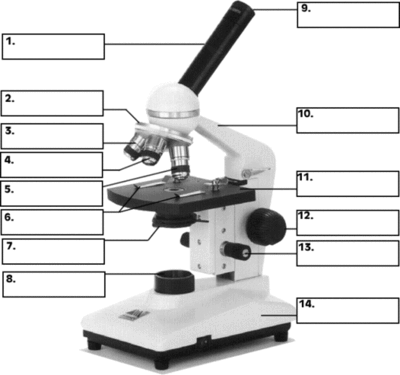
Answer
-
9
-
10
-
11
-
12
Question 12
Question
Which number represents the place where the slide is kept?
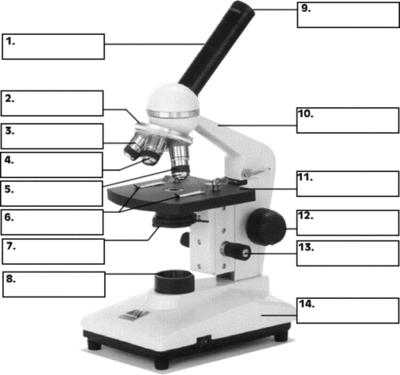
Answer
-
11
-
6
-
8
-
7
Question 13
Question
Which number(s) represent(s) the part(s) that change the focus of a slide?
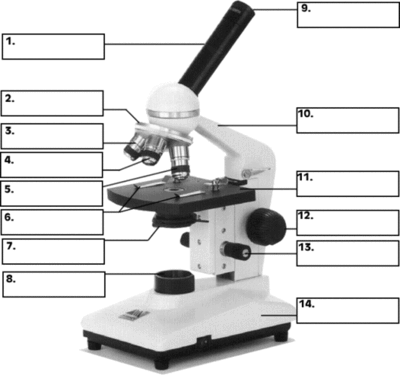
Answer
-
4
-
12
-
13
-
8
-
7
Question 14
Question
What number represents the part of the microscope that is used to illuminate the slide?
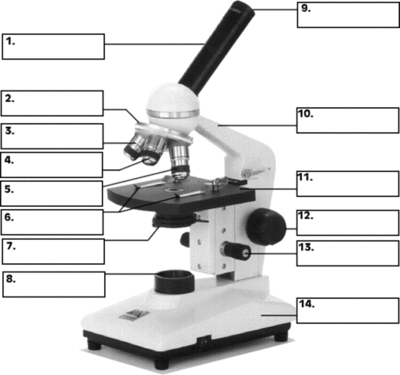
Answer
-
8
-
7
-
12
-
13
Question 15
Question
Shapes of Bacteria
[blank_start]Bacillus[blank_end] - rod shaped
[blank_start]Coccus[blank_end] - round/spherical shape
[blank_start]Spirilla[blank_end] - spiral shape
Answer
-
Bacillus
-
Coccus
-
Spirilla
Question 16
Question
Cell Grouping
[blank_start]Diplo[blank_end] - pair
[blank_start]Staphylo[blank_end] - cluster
[blank_start]Strepto[blank_end] - long chain
Answer
-
Diplo
-
Staphylo
-
Strepto
Question 17
Question
[blank_start]Nucleus[blank_end] - largest organelle, contains genetic information (DNA)
[blank_start]Endoplasmic Reticulum[blank_end] - transport system inside cell
[blank_start]Golgi Bodies/Apparatus[blank_end] - temporary storage of proteins where they modify into a more usable form
[blank_start]Chloroplast[blank_end] - capture light energy
[blank_start]Cytoplasm[blank_end] - mostly water. fluid that makes up body of cell
[blank_start]Ribosomes[blank_end] - produces protein
[blank_start]Mitochondria[blank_end] - digestive system of cell (takes in nutrients, and releases energy)
[blank_start]Cell Membrane[blank_end] - controls what goes in and out of cell
[blank_start]Cell Wall[blank_end] - offers protection/shape
[blank_start]Lysosomes[blank_end] - digest nutrients and remove waste from cell
[blank_start]Vacuole[blank_end] - storage for protein
[blank_start]Cilia/Flagella[blank_end] - helps cell movement
Answer
-
Nucleus
-
Endoplasmic Reticulum
-
Golgi Bodies/Apparatus
-
Chloroplast
-
Cytoplasm
-
Ribosomes
-
Mitochondria
-
Cell Membrane
-
Cell Wall
-
Lysosomes
-
Vacuole
-
Cilia/Flagella
Question 18
Question
Go To These Websites To Practice Animal and Plant Cell Diagrams
Animal Cell - http://www.sheppardsoftware.com/health/anatomy/cell/cell_quiz.htm
Plant Cell - http://www.sheppardsoftware.com/health/anatomy/cell/plant_cell_game.htm
Bacteria - http://www.sheppardsoftware.com/health/anatomy/cell/bacteria_cell_game.htm
*For the plant cell diagram quiz, the labels won't attach to the lines if the line in incorrect.*
Answer
-
Click this option to get credit for this question
-
. . .
Want to create your own Quizzes for free with GoConqr? Learn more.