
Apuntes
Can Architecture Save the World

Contenido del apunte (1)
Página 1
Can Architecture Save the World?
Topics:
INTRO
Global Warming:
What?
Causes?
Consequences
Preventing
Zero Carbon Housing:
What?
Science
2016 Law
History
Positives:
Effect On Global Warming
Effect On Environment
Future
Negatives:
Cost Of Building
Destruction Of Environment For Materials
Will It Make A Difference
CONCLUSION
Global Warming
What Is Global Warming
Carbon dioxide and other global warming pollutants are collecting in the atmosphere like a thickening blanket, trapping the sun's heat and causing the planet to warm up.
SOURCES
http://library.thinkquest.org/J003411/causes.htm
http://www.nrdc.org/globalwarming/
http://www.zmescience.com/tag/global-warming/
https://koshland-science-museum.org/explore-the-science/earth-lab/processes?gclid=CMWBzPKe-rkCFRMftAod4x8APw
http://www.infoplease.com/ipa/A0004686.html
http://hyperphysics.phy-astr.gsu.edu/hbase/thermo/grnhse.html
http://www.wwf.org.uk/what_we_do/tackling_climate_change/climate_change_explained/
http://www.climatehotmap.org/about/global-warming-causes.html
http://planetsave.com/2009/06/07/global-warming-effects-and-causes-a-top-10-list/
http://www.insidehousing.co.uk/sustainability/zero-carbon-homes-%E2%80%98too-expensive%E2%80%99-to-build/6518051.article
http://www.nrdc.org/globalwarming/fcons.asp
http://dsc.discovery.com/tv-shows/curiosity/topics/worst-effects-global-warming.htm
http://www.academia.edu/1740538/global_warming_and_architecture_in_20th_century_21th_century
http://www.homearchitects.com/green-architecture
http://environment.about.com/od/globalwarming/tp/globalwarmtips.htm
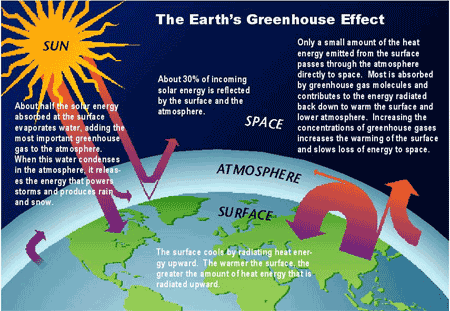
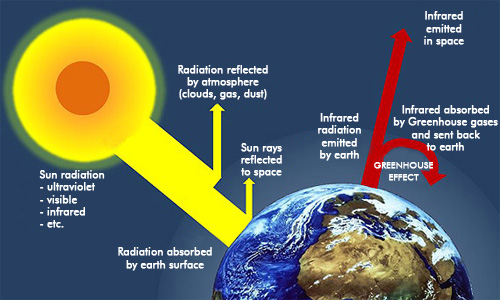
The Greenhouse Gas Effect
The greenhouse effect is a natural process by which some of the radiant heat from the Sun is captured in the lower atmosphere of the Earth, thus maintaining the temperature of the Earth's surface. The gases that help capture the heat, called “greenhouse gases,” include water vapour, carbon dioxide, methane, nitrous oxide, and a variety of manufactured chemicals. Some are emitted from natural sources; others are anthropogenic, resulting from human activities.
The greenhouse effect refers to circumstances where the short wavelengths of visible light from the sun pass through a transparent medium and are absorbed, but the longer wavelengths of the infrared re-radiation from the heated objects are unable to pass through that medium. The trapping of the long wavelength radiation leads to more heating and a higher resultant temperature. Besides the heating of an automobile by sunlight through the windshield and the namesake example of heating the greenhouse by sunlight passing through sealed, transparent windows, the greenhouse effect has been widely used to describe the trapping of excess heat by the rising concentration of carbon dioxide in the atmosphere. The carbon dioxide strongly absorbs infrared and does not allow as much of it to escape into space.
What Causes Global Warming
The causes of climate change is a complicated and often contentious topic. However, there is strong evidence that natural causes (e.g. variations in output from the sun) can't explain our changing climate alone. Instead, it is increasingly believed that the activities and lifestyles of the earth's human population are causing the changes.
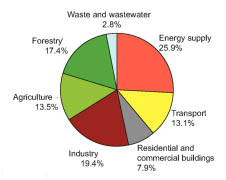
Global warming is
primarily a problem of too much carbon dioxide (CO2) in the atmosphere—which
acts as a blanket, trapping heat and warming the planet. As we burn fossil
fuels like coal, oil and natural gas for energy or cut down and burn forests to
create pastures and plantations, carbon accumulates and overloads our
atmosphere. Certain waste management and agricultural practices aggravate the
problem by releasing other potent global warming gases, such as methane and
nitrous oxide. See the pie chart for a breakdown of heat-trapping global
warming emissions by economic sector.
Consequences of Global Warming
This has been the warmest decade since 1880. In 2010, global surface temperatures tied 2005 as the warmest on record, according to the National Oceanic and Atmospheric Administration. Scientists say that the earth could warm by an additional 7.2 degrees Fahrenheit during the 21st century if we fail to reduce emissions from burning fossil fuels, such as coal and oil. This rise in average temperature will have far-reaching effects on the earth's climate patterns and on all living things. Many of these changes have already begun. Scientists report that some polar bears are drowning because they have to swim longer distances to reach ice floes. Unless we take effective action now, the polar bear will likely become extinct in Alaska by 2050.
Increasing global temperatures are expected to disrupt ecosystems, pushing to extinction those species that cannot adapt. The first comprehensive assessment of the extinction risk from global warming found that more than 1 million species could be obliterated by 2050 if the current trajectory continues.
More frequent and severe heat waves will result in a greater number of heat-related deaths. In July 2006, severe heat waves in North America contributed to the deaths of at least 225 people.
Rising global temperatures will speed the melting of glaciers and ice caps and cause early ice thaw on rivers and lakes. At the current rate of retreat, all of the glaciers in Glacier National Park will be gone by 2070
Warmer water in the oceans pumps more energy into tropical storms, making them stronger and potentially more destructive. Even with storms of the same intensity, future hurricanes will cause more damage as higher sea levels exacerbate storm surges, flooding, and erosion. Hot, dry weather led to a record-setting 2006 wildland fire season with close to 100,000 fires reported and nearly 10 million acres burned, 125 percent above the decade's average.
TOP TEN WORST EFFECTS OF GLOBAL WARMING 10. Rising Sea Level
Earth's hotter temperature doesn't necessarily
mean the Miami lifestyle is moving to the Arctic, but it does mean rising sea
levels. How are hotter temperatures linked to rising waters?
Hotter temperatures mean ice -- glaciers,
sea ice and polar ice sheets -- is melting, increasing the amount of water in
the world's seas and oceans. Scientists are able to measure that melt water from Greenland's ice cap directly impacts people in the United States:
The flow of the Colorado River has increased sixfold [source: Scientific American]. And
scientists project that as the ice shelves on Greenland and Antarctica melt, sea levels could be more than 20
feet (6 meters) higher in 2100 than they are today [source: An Inconvenient Truth].
Such levels would submerge many of Indonesia's tropical islands and flood
low-lying areas such as Miami, New York City's Lower Manhattan and Bangladesh. You can't have as much
fun in the sun when the beach is underwater. Miami, along with many other areas
around the world, is threatened by rising oceans.
9.
Shrinking Glaciers
You
don't need special equipment to see that glaciers around the world are
shrinking. Tundra once covered with thick permafrost is melting with rising
surface temperatures and is now coated with plant life. In the span of a
century, glaciers in Montana's Glacier National
Park have deteriorated from 150 to just 35 [source: New York Times]. And the Himalayan glaciers
that feed the Ganges River, which supplies drinking and irrigation water to 500
million people, are reportedly shrinking by 40 yards (37 meters) each year
[source: The Washington Post]. Montana's Glacier National Park will lose some of its
majestic beauty as surface temperatures continue to rise.
8.
Heat Waves
The
deadly heat wave that swept across Europe in
2003, killing an estimated 35,000 people, could be the harbinger of an intense
heat trend that scientists began tracking in the early 1900s [source: MSNBC].
Extreme heat waves are happening two to four times more often now, steadily
rising over the last 50 to 100 years, and are projected to be 100 times more
likely over the next 40 years [source: Global Development and Environment Institute, Tufts
University]. Experts suggest continued heat waves may mean future
increases in wildfires, heat-related illness and a general rise in the planet's
mean temperature. Heat waves not only make it seem
difficult to function, they can be deadly as well. This man tried to cool
himself with a water bottle during a 2008 heat wave in New York City.
5.
Disease
Depending
on where you live, you may use bug repellent to protect against West Nile virus
or Lyme disease. But when was the last time you considered your risk of
contracting dengue fever?
Warmer
temperatures along with associated floods and droughts are encouraging worldwide
health threats by creating an environment where mosquitoes, ticks,
mice and other disease-carrying creatures thrive. The World Health
Organization (WHO) reports
that outbreaks of new or resurgent diseases are on the rise and in more
disparate countries than ever before, including tropical illnesses in once cold
climates -- such as mosquitoes infecting Canadians with West Nile virus.
While
more than 150,000 people die from climate change-related sickness each year,
everything from heat-related heart and respiratory problems to malaria are on
the rise [source: The
Washington Post]. Cases of allergies and asthma are also increasing.
How is hay fever related to global
warming? Global warming fosters increased smog -- which is linked to
mounting instances of asthma attacks -- and also advances weed growth, a bane
for allergy sufferers.
4.
Economic Consequences
The
costs associated with climate change rise along with the temperatures. Severe
storms and floods combined with
agricultural losses cause billions of dollars in damages, and money
is needed to treat and control the spread of disease. Extreme weather can
create extreme financial setbacks. For example, during the record-breaking hurricane year of 2005,
Louisiana saw a 15 percent drop in income during the months following the
storms, while property damage was estimated at $135 billion [source: Global Development
and Environment Institute, Tufts University]. Economic considerations reach into
nearly every facet of our lives. Consumers face rising food and energy costs
along with increased insurance premiums for health and home. Governments suffer
the consequences of diminished tourism and industrial profits, soaring energy,
food and water demands, disaster
clean-up and border tensions. And ignoring the problem won't make it go away. A
recent study conducted by the Global Development and Environment Institute at
Tufts University suggests that inaction in the face of global warming crises
could result in a $20 trillion price tag by 2100 [source: Global Development
and Environment Institute, Tufts University]. In
addition to the loss of life caused by Hurricane Katrina, New Orleans and
Louisiana have faced the economic consequences of billions of dollars in damage
3.
Conflicts and War
Declining
amounts of quality food, water and land may be leading to an increase in global
security threats, conflict and war. National security experts analysing the
current conflict in Sudan's Darfur
region suggest that while global warming is not the sole cause of the crisis,
its roots may be traced to the impact of climate change, specifically the
reduction of available natural resources [source: Seattle Post-Intelligencer]. The violence
in Darfur broke out during a time of drought, after two decades of little-to-no
rain along with rising temperatures in the nearby Indian Ocean. Scientists and
military analysts alike are theorizing climate change and its consequences such
as food and water instability pose threats for war and conflict, suggesting
that violence and ecological crises are entangled. Countries suffering from
water shortages and crop loss become vulnerable to security trouble, including
regional instability, panic and aggression. The
conflict in Darfur has been partly blamed on stresses caused by global warming.
1.
Destruction of Ecosystems
Changing
climatic conditions and dramatic increases in carbon dioxide will put our
ecosystems to the test, threatening supplies of fresh water, clean air, fuel
and energy resources, food, medicine and other matters we depend upon not just
for our lifestyles but for our survival. Evidence shows effects of climate
change on physical and biological systems, which means no part of the world is
spared from the impact of changes to land, water and
life. Scientists are already observing the bleaching and death of coral reefs due to warming ocean waters, as well
as the migration of vulnerable plants and animals to alternate geographic
ranges due to rising air and water temperatures and melting ice sheets. Models
based on varied temperature increases predict scenarios of devastating floods,
drought, wildfires, ocean acidification and eventual
collapse of functioning ecosystems worldwide, terrestrial and aquatic alike. Forecasts
of famine, war and death paint a dire picture of climate change on our planet.
Scientists are researching the causes of these changes the vulnerability of Earth not
to predict the end of days but rather to help us mitigate or reduce changes
that may be caused by humans. If we know and understand the problems and take
action through adaptation, the use of more energy-efficient and sustainable
resources and the adoption of other green ways of living, we may be able to
make some impact on the climate change process. Coral
bleaching is only a tangible aspect of global warming's effect on ecosystems.
7.
Storms and Floods
Experts
use climate models to project the impact rising global temperatures will have
on precipitation. However, no modelling is needed to see that severe storms are
happening more frequently: In just 30 years the occurrence of the strongest hurricanes -- categories 4 and 5 -- has nearly
doubled [source: An
Inconvenient Truth]. Warm waters give
hurricanes their strength, and scientists are correlating the increase in ocean
and atmospheric temperatures to the rate of violent storms. During the last few
years, both the United States and Britain have
experienced extreme storms and flooding, costing lives and billions of
dollars in damages. Between 1905 and 2005 the frequency of hurricanes has been
on a steady ascent. From 1905 to 1930, there were an average of 3.5 hurricanes
per year; 5.1 between 1931 and 1994; and 8.4 between 1995 and 2005 [source: USA Today]. In 2005, a record number of
tropical storms developed, and in 2007, the worst flooding in 60 years hit
Britain [sources: Reuters, Centre for American Progress]. Warmer waters increase the likelihood of violent storms.
Hurricane Dolly swept over the Texas-Mexico border in July 2008.
6.
Drought
While
some parts of the world may find themselves deluged by increasing storms and
rising waters, other areas may find themselves suffering from drought. As the climate
warms, experts estimate drought conditions may increase by at least 66 percent
[source: Scientific American]. An
increase in drought conditions leads quickly to a shrinking water supply and a
decrease in quality agricultural conditions. This puts global food production
and supply in danger and leaves populations at risk for starvation. Today, India, Pakistan and sub-Saharan Africa already experience droughts, and
experts predict precipitation could continue to dwindle in the coming decades.
Estimates paint a dire picture. The Intergovernmental Panel on Climate Change
suggests that by 2020, 75 to 250 million Africans may experience water
shortages, and the continent's agricultural output will decrease by 50 percent
[source: BBC].
Worldwide droughts, like that in a village
northeast of Nairobi, expose rural communities to food shortages.
2. Loss of Biodiversity
Species
loss and endangerment is rising along with global temperatures. As many as 30
percent of plant and animal species alive today risk extinction by 2050 if average temperatures rise
more than 2 to 11.5 degrees F (1.1 to 6.4 degrees C) [sources: EPA, Scientific
American]. Such extinctions will be due to loss of habitat through
desertification, deforestation and ocean warming, as well as the inability to
adapt to climate warming. Wildlife researchers have noted some of the more
resilient species migrating to the poles, far north and far south to maintain
their needed habitat; the red fox, for example, normally an inhabitant of North America, is now seen living in the
Arctic. Humans also aren't immune to the threat. Desertification and rising sea
levels threaten human habitats. And when plants and animals are lost to climate
change, human food, fuel and income are lost as well. The red fox has been affected by rising global
temperatures.
Preventing Global
Warming (Reducing Global Warming)
TOP
10 THINGS YOU CAN DO TO REDUCE GLOBAL WARMING
1. Reduce,
Reuse, Recycle
Do your part
to reduce waste by choosing reusable products instead of disposables. Buying
products with minimal packaging (including the economy size when that makes
sense for you) will help to reduce waste. And whenever you can, recycle paper, plastic, newspaper, glass and aluminium cans.
If there isn't a recycling program at your workplace, school, or in your
community, ask about starting one. By recycling half of your household waste,
you can save 2,400 pounds of carbon dioxide annually.
2. Use Less
Heat and Air Conditioning
Adding
insulation to your walls and attic, and installing weather stripping or
caulking around doors and windows can lower your heating costs more than 25
percent, by reducing the amount of energy you need to heat and cool your home.
Turn down the heat while you're sleeping at night or away during
the day, and keep temperatures moderate at all times. Setting your thermostat
just 2 degrees lower in winter and higher in summer could save about 2,000
pounds of carbon dioxide each year.
3. Change a Light Bulb
Wherever
practical, replace regular light bulbs with compact fluorescent light (CFL)
bulbs. Replacing just one 60-watt incandescent light bulb with a CFL will save
you $30 over the life of the bulb. CFLs also last 10 times longer than
incandescent bulbs, use two-thirds less energy, and give off 70 percent less
heat.
If every U.S. family replaced one regular light bulb with a CFL,
it would eliminate 90 billion pounds of greenhouse gases, the same as taking
7.5 million cars off the road.
4. Drive Less and Drive Smart
Less driving
means fewer emissions. Besides saving gasoline, walking and biking are great
forms of exercise. Explore your community mass transit system, and check out
options for carpooling to work or school.
When you do drive, make sure
your car is running efficiently. For example, keeping your tires properly inflated can improve your gas mileage by more
than 3 percent. Every gallon of gas you save not only helps your budget; it
also keeps 20 pounds of carbon dioxide out of the atmosphere.
5. Buy
Energy-Efficient Products
When it's time
to buy a new car, choose one that offers good gas mileage. Home appliances now
come in a range of energy-efficient models, and compact florescent bulbs are
designed to provide more natural-looking light while using far less energy than
standard light bulbs.
Avoid products that come with excess packaging, especially moulded plastic
and other packaging that can't be recycled. If you reduce your household
garbage by 10 percent, you can save 1,200 pounds of carbon dioxide annually.
6. Use Less
Hot Water
Set your water
heater at 120 degrees to save energy, and wrap it in an insulating blanket if
it is more than 5 years old. Buy low-flow showerheads to save hot water and
about 350 pounds of carbon dioxide yearly. Wash your clothes in warm or cold
water to reduce your use of hot water and the energy required to produce it.
That change alone can save at least 500 pounds of carbon dioxide annually in
most households. Use the energy-saving settings on your dishwasher and
let the dishes air-dry.
7. Use the "Off"
Switch
Save
electricity and reduce global warming by turning off lights when you leave a
room, and using only as much light as you need. And remember to turn off your
television, video player, stereo and computer when you're not using them.
It's also a good idea to turn off the water when you're not
using it. While brushing your teeth, shampooing the dog or washing your car,
turn off the water until you actually need it for rinsing. You'll reduce your
water bill and help to conserve a vital resource.
8. Plant a Tree
If you have
the means to plant a tree, start digging. During photosynthesis, trees and
other plants absorb carbon dioxide and give off oxygen. They are an integral
part of the natural atmospheric exchange cycle here on Earth, but there are too
few of them to fully counter the increases in carbon dioxide caused by
automobile traffic, manufacturing and other human activities. A single tree
will absorb approximately one ton of carbon dioxide during its lifetime.
9. Get a Report Card from Your Utility Company
Many utility
companies provide free home energy audits to help consumers identify areas in
their homes that may not be energy efficient. In addition, many utility
companies offer rebate programs to help pay for the cost of energy-efficient
upgrades.
10. Encourage Others to
Conserve
Share
information about recycling and energy conservation with your friends, neighbours
and co-workers, and take opportunities to encourage public officials to
establish programs and policies that are good for the environment.
First Look
Global Warming