
3316306


Pregunta 1
Pregunta
1000 Calories make up 1 calorie.
Respuesta
- True
- False
Pregunta 2
Pregunta
Cellular respiration starts with a pathway called [blank_start]glycolysis[blank_end].
Respuesta
-
glycolysis
Pregunta 3
Pregunta
The carriers for energy and high energy electrons during GLYCOLYSIS are
Respuesta
-
ATP
-
NADH
-
FADH2
-
NADPH
Pregunta 4
Pregunta
If oxygen is NOT present, glycolysis is followed by
Respuesta
-
Krebs cycle
-
Electron transport chain
-
Fermentation
-
Aerobic respiration
Pregunta 5
Pregunta
Fill in the chemical equation for cell respiration.
[blank_start]glucose[blank_end] + [blank_start]oxygen[blank_end] → [blank_start]carbon dioxide[blank_end] + [blank_start]water[blank_end] + [blank_start]energy[blank_end]
Respuesta
-
glucose
Pregunta 6
Pregunta
The 3-carbon molecule produced when glucose is broken in half during glycolysis is called
Respuesta
-
lactic acid
-
acetyl-CoA
-
pyruvic acid (pyruvate)
-
citric acid
Pregunta 7
Pregunta
Glycolysis results in the net gain of 4 electrons.
Respuesta
- True
- False
Pregunta 8
Pregunta
What role does O2 play in aerobic respiration?
Respuesta
-
It combines with acetyl-CoA at the start of the Krebs cycle
-
It combines with H2O to help drive the formation of ATP
-
It is the final electron acceptor at the end of the electron transport chain
-
It plays no role
Pregunta 9
Pregunta
NADH is produced during
Respuesta
-
glycolysis
-
oxidation of pyruvate
-
the Krebs cycle
-
all of the above
Pregunta 10
Pregunta
What substance is regenerated by fermentation?
Respuesta
-
O2
-
NAD+
-
acetyl-CoA
-
ATP
Pregunta 11
Pregunta
Which of the following are produced during the Krebs Cycle? (Check ALL that apply)
Respuesta
-
ATP
-
NADH
-
FADH2
-
CO2
Pregunta 12
Pregunta
Which stage of cell respiration produces the most ATP?
Respuesta
-
glycolysis
-
Krebs cycle
-
electron transport chain
-
fermentation
Pregunta 13
Pregunta
Which of the following happens as electrons pass down the Electron Transport Chain? (Check ALL that apply)
Respuesta
-
Energy from the moving electrons transports H+ ions into the intermembrane space
-
Carbon dioxide is released
-
Energy from H+ ions crossing back into the matrix causes ATP synthase to make ATP
-
Water is produced
Pregunta 14
Pregunta
Describe which type of fermentation takes place in the following examples.
a. Yeast use this to make bread dough rise. [blank_start]Alcohlic fermentation[blank_end]
b. Your muscles use this during rapid exercise when oxygen is low. [blank_start]Lactic acid fermentation[blank_end]
Respuesta
-
Alcohlic fermentation
-
Lactic acid fermentation
Pregunta 15
Pregunta
A net [blank_start]36[blank_end] ATP molecules are formed during cellular respiration.
Respuesta
-
32
-
34
-
36
-
38
Pregunta 16
Pregunta
Name the ? molecule that joins in this reaction to make Acetyl-CoA.
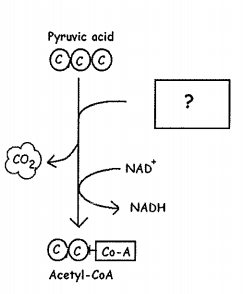
Respuesta
-
ATP
-
NADP+
-
Coenzyme A
-
Citric acid
Pregunta 17
Pregunta
If oxygen is present, what will happen to the NADH produced in this reaction?
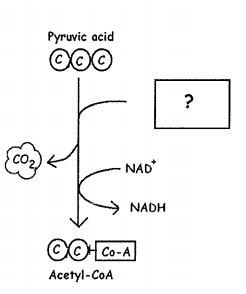
Respuesta
-
Its electrons will enter the electron transport chain
-
It will donate its H+ ions to make glucose
-
It will join with ATP to make citric acid
-
It will join with oxygen to make CO2
Pregunta 18
Pregunta
What is the 6-carbon molecule that form when acetyl-CoA joins its 2 carbons to a 4-carbon molecule during the Krebs Cycle?
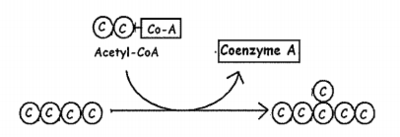
Respuesta
-
ATP
-
Pyruvic acid
-
Glucose
-
Citric Acid
Pregunta 19
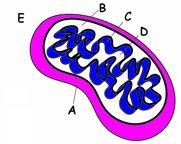
Respuesta
-
A
-
B
-
C
-
D
-
E
Pregunta 20
Pregunta
Which of the following are true about label C in the diagram? (Check ALL that apply)
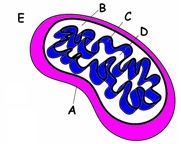
Respuesta
-
Place where enzymes for the electron transport chain are located
-
Place where ADP and P join to make ATP
-
Place where oxygen joins as the final electron acceptor
-
It is known as the matrix
-
It is an inner membrane called cristae
Pregunta 21
Pregunta
In which order do the stages of aerobic cellular respiration occur?
Respuesta
-
glycolysis, citric acid cycle, pyruvate oxidation, electron transport chain.
-
citric acid cycle, glycolysis, electron transport chain, pyruvate oxidation.
-
glycolysis, citric acid cycle, electron transport chain, pyruvate oxidation.
-
glycolysis, pyruvate oxidation, citric acid cycle, electron transport chain.
Pregunta 22
Pregunta
This diagram is of a mitochondrion. Select the correct labels from the following.
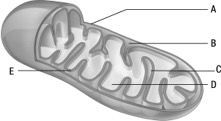
Respuesta
-
A: outer membrane, B: intermembrane space, C: crista, D: matrix
-
A: outer membrane, B: crista, D: matrix, E: outer membrane
-
A: intermembrane space, B: inner membrane, C: crista, D: matrix
-
A: inner membrane, B: intermembrane space, D: matrix, E: outer membrane
Pregunta 23
Pregunta
[blank_start]Photosynthesis[blank_end] releases oxygen into the atmosphere, and [blank_start]cellular respiration[blank_end] uses the oxygen to
release energy from food.
Respuesta
-
Photosynthesis
-
Cellular respiration
-
cellular respiration
-
photosynthesis
Pregunta 24
Pregunta
Which of the following is NOT a stage of cellular respiration?
Respuesta
-
Fermentation
-
Electron transport
-
Glycolysis
-
Krebs cycle
¿Quieres crear tus propios Tests gratis con GoConqr? Más información.