
Test
CCNA 3v5.03 Chapter 6
Este test tiene tipos de pregunta que se abren en el reproductor de siempre.
Preguntas del test (23)
1Why do OSPF serial interfaces usually require manual bandwidth configuration?
- AOSPF uses the bandwidth value to compute routes for its routing table.
- BEach side of an OSPF serial link should be configured with a unique value.
- CAll serial interfaces default to a value of 1.544 Mb/s.
- DBandwidth value affects the actual speed of the link.
2Which statement describes a multiarea OSPF network?
- AIt consists of multiple network areas that are daisy-chained together.
- BIt requires a three-layer hierarchical network design approach.
- CIt has a core backbone area with other areas connected to the backbone area.
- DIt has multiple routers that run multiple routing protocols simultaneously, and each protocol consists of an area.
3What is one advantage of using multiarea OSPF?
- AIt allows OSPFv2 and OSPFv3 to be running together.
- BIt enables multiple routing protocols to be running in a large network.
- CIt increases the routing performance by dividing the neighbor table into separate smaller ones.
- DIt improves the routing efficiency by reducing the routing table and link-state update overhead.
4Which characteristic describes both ABRs and ASBRs that are implemented in a multiarea OSPF network?
- AThey usually have many local networks attached.
- BThey both run multiple routing protocols simultaneously.
- CThey are required to perform any summarization or redistribution tasks.
- DThey are required to reload frequently and quickly in order to update the LSDB.
5What is used to facilitate hierarchical routing in OSPF?
- Aautosummarization
- Bthe use of multiple areas
- Cfrequent SPF calculations
- Dthe election of designated routers
6Which two statements correctly describe OSPF type 3 LSAs? (Choose two.)
- AType 3 LSAs are known as autonomous system external LSA entries.
- BType 3 LSAs are generated without requiring a full SPF calculation.
- CType 3 LSAs are used for routes to networks outside the OSPF autonomous system.
- DType 3 LSAs are known as router link entries.
- EType 3 LSAs are used to update routes between OSPF areas.
7What OSPF LSA type is used to inform routers of the router ID of the DR in each multiaccess network in an OSPF area?
- Atype 1
- Btype 2
- Ctype 3
- Dtype 4
8What type of OSPF LSA is originated by ASBR routers to advertise external routes?
- Atype 1
- Btype 2
- Ctype 3
- Dtype 5
9Refer to the exhibit. What can be concluded about network 192.168.4.0 in the R2 routing table?
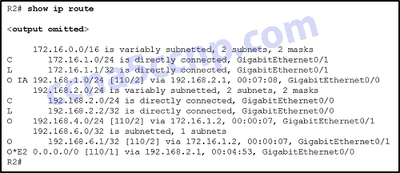
- AThe network was learned from a router within the same area as R2.
- BThe network was learned through summary LSAs from an ABR.
- CThe network can be reached through the GigabitEthernet0/0 interface.
- DThis network should be used to forward traffic toward external networks.
10What routing table descriptor is used to identify OSPF summary networks that originate from an ABR?
- AO
- BO IA
- CO E1
- DO E2
11Which three steps in the design and implementation of a multiarea OSPF network are considered planning steps? (Choose three.)
- AVerify OSPF.
- BConfigure OSPF.
- CDefine the OSPF parameters.
- DGather the required parameters.
- ETroubleshoot the configurations.
- FDefine the network requirements.
12A network administrator is implementing OSPF in a portion of the network and must ensure that only specific routes are advertised via OSPF. Which network statement would configure the OSPF process for networks 192.168.4.0, 192.168.5.0, 192.168.6.0, and 192.168.7.0, now located in the backbone area, and inject them into the OSPF domain?
- Ar1(config-router)# network 192.168.0.0 0.0.0.255 area 1
- Br1(config-router)# network 192.168.4.0 0.0.3.255 area 1
- Cr1(config-router)# network 192.168.4.0 0.0.15.255 area 1
- Dr1(config-router)# network 192.168.0.0 0.0.3.255 area 0
- Er1(config-router)# network 192.168.4.0 0.0.3.255 area 0
- Fr1(config-router)# network 192.168.4.0 0.0.255.255 area 0
13The network administrator has been asked to summarize the routes for a new OSPF area. The networks to be summarized are 172.16.8.0, 172.16.10.0, and 172.16.12.0 with subnet masks of 255.255.255.0 for each network. Which command should the administrator use to forward the summary route for area 15 into area 0?
- Aarea 0 range 172.16.8.0 255.255.255.248
- Barea 0 range 172.16.8.0 255.255.248.0
- Carea 15 range 172.16.8.0 255.255.248.0
- Darea 15 range 172.16.8.0 255.255.255.248
14Which two networks are part of the summary route 192.168.32.0/22? (Choose two.)
- A192.168.31.0/24
- B192.168.33.0/24
- C192.168.37.0/24
- D192.168.35.0/24
- E192.168.36.0/24
- F192.168.38.0/24
15Where can interarea route summarization be performed in an OSPF network?
- AASBR
- BDR
- CABR
- Dany router
16Refer to the exhibit. After attempting to enter the configuration that is shown in router RTA, an administrator receives an error and users on VLAN 20 report that they are unable to reach users on VLAN 30. What is causing the problem?
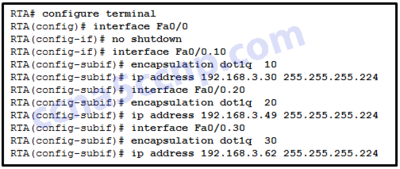
- ADot1q does not support subinterfaces.
- BThere is no address on Fa0/0 to use as a default gateway.
- CRTA is using the same subnet for VLAN 20 and VLAN 30.
- DThe no shutdown command should have been issued on Fa0/0.20 and Fa0/0.30.
17Refer to the exhibit. A network administrator has been asked to summarize the networks shown in the exhibit as part of a multiarea OSPF implementation. All addresses are using a subnet mask of 255.255.255.0. What is the correct summarization for these eight networks?
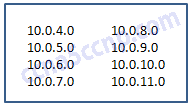
- A10.0.4.0 255.255.0.0
- B10.0.0.0 255.255.240.0
- C10.0.4.0 255.255.248.0
- D10.0.8.0 255.255.248.0
18Refer to the exhibit. Which two statements are correct? (Choose two.)
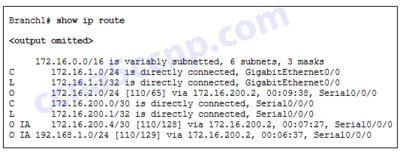
- AThe entry for 172.16.200.1 represents a loopback interface.
- BThe routing table contains routes from multiple areas.
- CTo reach network 172.16.2.0, traffic will travel through the GigabitEthernet0/0 interface.
- DThe routing table contains two intra-area routes.
- ETo reach network 192.168.1.0, traffic will exit via the Serial0/0/0 interface.
19Which command can be used to verify the contents of the LSDB in an OSPF area?
- Ashow ip ospf database
- Bshow ip ospf interface
- Cshow ip ospf neighbor
- Dshow ip route ospf
20Refer to the exhibit. Fill in the blank. Do not use abbreviations.
The [blank_start]network 192.168.10.128 0.0.0.127 area 1[blank_end] command must be issued to configure R1 for multiarea OSPF.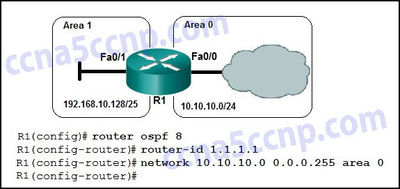
- Anetwork 192.168.10.128 0.0.0.127 area 1
21Match each type of OSPF router to its description. (Not all options are used.)
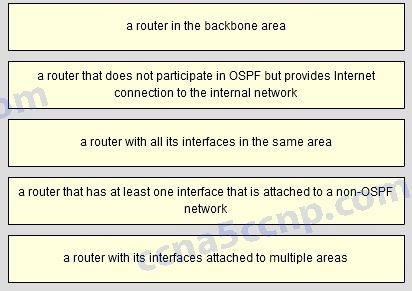
- A_ backbone router _
- B_ internal router _
- C_ Autonomous System Boundary Router _
- D_ Area Border Router _
22Open the PT Activity. Perform the tasks in the activity instructions and then answer the question.
What is preventing users who are connected to router R2 from accessing resources located either within the network 192.168.1.0 or the internet?- AThe default route is not redistributed correctly from router R1 by OSPF.
- BThe interface that is connected to the ISP is down.
- CThe router R2 is not receiving any updates from either router R1 or R3.
- DThe OSPF network statements are misconfigured on one of the routers.
- EThe OSPF timers that are configured on routers R1, R2, and R3 are not compatible.
23Open the PT Activity. Perform the tasks in the activity instructions and then answer the question.
Fill in the blank. Do not use abbreviations.
What is the missing command on router R2 to establish an adjacency between routers R1 and R3?
[blank_start]network 172.16.10.0 0.0.0.255 area 0[blank_end]- Anetwork 172.16.10.0 0.0.0.255 area 0
Información
- Descripción
- sophomore CCNA 3 Test sobre CCNA 3v5.03 Chapter 6, creado por Christina Evans el 28/06/2016.
- Autor
- Christina Evans
- Idioma
- English
- Visitas
- 59
- Etiquetas
- Valoración
- Aún sin valoraciones Valora este test