
Test
Chapter 10- liquids and intermolecular forces
Preguntas del test (69)
11) Crystalline solids __________.
- AA) have their particles arranged randomly
- BB) have highly ordered structures
- CC) are usually very soft
- DD) exist only at high temperatures
- EE) exist only at very low temperatures
2In liquids, the attractive intermolecular forces are __________.
- AA) very weak compared with kinetic energies of the molecules
- BB) strong enough to hold molecules relatively close together
- CC) strong enough to keep the molecules confined to vibrating about their fixed lattice points
- DD) not strong enough to keep molecules from moving past each other
- EE) strong enough to hold molecules relatively close together but not strong enough to keep molecules from moving past each other
3As a solid element melts, the atoms become __________ and they have __________ attraction for one another.
- AA) more separated, more
- BB) more separated, less
- CC) closer together, more
- DD) closer together, less
- EE) larger, greater
4As a gaseous element condenses, the atoms become __________ and they have __________ attraction for one another.
- AA) more separated, more
- BB) more separated, less
- CC) closer together, more
- DD) closer together, less
- EE) larger, greater
5A gas is __________ and assumes __________ of its container whereas a liquid is __________ and assumes __________ of its container.
- AA) compressible, the volume and shape, not compressible, the shape of a portion
- BB) compressible, the shape, not compressible, the volume and shape
- CC) compressible, the volume and shape, compressible, the volume
- DD) condensed, the volume and shape, condensed, the volume and shape
- EE) condensed, the shape, compressible, the volume and shape
66) Together, liquids and solids constitute __________ phases of matter.
- AA) the compressible
- BB) the fluid
- CC) the condensed
- DD) all of the
- EE) the disordered
7Which statement is true about liquids but not true about solids?
- AA) They flow and are highly ordered.
- BB) They are highly ordered and not compressible.
- CC) They flow and are compressible.
- DD) They assume both the volume and the shape of their containers.
- EE) They flow and are not compressible.
8The strongest interparticle attractions exist between particles of a __________ and the weakest interparticle attractions exist between particles of a __________.
- AA) solid, liquid
- BB) solid, gas
- CC) liquid, gas
- DD) liquid, solid
- EE) gas, solid
99) Which one of the following exhibits dipole-dipole attraction between molecules?
- AA) XeF4
- BB) AsH3
- CC) CO2
- DD) BCl3
- EE) Cl2
1010) Which one of the following exhibits dipole-dipole attraction between molecules?
- AA) PH3
- BB) CCl4
- CC) Br2
- DD) CO2
- EE) C10H22
11Of the following substances, only __________ has London dispersion forces as its only intermolecular force.
- AA) CH3OH
- BB) NH3
- CC) H2S
- DD) CH4
- EE) HCl
12Of the following substances, only __________ has London dispersion forces as its only intermolecular force.
- AA) H2O
- BB) CCl4
- CC) HF
- DD) CH3COOH
- EE) PH3
13Of the following substances, only __________ has London dispersion forces as the only intermolecular force.
- AA) CH3OH
- BB) NH3
- CC) H2S
- DD) Kr
- EE) HCl
14Which one of the following should have the lowest boiling point?
- AA) PH3
- BB) H2S
- CC) HCl
- DD) SiH4
- EE) H2O
15Which one of the following should have the lowest boiling point?
- AA) CH3OH
- BB) H2S
- CC) NH3
- DD) HCl
- EE) CH4
16Of the following substances, __________ has the highest boiling point.
- AA) H2O
- BB) CO2
- CC) CH4
- DD) Kr
- EE) NH3
17Of the following substances, __________ has the highest boiling point.
- AA) CH3CH2OH
- BB) C2H6
- CC) N2
- DD) F2
- EE) HOCH2CH2OH
18Of the following, __________ has the highest boiling point.
- AA) N2
- BB) Br2
- CC) H2
- DD) Cl2
- EE) O2
19In which of the following molecules is hydrogen bonding likely to be the most significant component of the total intermolecular forces?
- AA) CH4
- BB) C5H11OH
- CC) C6H13NH2
- DD) CH3OH
- EE) CO2
20Which of the following has dispersion forces as its only intermolecular force?
- AA) CH4
- BB) HCl
- CC) C6H13NH2
- DD) NaCl
- EE) CH3Cl
21When NaCl dissolves in water, aqueous Na+ and Cl- ions result. The force of attraction that exists between Na+ and H2O is called a(n) __________ interaction.
- AA) dipole-dipole
- BB) ion-ion
- CC) hydrogen bonding
- DD) ion-dipole
- EE) London dispersion force
22__________ are particularly polarizable.
- AA) Small nonpolar molecules
- BB) Small polar molecules
- CC) Large nonpolar molecules
- DD) Large polar molecules
- EE) Large molecules, regardless of their polarity,
23The ease with which the charge distribution in a molecule can be distorted by an external electrical field is called the __________.
- AA) electronegativity
- BB) hydrogen bonding
- CC) polarizability
- DD) volatility
- EE) viscosity
24Which one of the following derivatives of ethane has the highest boiling point?
- AA) C2Br6
- BB) C2F6
- CC) C2I6
- DD) C2Cl6
- EE) C2H6
25What is the predominant intermolecular force in CBr4?
- AA) London-dispersion forces
- BB) ion-dipole attraction
- CC) ionic bonding
- DD) dipole-dipole attraction
- EE) hydrogen-bonding
26What is the predominant intermolecular force in CH3CH2OH?
- AA) London-dispersion forces
- BB) ion-dipole attraction
- CC) ionic bonding
- DD) induced dipole-dipole attraction
- EE) hydrogen-bonding
27The intermolecular force(s) responsible for the fact that CH4 has the lowest boiling point in the set CH4, SiH4, GeH4, SnH4 is/are __________.
- AA) hydrogen bonding
- BB) dipole-dipole interactions
- CC) London dispersion forces
- DD) mainly hydrogen bonding but also dipole-dipole interactions
- EE) mainly London-dispersion forces but also dipole-dipole interactions
28Elemental iodine (I2) is a solid at room temperature. What is the major attractive force that exists among different I2 molecules in the solid?
- AA) London dispersion forces
- BB) dipole-dipole rejections
- CC) ionic-dipole interactions
- DD) covalent-ionic interactions
- EE) dipole-dipole attractions
29Hydrogen bonding is a special case of __________.
- AA) London-dispersion forces
- BB) ion-dipole attraction
- CC) dipole-dipole attractions
- DD) ion-ion interactions
- EE) none of the above
30Which one of the following substances will have hydrogen bonding as one of its intermolecular forces?
- A
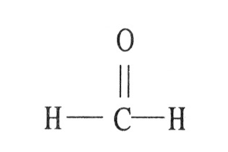
- B
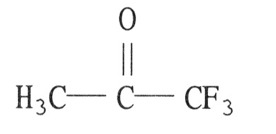
- C
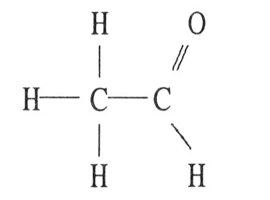
- D
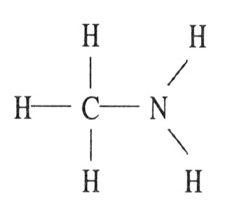
- E
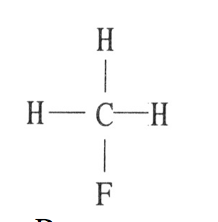
- A
31What intermolecular force is responsible for the fact that ice is less dense than liquid water?
- AA) London dispersion forces
- BB) dipole-dipole forces
- CC) ion-dipole forces
- DD) hydrogen bonding
- EE) ionic bonding
32The predominant intermolecular force in (CH3)2NH is __________.
- AA) London dispersion forces
- BB) ion-dipole forces
- CC) ionic bonding
- DD) dipole-dipole forces
- EE) hydrogen bonding
33The predominant intermolecular force in AsH3 is __________.
- AA) London dispersion forces
- BB) ion-dipole forces
- CC) ionic bonding
- DD) dipole-dipole forces
- EE) hydrogen bonding
34What types of intermolecular forces exist between HI and H2S?
- AA) dipole-dipole and ion-dipole
- BB) dispersion forces, dipole-dipole, and ion-dipole
- CC) dispersion forces, hydrogen bonding, dipole-dipole, and ion-dipole
- DD) dispersion forces and dipole-dipole
- EE) dispersion forces, dipole-dipole, and ion-dipole
35What type(s) of intermolecular forces exist between Cl2 and CO3-2?
- AA) dispersion forces
- BB) dispersion forces and ion-dipole
- CC) dispersion forces, ion-dipole, and induced dipole - induced dipole
- DD) dispersion forces and ion-induced dipole
- EE) dispersion forces, ion-dipole, dipole-dipole, and ion-induced dipole
36What types of intermolecular forces exist between NH3 and CBr4?
- AA) dispersion forces and dipole-dipole forces
- BB) dispersion forces and dipole-induced dipole forces
- CC) dispersion forces and hydrogen bonds
- DD) dispersion forces, hydrogen bonds, and induced dipole-induced dipole forces
- EE) dispersion forces, hydrogen bonds, and dipole-induced dipole forces
37What types of intermolecular forces exist between PH3 and N2?
- AA) dispersion forces and dipole-dipole forces
- BB) dispersion forces and dipole-induced dipole forces
- CC) dispersion forces and hydrogen bonds
- DD) dispersion forces, hydrogen bonds, and induced dipole-induced dipole forces
- EE) dispersion forces, hydrogen bonds, and dipole-induced dipole forces
38Which statements about viscosity are true?
(i) Viscosity increases as temperature decreases.
(ii) Viscosity increases as molecular weight increases.
(iii) Viscosity increases as intermolecular forces increase.- AA) (i) only
- BB) (ii) and (iii)
- CC) (i) and (iii)
- DD) none
- EE) all
39The shape of a liquid's meniscus is determined by __________.
- AA) the viscosity of the liquid
- BB) the type of material the container is made of
- CC) the relative magnitudes of cohesive forces in the liquid and adhesive forces between the liquid and its container
- DD) the amount of hydrogen bonding in the liquid
- EE) the volume of the liquid
40Viscosity is __________.
- AA) the "skin" on a liquid surface caused by intermolecular attraction
- BB) the resistance to flow
- CC) the same as density
- DD) inversely proportional to molar mass
- EE) unaffected by temperature
41How high a liquid will rise up a narrow tube as a result of capillary action depends on __________.
- AA) the magnitudes of cohesive forces in the liquid and adhesive forces between the liquid and the tube, and gravity
- BB) gravity alone
- CC) only the magnitude of adhesive forces between the liquid and the tube
- DD) the viscosity of the liquid
- EE) only the magnitude of cohesive forces in the liquid
42The property responsible for the "beading up" of water is __________.
- AA) density
- BB) viscosity
- CC) vapor pressure
- DD) surface tension
- EE) hydrogen bonding
43Heat of sublimation can be approximated by adding together __________ and __________.
- AA) heat of fusion, heat of condensation
- BB) heat of fusion, heat of vaporization
- CC) heat of freezing (solidification), heat of condensation
- DD) heat of freezing (solidification), heat of vaporization
- EE) heat of deposition, heat of vaporization
44Which of the following statements is false?
- AA) The absolute value of the heat of sublimation is equal to the absolute value of the heat of deposition.
- BB) The heat of sublimation is equal to the sum of the heat of vaporization and the heat of melting.
- CC) The heat of sublimation is equal to the sum of the heat of vaporization and the heat of freezing.
- DD) The absolute value of the heat of sublimation is equal to the absolute value of the sum of the heat of condensation and the heat of freezing.
- EE) The absolute value of the heat of deposition is equal to sum of the absolute value of the heat of vaporization and the absolute value of the heat of freezing.
45The phase changes B → C and D → E are not associated with temperature increases because the heat energy is used up to __________.
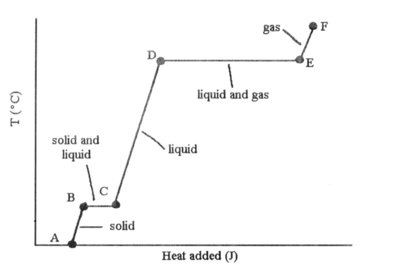
- AA) increase distances between molecules
- BB) break intramolecular bonds
- CC) rearrange atoms within molecules
- DD) increase the velocity of molecules
- EE) increase the density of the sample
46Based on the following information, which compound has the strongest intermolecular forces?
Substance ΔHvap(kJ/mol)
Argon (Ar) 6.3
Benzene (C6H6) 31.0
Ethanol (C2H5OH) 39.3
Water (H2O) 40.8
Methane (CH4) 9.2- AA) Argon
- BB) Benzene
- CC) Ethanol
- DD) Water
- EE) Methane
47Large intermolecular forces in a substance are manifested by __________.
- AA) low vapor pressure
- BB) high boiling point
- CC) high heats of fusion and vaporization
- DD) high critical temperatures and pressures
- EE) all of the above
48The critical temperature and pressure of CS2 are 279°C and 78 atm, respectively. At temperatures above 279°C and pressures above 78 atm, CS2 can only occur as a __________.
- AA) solid
- BB) liquid
- CC) liquid and gas
- DD) gas
- EE) supercritical fluid
49The substance with the largest heat of vaporization is __________.
- AA) I2
- BB) Br2
- CC) Cl2
- DD) F2
- EE) O2
50Of the following, __________ is an exothermic process.
- AA) melting
- BB) subliming
- CC) freezing
- DD) boiling
- EE) All of the above are exothermic.
51Of the following, __________ should have the highest critical temperature.
- AA) CBr4
- BB) CCl4
- CC) CF4
- DD) CH4
- EE) H2
52Of the following, __________ is the most volatile.
- AA) CBr4
- BB) CCl4
- CC) CF4
- DD) CH4
- EE) C6H14
53Of the following, __________ is the least volatile.
- AA) CBr4
- BB) CCl4
- CC) CF4
- DD) CH4
- EE) C6H14
54A volatile liquid is one that __________.
- AA) is highly flammable
- BB) is highly viscous
- CC) is highly hydrogen-bonded
- DD) is highly cohesive
- EE) readily evaporates
55Volatility and vapor pressure are __________.
- AA) inversely proportional to one another
- BB) directly proportional to one another
- CC) not related
- DD) the same thing
- EE) both independent of temperature
56The vapor pressure of a liquid __________.
- AA) increases linearly with increasing temperature
- BB) increases nonlinearly with increasing temperature
- CC) decreases linearly with increasing temperature
- DD) decreases nonlinearly with increasing temperature
- EE) is totally unrelated to its molecular structure
57When the phase diagram for a substance has a solid-liquid phase boundary line that has a negative slope (leans to the left), the substance __________.
- AA) can go from solid to liquid, within a small temperature range, via the application of pressure
- BB) sublimes rather than melts under ordinary conditions
- CC) cannot go from solid to liquid by application of pressure at any temperature
- DD) cannot be liquefied above its triple point
- EE) melts rather than sublimes under ordinary conditions
58The predominant intermolecular force in CaBr2 is __________.
- AA) London-dispersion forces
- BB) ion-dipole forces
- CC) ionic bonding
- DD) dipole-dipole forces
- EE) hydrogen bonding
59Which of the following is most likely to exhibit liquid-crystalline behavior?
- AA) CH3CH2-C(CH3)2-CH2CH3
- BB) CH3CH2CH2CH2CH2CH2CH2CH3
- CC) CH3CH2CH2CH2CH2-Na+
- DD)
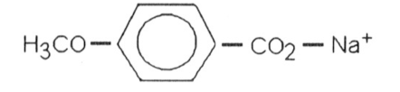
- EE)

60Which of the following characteristics would prevent liquid crystal behavior?
- AA) long axial structure
- BB) ionic configuration
- CC) carbon-carbon single bonds
- DD) double bonding
- EE) polar groups
61Molecules with only single bonds do not generally exhibit liquid-crystalline properties because __________.
- AA) molecules without multiple bonds lack the rigidity necessary for alignment
- BB) molecules without multiple bonds are too small to exhibit liquid-crystalline properties
- CC) molecules with only single bonds are gases
- DD) molecules with only single bonds are too big to exhibit liquid-crystalline properties
- EE) molecules without multiple bonds lack the flexibility necessary for alignment
62Based on molecular mass and dipole moment of the five compounds in the table below, which should have the highest boiling point?
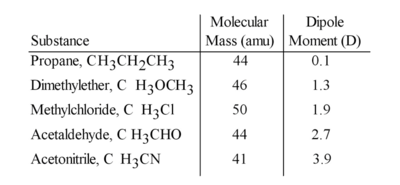
- AA) CH3CH2CH3
- BB) CH3OCH3
- CC) CH3Cl
- DD) CH3CHO
- EE) CH3CN
63The normal boiling point of the substance with the phase diagram shown above is __________°C.
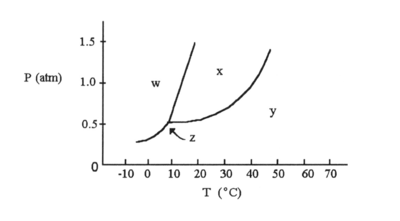
- AA) 10
- BB) 20
- CC) 30
- DD) 40
- EE) 50
64In general, intramolecular forces determine the __________ properties of a substance and intermolecular forces determine its __________ properties.
- AA) Physical, Chemical
- BB) Chemical, Physical
65The direct conversion of a solid to a gas is called __________.
- AA) Evaporation
- BB) Vaporization
- CC) Sublimation
- DD) Condensation
- EE) Deposition
66The boiling points of normal hydrocarbons are higher than those of branched hydrocarbons of similar molecular weight because the London-dispersion forces between normal hydrocarbons are greater than those between branched hydrocarbons.
- ATrue
- BFalse
67The principal source of the difference in the normal boiling points of ICl (97°C; molecular mass 162 amu) and Br2 (59°C; molecular mass 160 amu) is both dipole-dipole interactions and London dispersion forces.
- ATrue
- BFalse
68Heats of vaporization are greater than heats of fusion.
- ATrue
- BFalse
69Under ordinary conditions, a substance will sublime rather than melt if its triple point occurs at a pressure above atmospheric pressure.
- ATrue
- BFalse
Información
- Descripción
- Originally chapter 11
- Autor
- Dawn G
- Idioma
- English
- Visitas
- 886
- Etiquetas
- Valoración
- 5,0 de 5 · 1 valoración Valora este test