
Fichas
Week 8
Fichas del conjunto (50)
- 1What is necrotizing fasciitis?-Bacterium feeds on fascia
-Damage is spread along fascial planes
-Can consume an entire person in hours - 2The neck is divided into fascial compartments. Why?-Ease of movement during movement, swallowing etc.
-Forming natural planes of tissue packing
-Determine the spread of infection - 3What happens if there are infections...? -Between the investing and pretracheal fascia -In the retropharyngeal space -In the head What prevents abscess spread?-Spread to thoracic cavity
-Spread to superior mediastinum
-Inferior spread, posterior to oesophagus
Investing layer helps prevent abscess spread - 4What are the 3 compartments of the thigh? Describe themAnterior: knee extensors. Contain quadriceps
Posterior: knee flexors and hip extensors. Contain hamstrings
Medial: hip adductors. Contain adductors - 5Describe the innervation of the thigh muscular compartmentsAnterior: femoral nerve (L2-4)
Medial: obturator nerve (L2-4)
Posterior: Sciatic nerve (L4-S3) - 6Describe the arterial supply of the high muscular compartmentsAnterior: femoral artery
Medial: obturator artery
Posterior: perforating branches of profunda femoris - 7Describe the superficial muscles of the posterior compartment of the leg-3 muscles: gastrocnemius, soleus and plantaris
-Share a common tendon: tendon calcaneous (AKA. Archilles Tendon)
-Tendon inserts into calcaneous of the foot
-Main action is to plantar flex - 8What are the 4 deep muscles of the posterior compartment of the leg?-Popliteus
-Flexor halucis longus
-Tibialis posterior
-Flexor digitorum longus - 9What are perforating veins?-Connect deep veins to superficial veins
-Allows venous blood to flow from superficial to deep veins - 10What is compartment syndrome? Treatment?-Limb and life threatening condition
-Perfusion pressure falls below tissue pressure in a closed anatomical compartment (ischaemia)
-Blood loss is lost at a capillary level
-Can lead to necrosis and death
-Consequence of decreased compartment size or increased fluid content
Treatment: fasciotomy (relieves tension/pressure) - 11What are the different types of consequences in trauma?Anatomical ie. fracture, dislocation, soft tissue injury
Physiological ie. bleeding/shock, coagulopathy, multiple organ failure - 12What type of energy and anatomy is involved in pelvic fractures?Energy: high
Anatomy: strong bone and ligaments - 13What are the consequences of pelvic fractures?Anatomical: pubic rami fractures, sacro-iliac dislocation, urethral injury
Physiological: haemorrhage and shock, coagulopathy, multiple organ failure - 14What ligaments are associated with the pubic symphysis?Superior pubic ligament
Arcuate ligament - 15What ligaments control sagittal tilt of the spine?Iliolumbar
Sacrospinous
Sacrotuberous - 16What ligaments are associated with the sacroiliac joint?-Anterior sacroiliac ligament
-Interosseous sacroiliac ligament
-Posterior sacroiliac ligament - 17Why may haemorrhage occur in a pelvic fracture?-Pelvic floor is covered by major vascular structures
-Vessels within fractured bones
-Risk of mortality - 18Describe the energy and anatomy needed for a hip fracture What age group commonly gets these?Low energy eg. fall from standing height
Weak bone
The elderly - 19Describe the anatomical and physiological consequences of a hip fractureAnatomical: fracture needing surgery to restore. Mobility is encourage as there is a high risk with bed rest
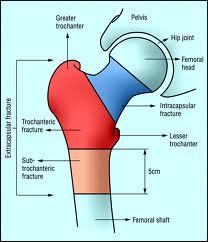
Physiological: frail patients with multiple comorbidities and have little physiological reserve. Cause of fall? - 20What are the types of hip fracture?Blue- intracapsular
Red- trochanteric
Pink- subtrochanteric - 21What does the affected leg look like in a hip fracture?The leg is shorter and externally rotated (hip is less painful in this position)
- 22Which artery is vulnerable in knee dislocation? Why?Popliteal artery
Shearing effect is created in the artery damaging the tunica intima - 23What is a compartment? (ie. in a leg/arm)Group of muscles enclosed by unyielding tissues ie. bone or fascia
- 24What are the consequences of untreated compartment syndrome? What are the complications of fasciotomies?-Muscle wastage
-Myoglobin in urine (from renal failure)
Fractures become open and infected - 25What infections affect the respiratory system?-Bronchitis
-Pneumonia
-TB
-Bronchiectasis
-CF
-Acute exacerbations of COPD/asthma - 26Describe acute bronchitis-Occurs in previously well people
-Cough with(out) sputum
-Viral
-Comes with preceding symptoms - 27Describe recurrent bronchitis-Cough with sputum for more than 2 out of 12 months
-Bacterial
-Underlying sinus infection (facial pain)
-Post-nasal drip
-Bronchiectasis - 28Describe typical community acquired pneumonia (CAP)-Pre-existing disease eg. COPD
-Abrupt onset (1-2 days)
-Purulent sputum (dark green)
-Pleuritic pain (pain in inhalation)
-Marked systemic upset (eg. low BP)
-Localised signs eg. coarse crackles/dullness in lungs
-Responds to beta-lactams eg. penicillin - 29Describe atypical CAP-Previously well
-Insidious onset (7-10 days)
-Dry cough, SoB, wheeze (small airways affected)
-Mild systemic upset
-No response to beta-lactams - 30Describe the aetiology of CAP-Caused by mycoplasma (bacteria without a cell wall) or leigonella
-Has winter peaks
-Can be epidemic
-Related to poor AC in a building - 31For pneumonia to be diagnosed, a CXR should be taken. Describe what is seen when the right upper/middle/lower lobe is affectedR upper: opacity
R middle: loss of R heart border
R lower: loss of R diaphragm. Heart border can be seen - 32What is cavitation?A black patch within a opacity
- 33How is the severity of CAP graded?CURB65 score:
Confusion
Urea
Respiratory rate
-Bp
-65+
-1 point is given for each factor
-Total score is out of 5 (higher the score, more intensive treatment is needed) - 34What are the complications of CAP?-Respiratory failure
-Lung abscess
-Parapneumonic effusion - 35What are the different severities of parapneumonic effusion?Simple: clear fluid like water. Clears on its own
Complex: opaque, soup consistancy. Chest drain needed
Empyema: thick liquid (like custard). Surgical intervention necessary - 36What is a loculated effusion?-Effusion is only partially drained
-Fluid collects due to fibrous scar tissue in the pleural cavity - 37How is empyema managed?Antibiotics eg. penicillins
Drainage
Surgery:
-break adhesions
-decortication (remove entire pleura)
-open drainage into a bag - 38Describe TB-Caused by M. Tb
-Night sweats, fever
-Weight loss
-Productive cough ie. coughing up mucus/sputum
-Haemoptysis
-Is either latent or active
-Upper lung zone shadowing is seen - 39How is TB diagnosed?-Test sputum
-Aspirate lymph nodes if involved
-Bronchoscopy
-Test for HIV
-Test Vit. D levels (deficiency is highly associated with TB)
Ask about: travel (to S. Asia/Sub-Saharan Africa), social factors, HIV - 40TB can spread via the blood. What other systems can it spread to?-Meninges (headaches, neck stiffness)
-Musculoskeletal (damage to vertebrae/intervertebral discs)
-Genitourinary
-Gastrointestinal (affects peritoneum: ascites, pain, stiffened peritoneum)
-Pericardial (pericardial effusion) - 41How can TB be controlled?-Public health campaigns
-Housing/overcrowding
-Nutrition, child health
-Immunisation (current vaccine only covers a few strains)
-Chemoprophylaxis (preventative treatment for those with latent TB who are asymptomatic) - 42What is bronchiectasis?-Chronic bronchial dilation
-Poor mucus clearance
-Recurrent/chronic infection
*cycle repeats
Associated with:
-chest crackles on inspiration and expiration
(-clubbing of fingers)
-large volume of phlegm coughed up everyday - 43Describe the aetiology of bronchiectasis-Post-infective
-Aspiration of stomach contents
-Mechanical deficiency
-Immune deficiency
-RA, IBD
-Poor mucociliary clearance (CF, primary ciliary dyskinesia) - 44Describe the investigations for bronchiectasisCXR/HRCT
Sputum culture - 45How is bronchiectasis managed?-Physiotherapy (huffing, flutter device, postural drainage)
-Bronchodilators (airways are prone to collapse on expiration
-Antibiotics (nebulised, inhaled or oral macrolides) - 46Describe CF-Autosomal recessive (mutation: deletion of F508 gene)
-Impaired mucus clearance leads to bronchiectasis
-Obstruction of pancreatic duct leads to diabetes and nutritional abnormalities
-Infertility due to obstruction of male reproductive tract
-Focal biliary cirrhosis - 47What investigations are carried out for CF? How is it managed?-Sweat test (saltier than normal)
-Genetic testing
-Manage bronchiectasis
-Pancreatic enzyme suppliments
-Insulin
-Lung transplantation if type 2 respiratory failure occurs - 48Describe the exacerbations caused by COPD-Increased breathlessness
-Green sputum
-Increased sputum volume - 49In AECOPD, what happens if admitted to the hospital?-CXR
-Blood gases if saturation < 92% (possible respiratory failure)
-ECG (higher risk of heart attack)
-DECAF score (predicts mortality) - 50What happens in exacerbations of asthma?-Often viral or allergic (can be bacterial)
-Steroids are used as treatment
-Monitor PEFR
-If hospitalised, must be off the nebuliser for 24 hours before discharge
Información
- Descripción
- Muscular Fascial Compartments and Venous Drainage Lower limb trauma
- Creado por
- Dolu Falowo
- Visitas
- 10
- Valoración