
Lower Limb
80 resources created by 56 users
This Lower Limb page on GoConqr gathers community-made quizzes, mind maps, flashcards, notes and slide sets, from the bones of the lower limb and the hip joint to the knee, ankle and sole of the foot. It's built for university students testing what they know and teachers after ready-made material. There are over 550 resources here, including more than 130 quizzes, over 170 mind maps and more than 230 flashcard decks. Pick a topic, try a quiz, then see what you can recall.
Top Lower Limb resources
-
53 questionsArthrology, Myology - Part 1 (b) The pulse of the femoral artery is best felt at which superficial reference point?
-
41 cardsBones and Joints of the Lower Limb What are the four parts of the lower limb? Define each part.
-
37 questionsQuiz - Muscles Lower Limb (Insertions and Origins) Quiz - Muscles Lower Limb (Insertions and Origins)
-
18 questionsMerrill's Chapter 6 Lower limb
-
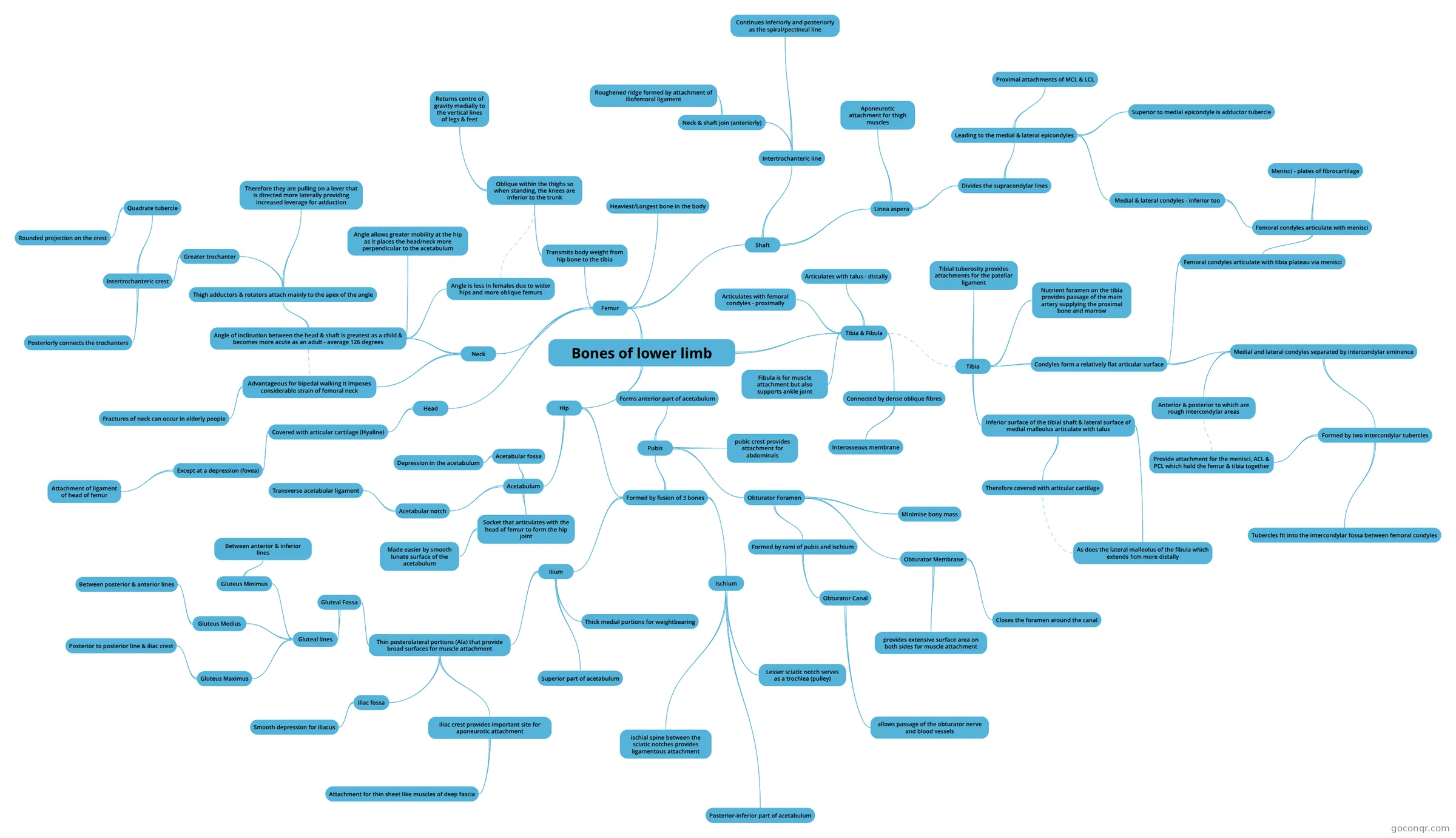 Mind map Bones of lower limb
-
40 questionsmuscle identification - lower limb (labelling) Label the diagram
-
6 questionsHip Muscles What are the hip flexors?
-
6 cardsDeep Hip Rotators (PQGOGO) Origin, Insertion, Function, Innervation
Quizzes
See all 19 quizzes-
53 questionsArthrology, Myology - Part 1 (b) The pulse of the femoral artery is best felt at which superficial reference point?
-
37 questionsQuiz - Muscles Lower Limb (Insertions and Origins) Quiz - Muscles Lower Limb (Insertions and Origins)
-
18 questionsMerrill's Chapter 6 Lower limb
-
40 questionsmuscle identification - lower limb (labelling) Label the diagram
-
6 questionsHip Muscles What are the hip flexors?
-
7 questionsLigaments of the joints of the lower limb Identify the ligaments
-
8 questionsMuscles of Leg what muscle is this?
-
2 questionsAnatomy practical #2 practice Where is the Linea Aspera?
Mind maps
See all 23 mind maps-
Bones of lower limb
-
VENOUS DRAINAGE OF THE LOWER LIMBS
-
Ahmad Can't Run
-
Anatomy Lower body
-
Swelling in the Leg
-
Fatimah's Soft Bones
-
A swelling in the leg
-
 Gluteal region, posterior thigh and popliteal fossa (bones and landmarks) Mind Map on Gluteal region, posterior thigh and popliteal fossa, created by Thin Kyi Phyu Naing on 03/27/2017.
Flashcards
See all 37 flashcards-
41 cardsBones and Joints of the Lower Limb What are the four parts of the lower limb? Define each part.
-
6 cardsDeep Hip Rotators (PQGOGO) Origin, Insertion, Function, Innervation
-
5 cardsLower Limb - ANTERIOR AND MEDIAL THIGH
-
4 cardsKnee Joint (Ligaments) Which Ligament is this?
-
15 cardsCSB531 Accessory Bones
-
65 cardsWeek 6 Describe the hip joint
-
50 cardsWeek 8 What is necrotizing fasciitis?
-
53 cardsUnit 3 OIAs OIAs of pelvis and lower limb/foot
Notes
More Anatomy topics
About Lower Limb
GoConqr OriginalWhat the page covers
The resources follow the limb from the pelvis down to the toes. You will find bones, joints, ligaments, muscles, nerves and blood vessels, all made by GoConqr users rather than by GoConqr itself.
- Bones and joints: the mind map Bones of lower limb covers the hip, acetabulum, tibia and fibula, and notes how the acetabulum forms from three fused bones.
- Muscles: from the hip and thigh to the leg and the intrinsic muscles of the foot.
- Vessels and nerves: venous drainage, the femoral triangle, the femoral nerve and the popliteal fossa.
Where to start
Begin with the bones. Open the Bones of lower limb mind map, then try the quiz pelvic girdle/lower limb, which asks you to label the pelvis, femur, tibia, fibula and tarsals. Once the framework feels familiar, move to the joints with Ligaments of the joints of the lower limb, where you name each ligament in full.
Muscles next
Muscles take the most repetition. The quiz Quiz - Muscles Lower Limb (Insertions and Origins) uses fill-in-the-blank questions, such as the origin and insertion of tibialis anterior. The Deep Hip Rotators flashcard deck lists piriformis, quadratus femoris, both gemelli and the obturators with origin, insertion and function. Then try the labelling quiz muscle identification - lower limb (labelling) and Hip Muscles, which groups the flexors, adductors, rotators, abductors and extensors.
Using quizzes and maps together
Read a mind map first, such as Anatomy of the knee or Anatomy of the hip. Close it, then take a quiz on the same region and note what you missed. Return to the map for those gaps. Clinical maps like Painful Knee and Swelling In The Leg help you apply what you have learned.
Where it fits
This unit sits in the strand Regional Anatomy: Trunk and Limbs, within Anatomy. Teachers can set a quiz or a flashcard deck as ready-made practice for a class.
Choose one region, take a quiz, and then build your own maps and flashcards for the parts you want to revisit.
Frequently asked questions
Which resource should I open first?
Start with the Bones of lower limb mind map to see the framework, then take the quiz pelvic girdle/lower limb to label the pelvis, femur, tibia, fibula and tarsals. After that, move on to the ligament and muscle quizzes once the bones feel familiar.
What do the mind maps cover?
The mind maps cover bones, the hip joint, the knee, the ankle and foot, thigh and leg muscles, venous drainage and nerve supply. Some are clinical, such as Painful Knee and Swelling In The Leg, so you can link structure to a patient scenario.
Are the resources free to use?
Yes. Every resource on this page is free to open, study and take, with no account needed. They were made by GoConqr users, not by GoConqr. A free account also saves your quiz scores and lets you make your own quizzes, mind maps, flashcards and notes.
Who are these resources for?
They suit university students who want to practise labelling, origins and insertions, and joint structures. Teachers can use them as ready-made material for a class. Nearly all of the resources are at university level.
Is there a quiz for muscle origins and insertions?
Yes. Quiz - Muscles Lower Limb (Insertions and Origins) uses fill-in-the-blank prompts, for example tibialis anterior. The Deep Hip Rotators flashcard deck also gives origin, insertion and function for each of the six muscles.
What if the topic I need is missing?
Look at the neighbouring regions first, since the hip, thigh, knee, leg, ankle and foot are each covered by several resources. If you still cannot find it, you can make your own quiz, mind map, flashcards or notes for that topic.