
Fichas
Normalisation
Fichas del conjunto (23)
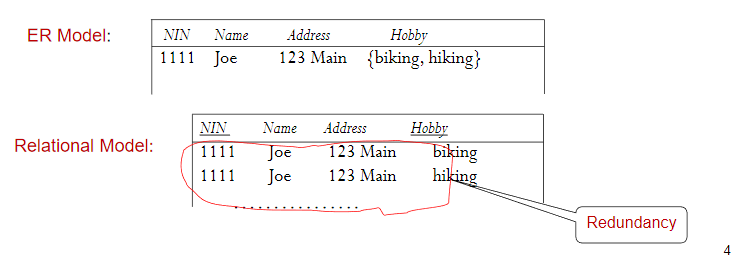
- 1What is the purpose of normalisation? Why do we need to avoid redundancy?Purpose: every relation represents a real world entity
Single valued columns
avoid redundancy
data is easy to update correctly and avoid anomalies
Redundancy:
-Minimise amount of space required
-Simplify maintenance of database
exception (foreign keys) - 2What is one cause of redundancy?-Set valuedd attributes in the ER diagram can result in multiple rows in the corresponding table
- 3What is another cause of redundancy?Dependencies between attibutes can cause redundancy
eg: all addresses in the same town have the same zip code. - 4What are: 1. Modification anomaly 2. Deletion anomaly 3. Insertion anomaly1. Failure to maintain all existing instances of a specific value
2. Losing other values as a side effect when you delete data - eg deleting Top Gun from video list at blockbuster. What genre is it now?
3. Inconsistency caused by adding a new item - eg collection of blockbuster videos. Top Gun classed as action. add new video, class Top Gun as mystery. Which is it? - 5How to avoid modification, insertion, or deletion anomalies?-Decompose the table into two tables. This is called schema refinement
- 6What is a functional data dependency?-Describes the relationship among attributes in the same relation
-Let A and B be two sets of attributes. A is functionally dependent on B (B->A) if each value of B is associated with exactly one value of A. - 7What are full, partial, and transitive functional dependencies?Full: A->B. B is functionally dependent on A, but not on any proper subset of A
Partial: A->B. B functionally dependent on A and on at least one proper subset of A
Transitive: A->B and B->C, then A->C. - 8What is the closure of F?F^+. The set of all functional dependencies that are implied by the dependencies in F.
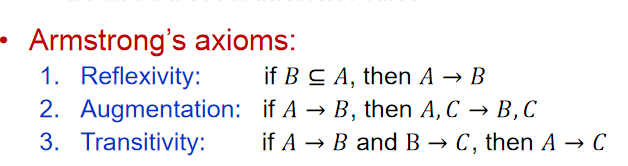
- 9Define Armstrong's Axioms.
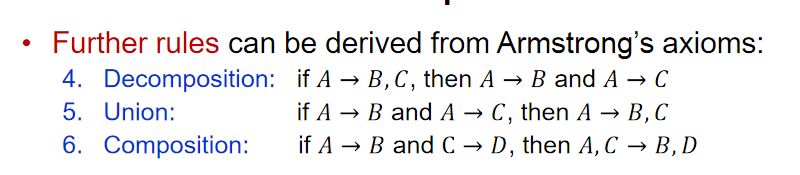
- 10What are the further rules that can be derived from Armstrong's axioms?
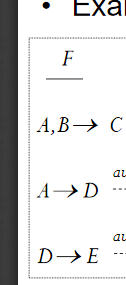
- 11Compute the closure of this set of dependencies
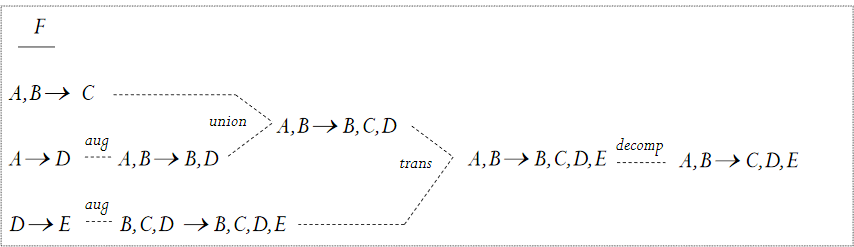
- 12What is a candidate key? How can we choose a primary key from them?-Minimal set of attributes which functionally determine all attributes in a relation
-Among all candidate keys, we can choose any one of them as the primary key. - 13How to bring a table in First Normal Form?- Table is in 1NF if it has no repeating groups (every cell has one value), no identical rows.
-Can "fill in the blanks" by entering appropriate data in the empty columns (but introduces a lot of redundancy).
-Or can place repeating data in separate relation, place copy of the original primary key in new relation which now becomes foreign key. - 14Flatten this table:
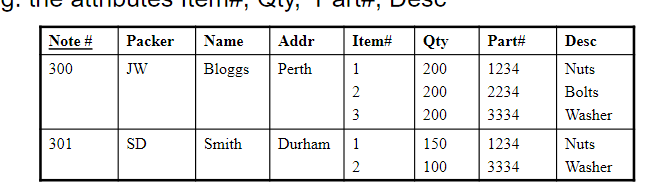
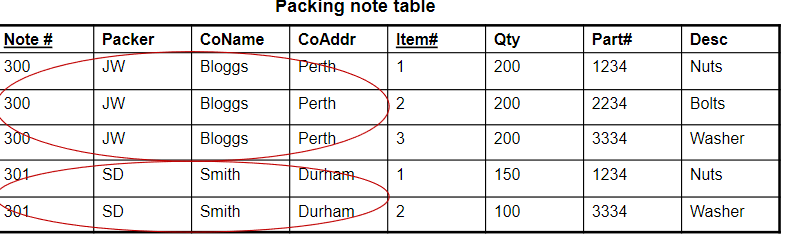
- 15Put this table in 1NF by using two-tables. Label FK and PK of new table
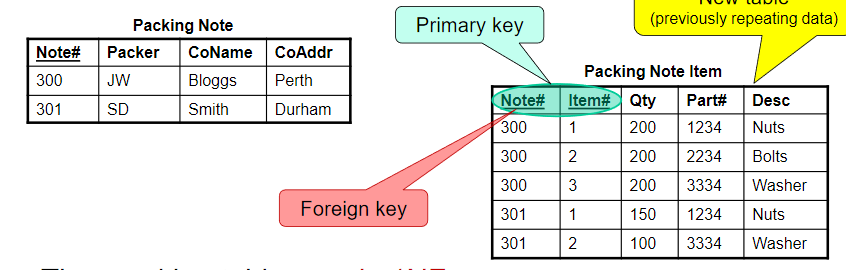
- 16When is a table in 2NF?-If it is in 1NF and nthere are no partial functional dependencies (ie every non-key attribute is dependent on the whole primary key).
-Applies to relations with composite keys, if relation has a single primary key, the table is in 2NF if it is in 1NF - 17How do you bring a table into 2NF?-Remove partially dependent attributes, place them in a new relation, along with a copy of their determinant.
- 18Is this in 2NF?

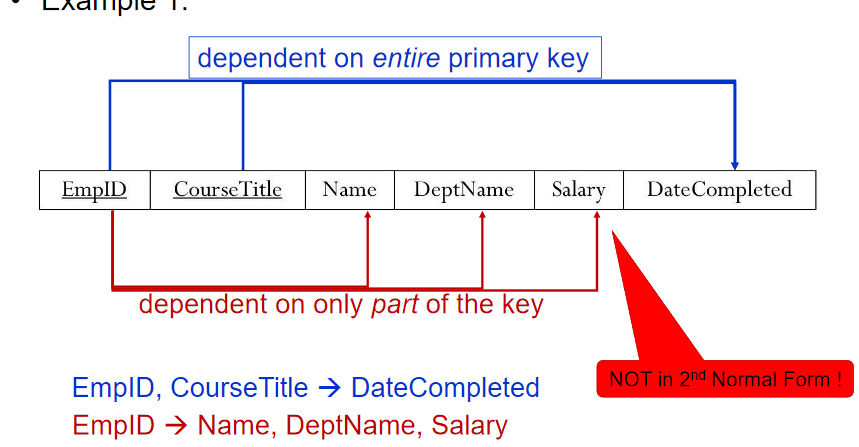
- 19Convert to 2NF
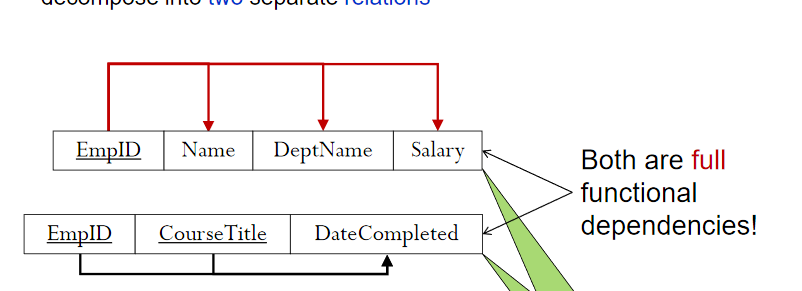
- 20Convert to 2NF

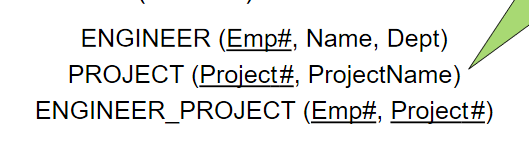
- 21When is a table in 3NF?-If it is in 2NF and there are no transitive functional dependencies (ie no non-key attribute is transitively dependent on the primary key)
- 22How do you bring a table into 3NF?-Remove transitively dependent attributes
-Place them in a new relation
-Take the attributes of their determinant as the PK in a new table - 23Convert to 3NF

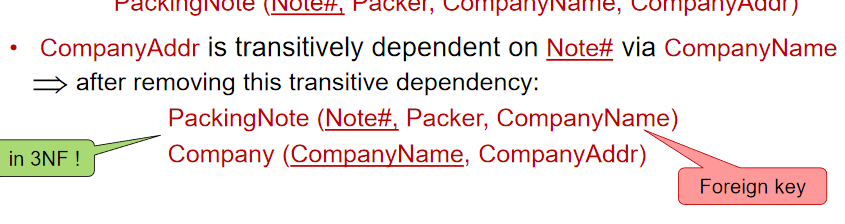
Información
- Descripción
- Fichas sobre Normalisation, creado por SEZ McKelvey el 06/04/2018.
- Creado por
- SEZ McKelvey
- Visitas
- 2
- Valoración