
Relational Model, Relational Algebra and Normalization
83 resources created by 71 users
This Relational Model, Relational Algebra and Normalization page on GoConqr gathers community-made quizzes, mind maps, flashcards and notes, from relational database terms and keys to relational algebra symbols and the normal forms. It's built for university students filling gaps, school students revising a topic, and teachers after ready-made material. There are over 80 resources here, including more than 20 quizzes, over 30 mind maps and more than 20 flashcard decks, mostly at university level. Pick a quiz to find your gaps, then explore the maps.
Top Relational Model, Relational Algebra and Normalization resources
-
41 questionsChapter 3 (Multiple Choice) CIS 3365
-
42 questionsChapter 6 (Multiple Choice CIS 3365)
-
30 questionsChapter 3 (True/False) 1) The practical significance of taking the logical view of a database is that is serves as reminder of the...
-
11 questionsNormalization Practice In which state are the attributes shown (see table)?
-
Mind map First Normal Form (1FN) Mapa mental Primera Forma Normal(Normalización).
-
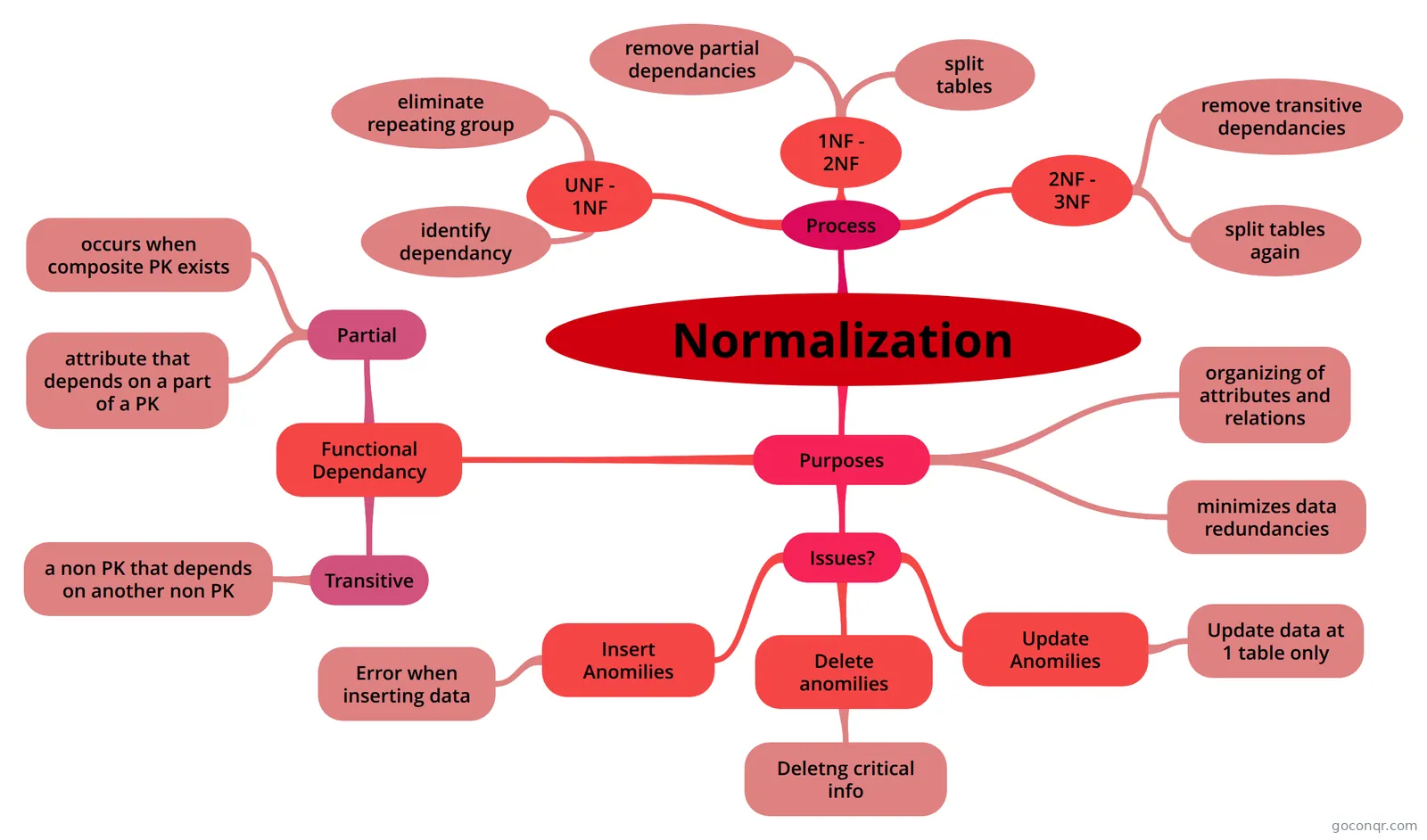 Mind map Normalization
-
8 cardsRelational Algebra Symbols shows basic relational algabra symbols and names.
-
38 questionsChapter 2 The classical/elementary types of file organization include:
Quizzes
See all 21 quizzes-
41 questionsChapter 3 (Multiple Choice) CIS 3365
-
42 questionsChapter 6 (Multiple Choice CIS 3365)
-
30 questionsChapter 3 (True/False) 1) The practical significance of taking the logical view of a database is that is serves as reminder of the...
-
11 questionsNormalization Practice In which state are the attributes shown (see table)?
-
38 questionsChapter 2 The classical/elementary types of file organization include:
-
13 questionsQ14 What best matches with the Relational Database Terminologies A, B, and C depicted in the representation below?
-
6 questionsUML Lec4 Quiz The process of normalisation involves applying a series of refinements to groups of data items in order to ...
-
13 questionsChapter 3 1.)A table is in NF3 if:
Mind maps
See all 32 mind maps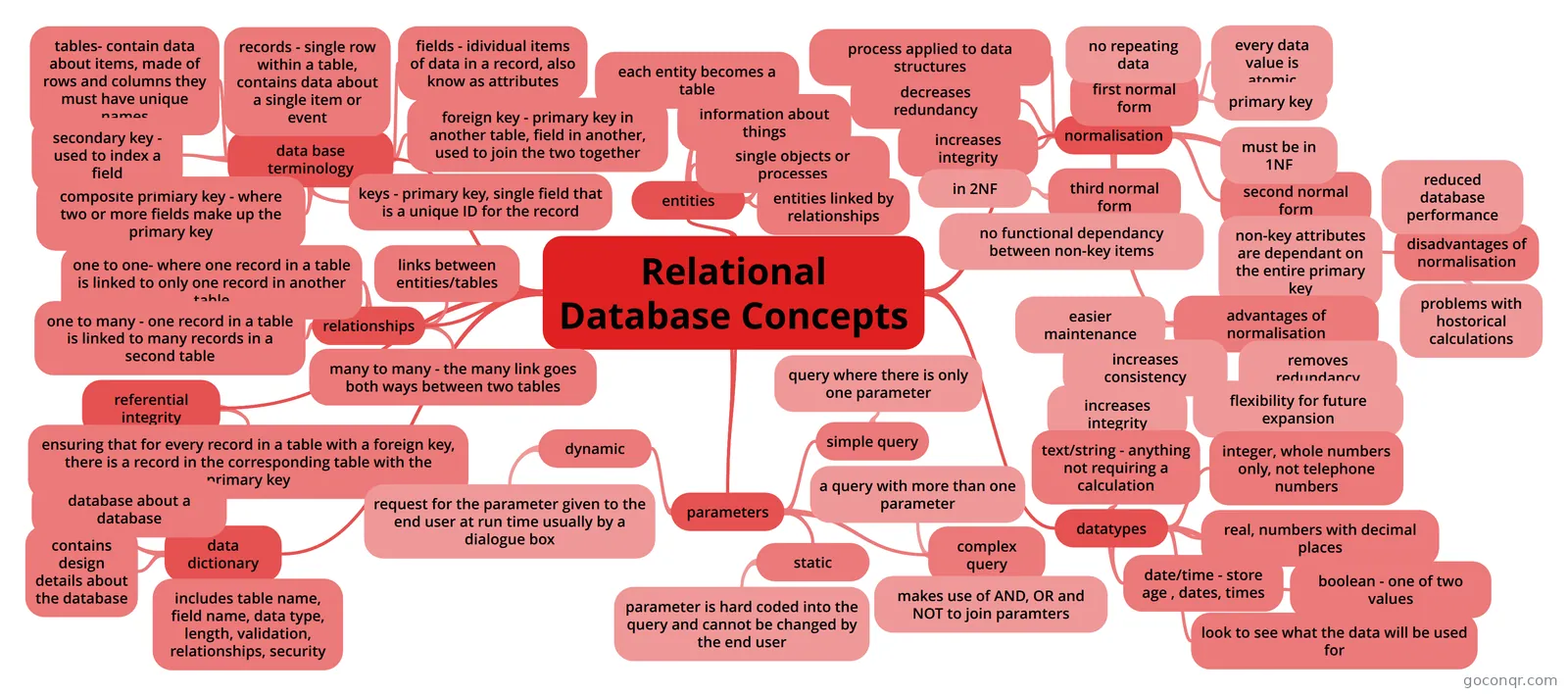
Flashcards
See all 21 flashcardsMore Databases and data science topics
About Relational Model, Relational Algebra and Normalization
GoConqr OriginalWhat this page covers
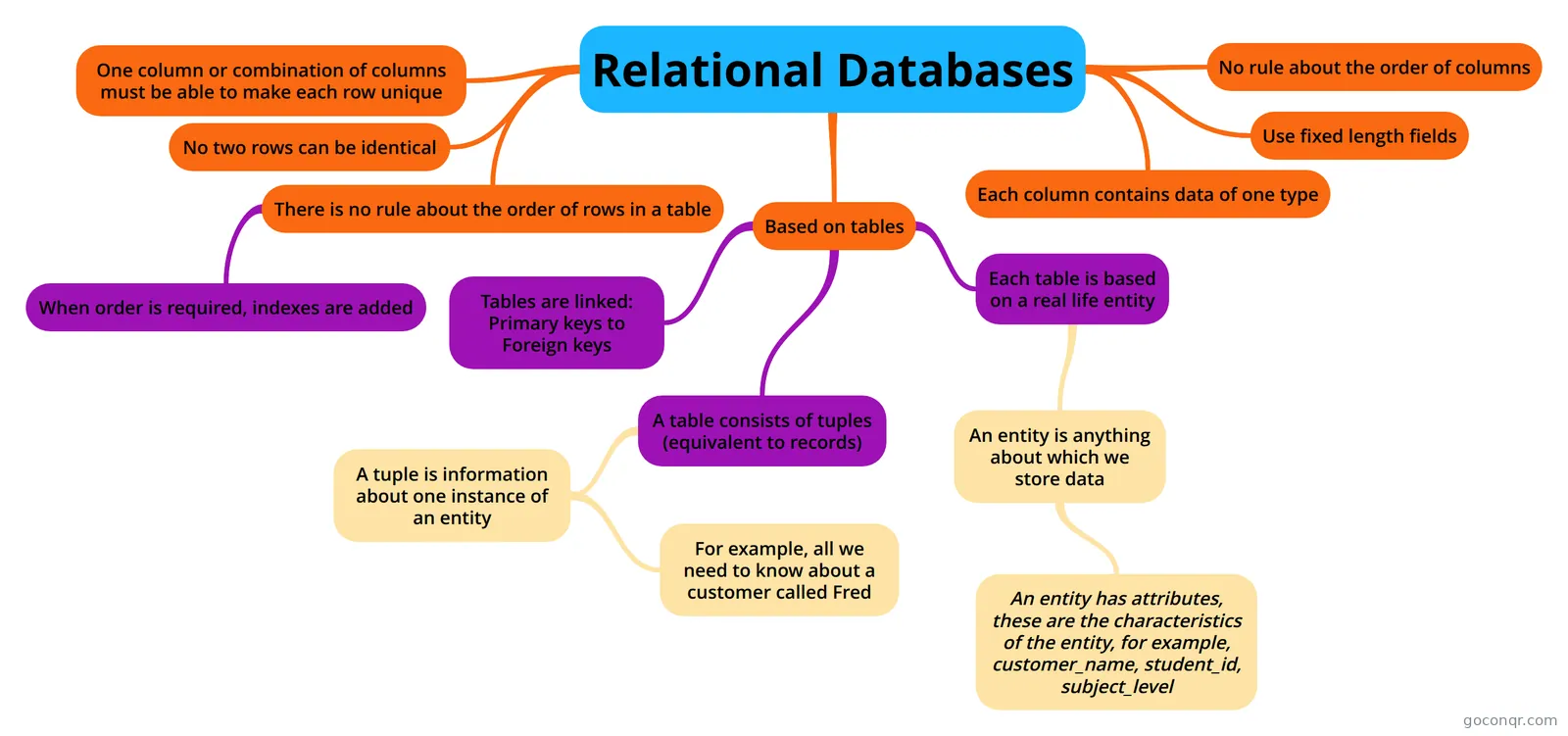
The resources here follow the unit from the basic ideas of the relational model through to normalisation. Mind maps such as Relational Database Concepts cover terminology: tables, records, unique names and keys. Others, such as Primary and foreign keys and DB Codd Rules, narrow in on specific ideas.
Relational algebra
The flashcard deck Relational Algebra Symbols pairs each symbol with its operation: selection, projection, union, set difference, intersection, natural join, rename and cartesian product. Another deck, SCC 201- Lecture 3 - Relational algebra, is a good follow-up once the symbols feel familiar.
Normalisation
Normalisation has the largest group of resources. The Normalization mind map explains the purpose: organising attributes and relations, and reducing redundancy and delete, update and insert anomalies. The First Normal Form (1FN) map lists the steps, such as removing repeating groups and creating a separate table for each group of related data. There are also decks on second and third normal form, plus notes on the Boyce Codd Model.
A sensible order
- Start with a relational model mind map to learn the vocabulary.
- Move to the flashcards on keys and relational algebra symbols.
- Read the normalisation maps, from first normal form onwards.
- Test yourself with Normalization Practice, which asks you to spot partial and transitive dependencies and name the state a table is in.
Quizzes such as the multiple-choice and true/false sets on chapters 3 and 6 give a quick check on definitions. If you miss a question, go back to the matching map and read that branch again. Doing it in that loop makes the gaps easier to see.
Where it sits
This unit belongs to the strand Relational Model and Database Design, within Databases and data science. It is mostly university material, with some resources suited to school students. Open a quiz now, then use what you find to choose your next map or deck.
Frequently asked questions
Which resource should I start with?
Start with a mind map such as Relational Database Concepts to get the terms straight: tables, records, keys. Then try the Normalization Practice quiz, which asks about partial and transitive dependencies. If a question trips you up, return to the matching normalisation map.
What do the mind maps cover?
They cover the relational model, keys, Codd's rules, and the normal forms. The Normalization map explains purposes and the three kinds of anomaly. The First Normal Form (1FN) map lists the steps for removing repeating groups. Other maps cover second and third normal form, and the benefits of normalisation.
Is there anything on relational algebra?
Yes. The Relational Algebra Symbols flashcard deck covers selection, projection, union, set difference, intersection, natural join, rename and cartesian product. There is also a deck from a lecture on relational algebra, and a flowchart on the topic, which are useful for revising the operations.
Are the resources free, and who made them?
Every resource listed here is free to open, study and take, with no account needed. They were made by GoConqr users, not by GoConqr itself. A free account saves your quiz scores and lets you make your own quizzes, maps, flashcards and notes.
Who are these resources for?
Most are at university level, so they suit university students most. Some suit school students revising database topics, and teachers can use the quizzes, maps and flashcards as ready-made material for lessons or practice.
What if I cannot find what I need?
Try a nearby resource first. Normalisation appears in maps, flashcards and quizzes under several titles, so a different name may match your course. You can also build your own mind map or flashcard deck on the missing topic.