
Fichas
PSY247: spatial vision
Fichas del conjunto (12)
- 1Explain central surround antagonismA ganglion cells receptive field has two concentric regions. For on-centre light on inner increases firing but light on outer increases. The final response is the sum of this inhibition/excitation. Off centre cells are the opposite!
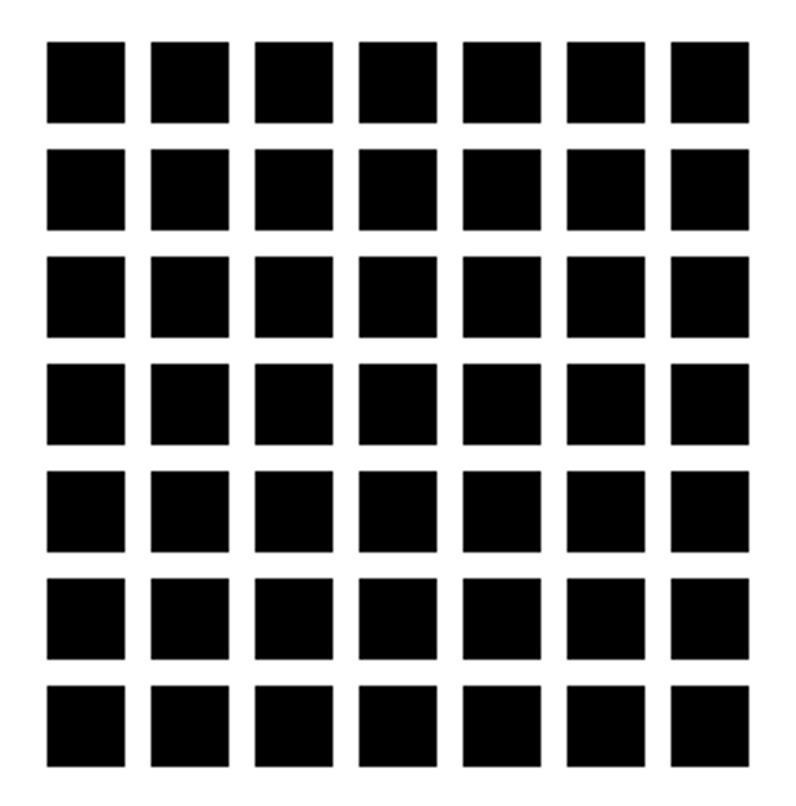
- 2What does central surround antagonism allow us to do? How does it explain the Herman's grid illusion?sensitive to change, edges and contrast.
cells at intersections are more inhibited than cell at bar but equal center excitation.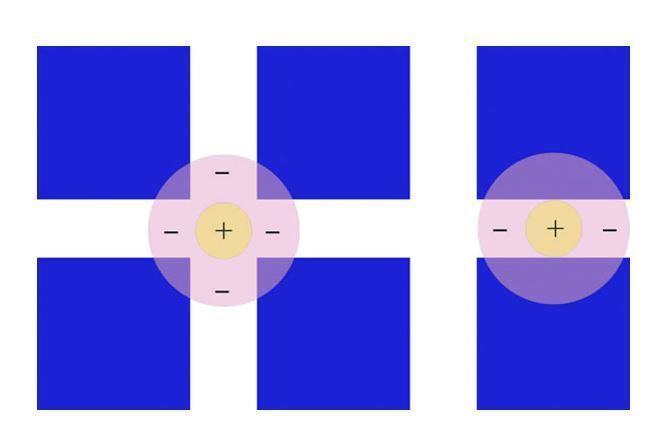
- 3What are the properties of the LGN?- similar to ganglion cells (RF)
- 6 retinotopic major layers
- all cells are monocular; 1,4,6 contralateral, 2,3,5 ipsilateral
- only one visual hemifield
- magnocellular (big cells, 1-2) vs Parvocellular (small) - 4What do we know about the V1 and its organisation?the V1 is retinotopic, cortical magnification,selectivity; orienation, eye of origin. organised into orientation columns, and ocular dominance (column eye specific). made of simple, complex and hyper-complex cells.
- 5How does vision act like a filter?Vision acts like a filter for many categories simultaneously
- 6what are simple cells and how are they built?simple cells respond to orientated stimulus that falls on a specific location on receptivr field. Built from outputs of retinal ganglion cells.
- 7what do complex cells do? how are they built?complex cells respond to orientated stimulus from anywhere within their receptive field.
built of inputs from simple cells with same orientation but diff edge locations. - 8How do hypercomplex cells work? why can we see a triangle here?hypercomplex cells respond like simple and complex cells but to particular edges/ lengths.
the are built by connecting diff complex cells, with ends 'stopped' by inhibitory ones. hence we can almost see edges that aren't there. Interconnected cells fire at contrast regardless of 'actual' edge present.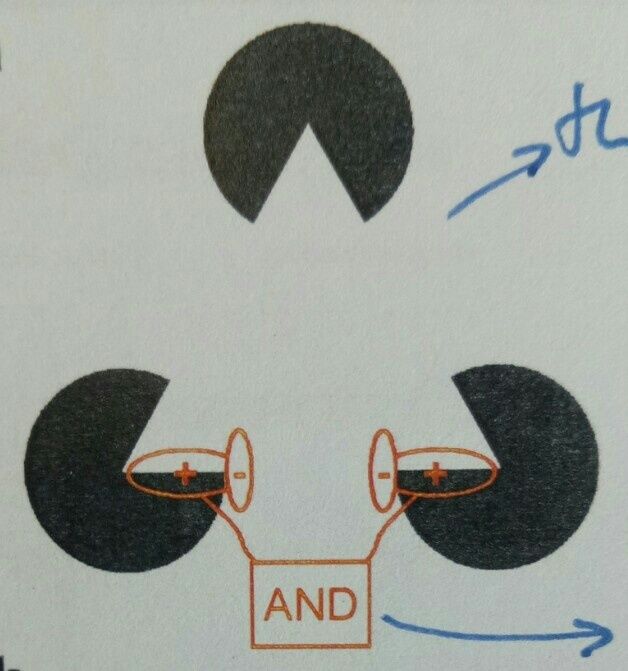
- 9how do orientation channels work? Explain the tilt after effect.orientation cells resupond strongest to preferred orientation but also somewhat to surrounding Os. this allows us to detect Os without specific cell; population coding. after continuous firing cells tire and adapt. When orientation changes to another nearby adapted cells don't fire at usual rate.and so our perception is distorted.
- 10What are spatial frequency channels?tuned to 'size'. tuned to specific sine wave frequency. represent how much light/ pairs of light dark stripes (gratings) can fit in a degree of visual space. high freq= small stripes etc.
- 11what's with vision, gratings and fourier analysis? How do we build a whole image?in vision (like audition) an image can be broken into sine wave components (freq, phase, orientation, contrast). in vision sine waves are pictured as gratings. each image has info at multiple spatial scales. we combine infor from high and low SFs to create a whole image.
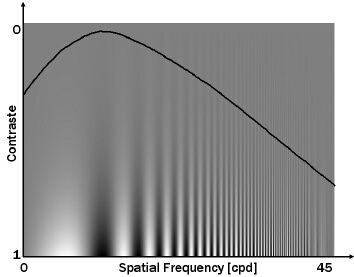
- 12according to contrast sensitivity function (CSF) what are we best at seeing?we are best at seeing high contrast intermediate spatial frequencies.
Información
- Descripción
- (Vision) PSY247 Fichas sobre PSY247: spatial vision, creado por Bridonie Nicholson el 15/04/2018.
- Creado por
- Bridonie Nicholson
- Visitas
- 1
- Valoración