
Fichas
Sin título
Fichas del conjunto (54)
- 1Forces are caused by particle ______exchange
- 2what are exchange particlesvirtual photons, virtual because we cannot detect them directly.
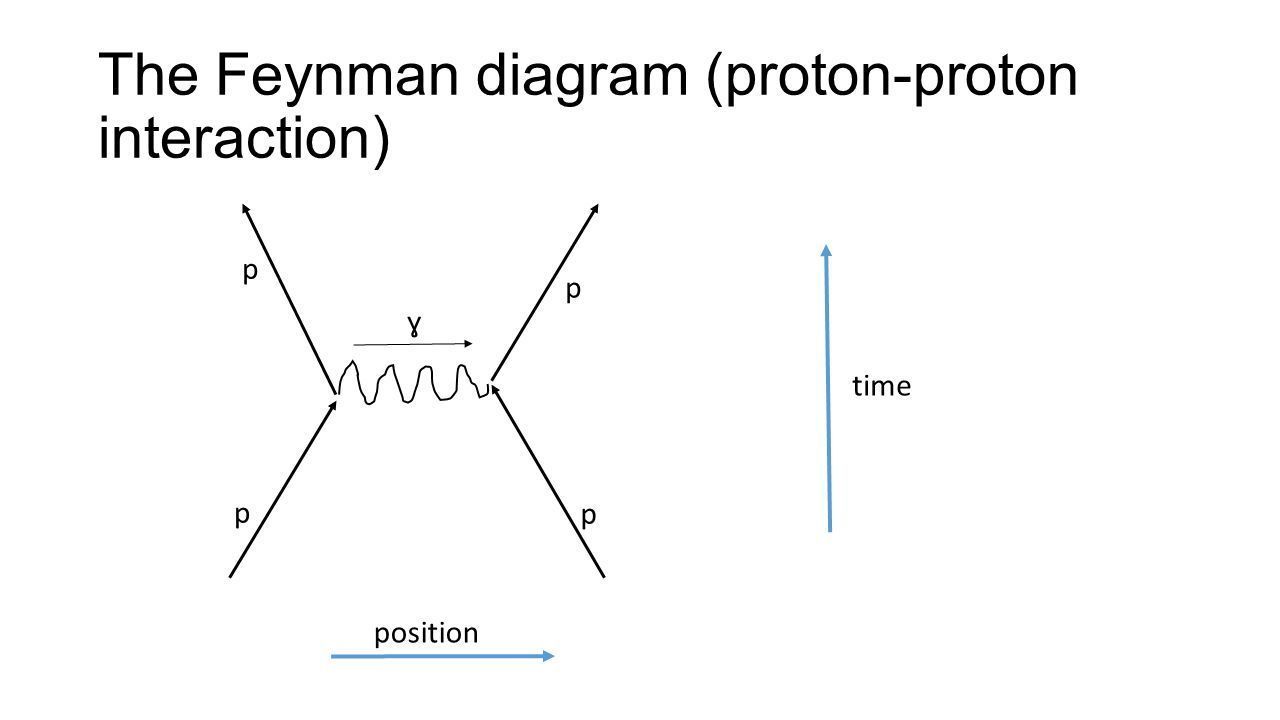
- 3diagram for electromagnetic force between 2 protons
- 4describe the interaction model in terms of 2 people on skateboards facing each other and throwing a ball to one anotherthe thrower recoils when the ball leaves their hands, the other person recoils when they catch the ball. the ball transfers momentum from the thrower to the catcher so they repel each other.
this only works with the exchange of a virtual photon between 2 like-charged particles.
for 2 oppositely charged particles it would need to be changed to a boomerang so the thrower and catcher attract one another - 5what are gauge bosonsvirtual particles/exchange particles - found in repulsion between 2 protons
- 6what is the weak nuclear forcethe force responsible for beta-decay.
- 7what are the 4 fundamental forces? and what are their gauge boson & the particles affected by them?- electromagnetic force:
gauge boson = virtual photon
particles affected = charges particles only
-Weak foce:
gauge boson = W+, W-
particles affected = all types
-Strong force:
gauge boson = pions (π+, π-, π0)
particles affected = hadrons only
pions are described as being exchanged between nucleons or gluons being exchanged between quarks
-gravity:
gravity only really matters with big masses like stars and planets - 8the larger the mass of the gauge boson, the ________ the range of the forceshorter
- 9does the weak force have a long or short range?very short, as W bosons have a mass of about 100 x that of a proton
- 10the photon has zero mass so the force has ________ rangeinfinite
- 11in feynmann diagrams what are gauge bosons represented bywiggly lines
- 12feynmann diagram for electromagnetic repulsion between 2 electrons and 2 positronsthis is for 2 electrons, it is the same for 2 positrons but the
-ve signs are changed to +ve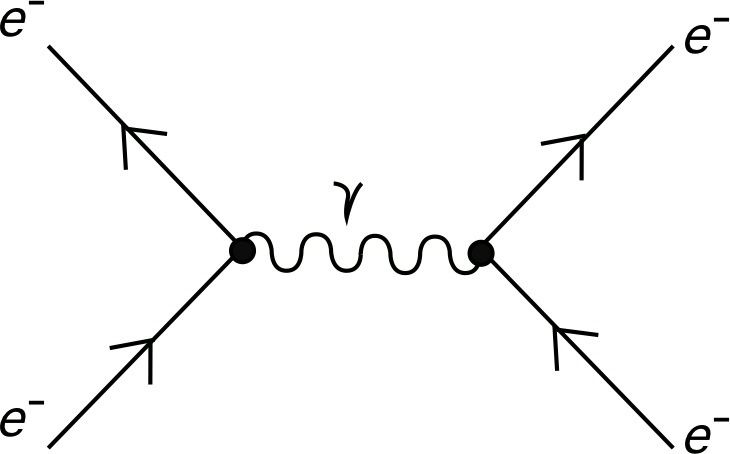
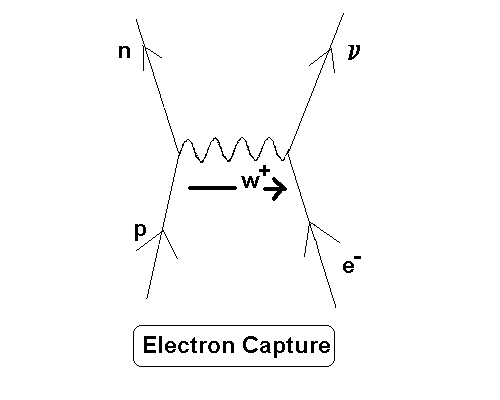
- 13feynmann diagram of electron capture
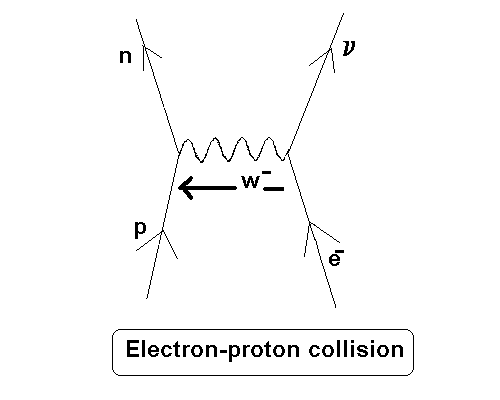
- 14feynmann diagram of electron-proton collisionsthe difference between this and electron capture is the gauge boson and it's direction
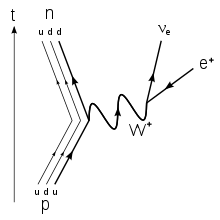
- 15feynmann diagrams for beta-plus decay
- 16feynmann diagrams for beta-minus decay
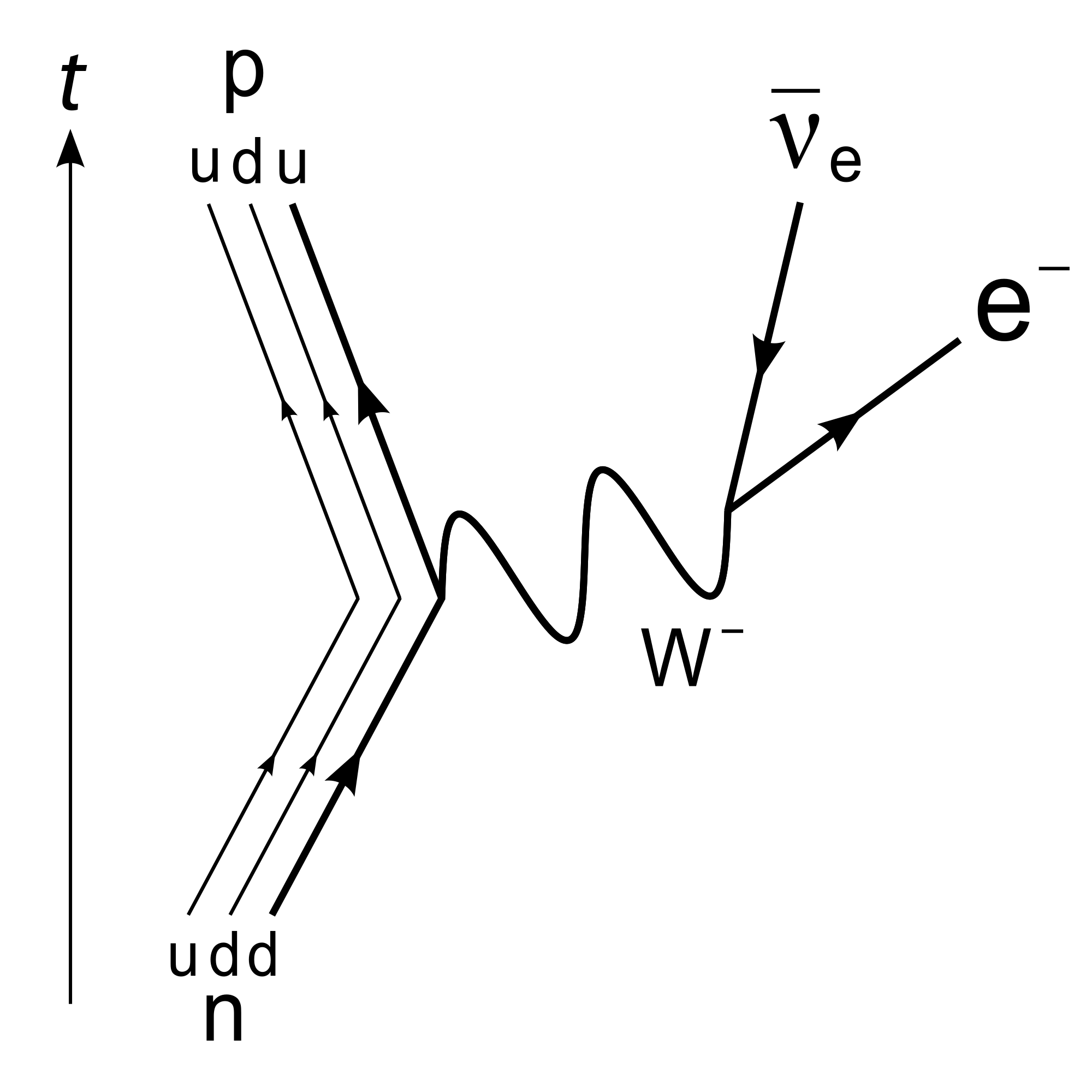
- 17how is lepton number conserved in beta+ and beta- decayyou get an antineutrino in B- decay and a neutrino in B+
- 18what are the RULES for drawing feynmann diagrams1. incoming particles start at the bottom and move upwards
2. baryons and leptons cannot cross from one side to the other
3. make sure charges on both sides balance. W bosons carry charge from one side of the diagram to the other
4. a W- going left has the same affect as a W+ going right - 19what are hadronsparticles that feel the strong nuclear force
e.g. protons and neutrons - 20are hadrons fundamental particles? why?no, they are made up of smaller particles called quarks
- 21what are the 2 types of hadrons?baryons and mesons
- 22name 2 baryonsprotons and neutrons
- 23which is the only stable baryonprotons, they do not decay
(all other baryons decay as they are all unstable, they decay into other particles - always including a proton) - 24antiprotons and antineutrons are ______________antibaryons
- 25why don't you find antibaryons in everyday matterantiparticles are annihilated when they meet the corresponding particle
- 26what is the baryon numberthe number of baryons in an interaction
- 27an example of a baryon you don't get in normal mattersigmas
- 28what are proton and neutron's baryon number?+1
- 29what are antibaryon's baryon number-1
- 30what are particles, which aren't baryons, baryon number0
- 31baryon number is a ________ number which must be _________ in any interactionbaryon number is a quantum number which must be conserved in any interaction
(total baryon number in any particle interaction never changes) - 32how can you predict if an interaction will happen againif the baryon numbers are the same = :)
cannot happen if the numbers do not match - 33what does a neutron produce when it decaysa proton, an electron and an antineutrino
- 34name 2 mesonspions and kaons
- 35all mesons are _______ and have a baryon number of ____unstable
zero - 36pions are the _______ mesons, coming in 3 versions each with different electric _______lightest
charges: (π+, π-, π0) - 37where do you get loads of pionshigh energy particle collisions
- 38kaons are ______ and more _______ than pionskaons are heavier and more unstable than pions
- 392 different versions of kaonsK+ & K0
- 40kaons have a very _______ lifetime and decay into _______kaons have a very short lifetime and decay into pions
- 41where we kaons and pions discoveredcosmic rays
cosmic ray showers are a source of both particles - you can observe the tracks of these particles with a cloud chamber - 42mesons interact with baryons via the _____________________strong force
- 43leptons don't feel the __________________strong nuclear force
- 44are leptons fundamental particlesyes
- 45how to (usually) leptons interact with other particles?the weak interaction
- 46name 2 leptonselectrons & muons
muons are just heavy electrons - 47are electrons stableyes
- 48muons are unstable, what to they decay into?ordinary electrons
- 49the electron and muon leptons each come with their own _________neutrino
- 50neutrinos have _____ mass and ______ electric charge, they only take part in ______ interactionszero
zero
weak - 51what happens if a neutrino passes right through earthnothing
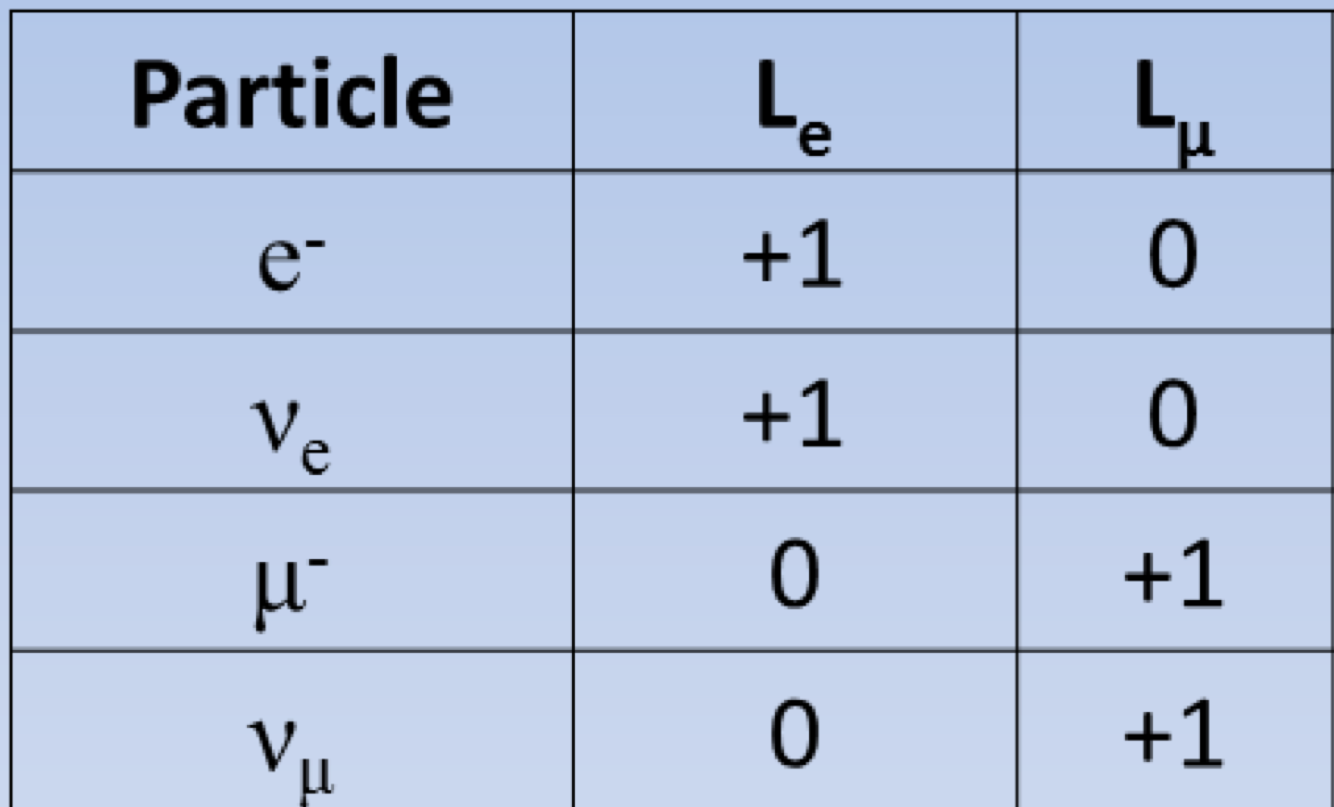
- 52what is the lepton number of leptons?+1
- 53you have to count the electron and muon types of lepton seperately, what are they for each of these: electron electron neutrino muon muon neutrino
- 54what are the charges of electron electron neutrino muon muon neutrinoelectron = -1
electron neutrino = 0
muon = -1
muon neutrino = 0
Información
- Descripción
- Fichas sobre Sin título, creado por Caitlin Kerr el 12/05/2018.
- Creado por
- Caitlin Kerr
- Visitas
- 0
- Valoración