
1891228

| Pregunta | Respuesta |
| Diffusion | Diffusion is the net movement of particles from an area of higher concentration to an area of lower concentration |
| Where does diffusion occur? | In liquids and gases because the particles in these substances are free to move about randomly |
| How does the difference in concentration of the two substances affect the rate of diffusion? | The bigger the difference in concentration, the faster the diffusion rate. |
| What kind of molecules can diffuse through the cell wall? | Small molecules like glucose, amino acids, water and oxygen. But big molecules like starch and protein can't fit through the membrane. |
| Do particles flow in or out of the cell membrane? | Particles are only moving about randomly, so they go both ways- but if there is more particles on one side of the membrane, there is a net (overall) movement from that side. |
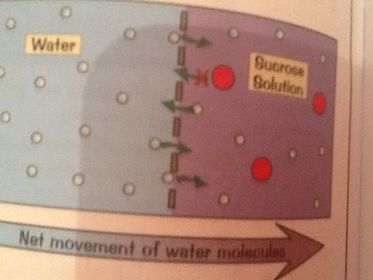
| What is osmosis? | Osmosis is the net movement of water molecules across a partially permeable membrane from a region of higher water concentration to a region of lower water concentration. |
| What is a partially permeable membrane? | A partially permeable membrane is just one with very small holes in it, so tiny molecules (water) can pass through them, the bigger molecules (sucrose) can't. A cell membrane is a partially permeable membrane. |
| What happens if there is more water molecules on one side of a partially membrane than the other? | There is a steady net flow of water in to the region with fewer water molecules |
| What would happen to the sucrose solution? | The sucrose solution becomes more dilute. The water acts like it is trying to even up the concentration either side of the membrane. |
| How does a tissue fluid demonstrate osmosis? | Tissue fluid usually have a different concentration to the fluid inside a cell. So water will be able to move into the cell from the tissue fluid, or out of the cell by osmosis. |
| What happens if a cell is out of water? | The solution inside will become concentrated. This usually means the solution outside is more dilute, so water will move into the cell by osmosis. |
| What happens if the cell has lots of water? | The solution inside it will be more dilute. Water will be drawn out of the cell and into the more concentrated fluid outside by osmosis. |
| How does a cell become turgid? | When plant cells draw water in by osmosis, they become plump and swollen (turgid) |
| What is turgor pressure? What is it's purpose? | When a cell becomes turgid, the contents of the cell push against the cell wall- this is turgor pressure. It helps support the plant tissues. |
| What happens if a plant receives no water from the soil? | The plant will start to wilt and droop. The cells lose water and so lose their turgor pressure. The cells are now flaccid, although the inelastic cell wall keeps things in position. |
| How can you investigate diffusion in a non living system? (With pH indicator phenolphthalein and agar jelly) | Add phenolphthalein to agar jelly and put it in sodium hydroxide (jelly pink- acidic solution). Take out some jelly and put in beaker of hydrochloric acid. Eventually they turn colourless, the acid diffuses into the agar jelly and neutralises the sodium hydroxide. |
| How can you investigate osmosis in living systems? (Potatoes) | Cut up potatoes into identical sized cylinders and measure them. Place into beakers of different sugar concentrations. Take them out after half an hour and measure. If longer- drawn in water If shorter- water has been drawn out |
| What should you change and keep the same in the previous experiment? (Osmosis with potato) | Same- volume of solution Time the expeiment runs for Change- concentration of the sugar solution |
| How can you investigate osmosis in a non living system? (Visking tubing) | Tie wire around one end of Viking tubing and a glass tube at the top end. Pour sugar solution down the glass tube into the Viking tube. Put the Viking tubing into a beaker of water and measure where the sugar solution comes up to on the glass tube. The next day, water should be drawn into the visking tube and will force liquid up the glass tube. |
| How does the visking tube a,low us to investigate osmosis? | It is a partially permeable membrane. |
| What is active transport? | Active transport is the movement of particles against a concentration gradient (area of lower concentration to an area of higher concentration) using energy released during respiration. |
| Give an example of how active transport is used in humans? | Active transport is used in the digestive system when there is a low concentration of nutrients in the gut, but a high concentration of nutrients in the blood |
| What is an example of the use of active transport in plants? | It is how they get their minerals from the soil (low mineral concentration) into their root hair cells (higher mineral comcemtration). |
| What is needed for active transport to work? | Energy from respiration is needed to make it work. |
| How does surface area to volume ratio affect the rate of active transport, diffusion and osmosis? | The rate of diffusion, osmosis and active transport is higher on cells with a larger surface area to volume ratio. Smaller cells have this and so substances can move into and out of the cell faster. |
| How does temperature affect the rate of osmosis, diffusion and active transport? | As particles in a substance get warmer they have more energy so they move faster. Temperatures increase, they move into and out of cells faster. |
| How does concentration gradient affect, osmosis and diffusion? Not active transport | The bigger the concentration difference, the faster particles move into and out of a cell. |
¿Quieres crear tus propias Fichas gratiscon GoConqr? Más información.