
Fichas
Looking Inside Materials
Fichas del conjunto (18)
- 1AtomsAre around 10 to the power of -10 meters in size
Contain a nucleus consisting of protons and neutrons and rings of electrons - 2MetalsHave low ionisation enthalpies
Are held together by delocalised electrons and electrostatic attractive forces
Bonds are equal in all directions
Good conductors of heat and electricity
Strong but malleable and ductile - 3CeramicsStrong and brittle
Have high melting and boiling points
Usually ionic or covalently bonded
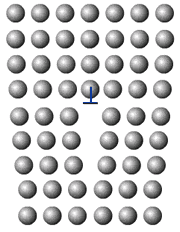
Prone to crack propagation - 4Ionic BondsElectrons are transferred from one atom to another
Strong electrostatic attractive forces
Atoms cannot 'slip' past each other - 5Covalent BondsElectrons are shared between atoms
Very strong bonds
High melting and boiling points
Not good conductors - 6Molecular SolidsMolecules held together by weak forces (dipoles)
Low melting and boiling points
Not good conductors - mostly polymers or organic materials - 7PolymersChains of monomers
Covalent bonds
Angled bonds to allow for rotation
Quite strong and flexible
Good insulators - 8BendingWhen a material bends elastic / strain energy is stored and released as fracture energy when broken
- 9Crack PropagationAtomic bonds are broken one by one from a particular point
- 10Pre-stressed GlassStrain energy is stored in the glass so that it shatters into tiny pieces when broken to prevent damage by large shards of broken glass
Mostly used in car windows - 11DislocationsImpurity in metals in the form of a gap in the atomic structure which acts as a weakness
- 12AlloysAdds an impurity atom to 'pin' dislocations in place by forming bonds with the surrounding atoms
This makes it stronger but more brittle - 13ToughnessToughness = energy of fracture / cross-sectional area
= J / m2 - 14StrengthStrength = breaking force / cross-sectional area
= N / m2 - 15Composite materialsComposites combine the useful properties of more than one material
- 16ElastomersHighly elastic polymers which can be toughened by vulcanisation (cross-linking chains)
- 17ThermoplasticsPolymers that are not cross-linked
Can be recycled
Weaker thank other polymers - 18Thermoset PlasticsPolymers that are cross-linked as the plastic sets
When heated, the plastic undergoes decomposition
Cannot be reformed or recycled (except as fillers)
Información
- Descripción
- AS Level (Chapter 5 - Looking Inside Materials) Physics Fichas sobre Looking Inside Materials, creado por Hannah Munday el 28/01/2015.
- Creado por
- Hannah Munday
- Visitas
- 21
- Etiquetas
- Valoración