
Fichas
Chemical calculations
Fichas del conjunto (21)
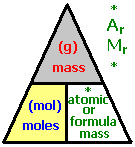
- 1Formulae for calculating Mr, Moles & Mass
- 2Relative atomic mass (Mr)Weighted average mass of atom of element
__________________________________________
1/12 mass of Carbon 12 (12C =1) - 3Explain the meaning of the numbers in the above graphic.6 = Atomic number = Number of Protons.
12.011 = Mass number (Ar) = Protons+Neutrons
(not an exact number due to weighted averaging of Isotopes of element).
2
4 = number of electrons in 1st & 2nd shell.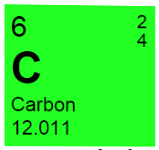
- 4Mass number (Ar)= Protons + Neutrons
(different for each isotope) - 5Mr = Relative formula mass = relative molecular mass= the sum of all the atomic masses for all the atoms in a given formula
- 6For an isotope, define the numbers in the adjacent graphic12 = Mass number (Ar) = exact number of Protons + Neutrons for the isotope.
6 = Atomic/proton number.
- 7Molecular/formula mass calculation Example: The diatomic molecules of the elements hydrogen H2 and chlorine Cl2Formula masses, RMM or Mr:
relative molecular mass for hydrogen H2 = 2 x 1 = 2
relative molecular mass for chlorine Cl2 = 2 x 35.5 = 71 respectively. - 8Molecular/formula mass calculation Example: The compound water H2ORelative atomic masses are H=1 and O=16
relative molecular mass or Mr = (1x2) + 16 = 18 (molecular mass of water). - 9Law of conservation of mass calculation Example: Magnesium + Oxygen ==> Magnesium oxide 2Mg + O2 ==> 2MgO (atomic masses required: Mg=24 and O=16)The mass changes in the reaction are:
(2 x 24) + (2 x 16) = 2 x (24 + 16)
48 + 32 = 2 x 40 and so 80 mass units of reactants produces 80 mass units of products. You can work with any mass units such as g, kg or tonne (1 tonne = 1000 kg), as long as you use the same units for all the masses involved. - 10Law of conservation of mass calculation Example: When limestone (calcium carbonate) is strongly heated, it undergoes thermal decomposition to form lime (calcium oxide) and carbon dioxide gas. CaCO3 ==> CaO + CO2 (relative atomic masses: Ca = 40, C = 12 and O = 16) Calculate the mass of calcium oxide and the mass of carbon dioxide formed by decomposing 50 tonnes of calcium carbonate.(40 + 12 + 3x16) ==> (40 + 16) + (12 + 2x16)
100 ==> 56 + 44
scaling down by a factor of two
gives
50 ==> 28 + 22
so decomposing 50 tonnes of limestone produces 28 tonnes of lime and 22 tonnes of carbon dioxide gas. - 11Formulae for Hydrochloric Acid, Nitric Acid and Sulphuric AcidHCl, HNO3, H2SO4
- 12Diatomic molecules of elementsH2, O2, N2, - F2, Cl2, Br2, I2.
- 13Formuae for Methane and AmmoniaCH4 and NH3
- 14Calculation of % composition Example: Calculate the % of copper in copper sulphate, CuSO4 Relative atomic masses: Cu = 64, S = 32 and O = 16Relative formula mass = 64 + 32 + (4x16) = 160
only one copper atom of relative atomic mass 64
% Cu = 100 x 64 / 160
= 40% copper by mass in the compound. - 15Calculate the % of water in hydrated magnesium sulphate MgSO4.7H2O Relative atomic masses: Mg = 24, S = 32, O = 16 and H = 1Relative formula mass = 24 + 32 + (4 x 16) + [7 x (1 + 1 + 16)] = 246
7 x 18 = 126 is the mass of water
so % water = 100 x 126 / 246 = 51.2 % H2O - 16The empirical formula of a compound is?The simplest whole number ratio of atoms present in a compound.
e.g. butane molecular formula C4H10, empirical formula C2H5 - 17Empirical formula calculation Example: The empirical formula of a lead oxide. It is found that 207g of lead combined with oxygen to form 239g of a lead oxide. Work out the formula of the lead oxide. (Relative atomic masses: Pb = 207 and O = 16)Work out the amount of oxygen combined with the lead. By simple logic from the law of conservation of mass, this is 239 - 207 = 32g
In atomic ratio terms, the 207 is equivalent to 1 atom of lead and the 32 is equivalent to 2 atoms of oxygen (1 x 207 to 2 x 16), so the formula is simply PbO2 - 18Empirical formula calculation Example: The analysis of sodium sulphate, calculating its empirical formula from the % composition by mass. On analysis, the salt sodium sulfate was found to contain 32.4% sodium, 22.5% sulphur and 45.1% oxygen (atomic masses: Na = 23, S = 32 and O = 16

- 19—

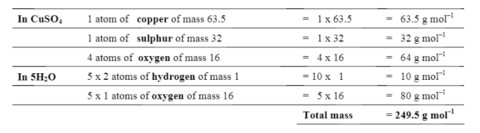
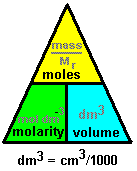
- 20The formulae to calculate Molarity (concentration) of a solution
- 21The formulae to calculate Moles and Volume of a gas.Volume = Moles x 24,000 cm3