
Fichas
PRC - Lecture 21
Fichas del conjunto (27)
- 1What is Diabetes?Diabetes mellitus is a group of metabolic disorders characterised by hyperglycaemia resulting in defects in insulin secretion, insulin action or both.
- 2What is the difference between Type I and Type II Diabetes?Type I
- Insulin-dependent diabetes mellitus (IDDM).
- Beta cell destruction
- Absolute insulin deficiency
- Juvenile onset
Type II
- Non-insulin dependent diabetes mellitus (NIDDM).
- Assosciated with obesity and tends to occur in later life.
- Mainfests as a result of insulin resistance and relative insulin deficiency. - 3What is Maturity onset dibaetes of the young (MODY)?When a child is born with a monogenic defect leading to defects of the beta cell.
- 4What are 3 Macro-vascular complications of Diabetes?- Ischemic heart disease
- Cerebrovascular disease
- Peripheral vascular disease - 5How much of a higher risk do diabetic patients have of developing macro-vascular complications in comparison to the rest of the general population?2 to 6 times higher risk.
- 6What % of the population is affected by Diabetes Type I ?0.4%
- 7What is meant by insulitis?When there is autoimmune destruction of the insulin producing beta cells, resulting in insulin deficiency.
- 8What type of disease is Diabetes Type I?Multifactorial
- 9What is the mean age of onset of Diabetes Type I?12 yrs,
- 10At what rate is the incidence of Diabetes Type I increasing each year?3% per year
- 11Where is the highest incidence of Type I Diabetes?Northern Europe
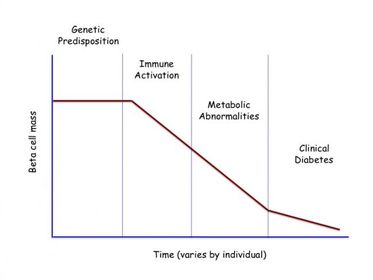
- 12Describe the following graph's sketch of the natural history of Type I Diabetes and how it influences prevention/ prediction of onset:- Those in the first quarter are genetically predisposed to T1D.
- If this population are to be exposed to an environmental trigger this can trigger cellular autoimmunity (humoral autoantibodies) thus beta cell destruction > if we can recognise it at this stage then we can promote beta-cell regeneration.
- Even so, the body can be sent into decline and this can cause the loss of first phase insulin response - the patient is now at the 'pre-diabetic' stage.
- We can now predict the onset of T1D from glucose intolerance and work to preserve remaining Beta-cell function. - 13What are islet cell autoantibodies?- Markers that appear when insulin producing beta cells in pancreas are damaged.
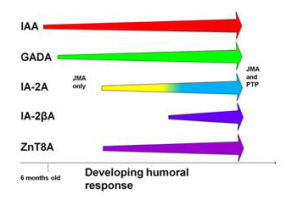
- Used to predict an individual's risk of T1D. - 14Describe the development in appearance of Islet autoantibodies from as early as 6 months old.- IAA or GADA autoantibodies can develop first, as early as 6 months.
- Followed by IA-2 and ZnT8 autoantibodies.
-
- 15Describe the steps leading to immune activation in T1D.- Peptides of pro-insulin from a patient with T1D are processed by APCs.
- APCs use their HLA-Class I receptors to express peptide.
- TCR from CD4 helper T cell recognises peptide and binds to APC.
- CTLA-4 from CD4 T helper cell also binds to activated B7 protein on APC (dual recognition).
- CD4 T helper cell becomes activated and stimulates CD8 T cell.
- CD8 T-cells become stimulated and bind to proinsulin peptide on beta cell via their HLA-Class 1 receptor
- CD8 cytotoxicity functions initiate - release of granzymes, IFN-gamma etc to break down tissue. - 16What percentage of patients have an affected sibling?10%
- 17What is the likelihood of both dizygotic twins developing diabetes type 1, and again monozygotic twins.- 5 to 10%
- 30 to 50%... rising to 70% in long term follow up. - 18What 3 factors is Type 1 diabetes characterised by?- Susceptibility genes
- Presence of multiple islet autoantibodies.
- Environmental effects - 19What percentage of Type 1 diabetes sufferers carries the either or both of the high risk HLA haplotypes? What are their names?95%
HLA DRB1 (DR4/ DQ8)
HLA DRB1 (DR3/ DQ2) - 20How would you describe the location of the Haplotypes for Type I Diabetes?- Chromosome 6
- MHC Class II region
- Here, you find variants genes in DR subregion, DQ subregion and DP subregion. - 21What is predicted about Diabetes by the year 2020?The incidence of Diabetes in the under 5s will have doubled in 15 years.
- 22What percentage of genetic susceptibility in Type 1 diabetes is the HLA responsible?50%
- 23What is the GWAS?- Genome Wide Association Studies.
- Studies that compare DNA markers across the genome in people with a disease to people without the disease.
- Used to help prevent, diagnose and treat disease. - 24How do we know that Type 1 Diabetes is autoimmune?- T-cell mediated (CD4/ CD8 T cells).
- The presence of autoantibodies directed against B cell antigens. - 25What are 3 factors which contribute to the multifactorial nature of T1D?- Genes
- Environment
- Immune regulation - 26Describe the concept of Nonobese Diabetic (NOD) Mice.- Susceptibility to spontaneous development of autoimmune insulin dependent diabetes mellitus (IDDM).
- Insulitis at 5 weeks > Diabetes at 16-30 weeks.
- NOD strain of mice have been developed from the cataract-prone strain
- Have a deficiency in CD4+CD25+ regulatory T cells. - 27List some of the ways in which we can prevent diabetes in the NOD mouse but not in humans.- Prevention: Identify & remove environmental insult.
- Reversal: Anti-T-cell strategies; induction of tolerance; T-cell regulation; islet transplantation; gene therapy to generate "super-islets".