
2916691
Descripción

Fichas por Alyssa Conte, actualizado hace más de 1 año

|
Creado por Alyssa Conte
hace más de 11 años
|
|
| Pregunta | Respuesta |
| continental drift theory | proposed by wegener, theory that continents moved around don earth's surface and were joined together at one point |
| paleoglation | term describing past periods of extensive glaciations that covered most of the continents |
| tectonic plates | large, rigid, moveable, slabs of rock |
| mountain range | chain of mountains |
| mid-ocean ridge | mountain range running north to south of equator |
| magnetometer | device that detects variations in magnetic fields |
| spreading ridge | where magma rises from the earth's surface, cools, hardens and forms new sea floor |
| sea floor spreading | where new magma rises and push old rock aside |
| plate tectonic theory | states that earth's surface is broken into large plates that move apart and then rejoin |
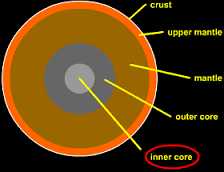
| layers of the earth from inside to out | inner core outer core lower mantle upper mantle crust |
| crust | solid rock layer |
| 2 types of crust | continental crust oceanic crust |
| mantle | thickest layer, mostly solid except for upper mantle |
| outer core | liquid iron and nickel |
| inner core | mostly iron, pressure keeps in solid |
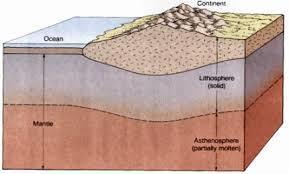
| lithosphere & asthenosphere | Lithosphere: crust and uppermost portion of upper mantle Asthenosphere: molten layer of the upper mantle |
| mantle convection | thermal energy transfer in the mantle where light magma rises and denser magma sinks |
| ridge push | mid-ocean ridge pushes the rest of the tectonic plate it is on away from the ridge |
| subduction | the action of one more dense tectonic plate pushing below another less dense plate |
| slab pull | subducting plate material pulls the rest of the attached plate toward the subduction zone and down into the mantle |
| plate boundary | location where two plates meet and move relative to each other |
| divergent plate boundaries | areas where tectonic plates are spreading apart |
| convergence plate boundaries | areas where tectonic plates collide |
| oceanic-continental plate convergence & what is found there? | ocean plate subjects under continental plate forming a trench volcano & volcanic belt |
| oceanic-oceanic plate convergence & what is found there? | denser plate subducts under less dense plate volcanic island arc |
| continental-continental plate convergence & what is found there? | both continental plates are colliding mountain ranges |
| convergence | |
| transform | |
| transform plate boundary | areas where tectonic plates slide past each other |
| focus | in earth where earthquake occurs |
| epicenter | point on earth's surface directly above the focus |
| 3 types of waves | primary wave (p-wave) secondary wave (s-wave) surface wave (l-wave) |
| primary waves (p-waves) | underground waves that travel through earth's crust travel through solids, liquids and gases (fastest) first to arrive |
| surface waves (s-waves) | underground waves that travel through solids (slower) second to arrive spring like |
| surface waves (l-waves) | waves that ripple along earth's surface cause more damage than p-waves (slowest) last to arive |
| seismometers or seismographs | machines that measure and record seismic wave energy |
| seismogram | graph that shows the arrival times and sizes of seismic waves produced by an earthquake |
| 3 types of volcanoes | composite volcanoes shield volcanoes rit eruptions |
| composite volcanoes | found along plate boundaries & there is an eruption |
| shield volcanoes | form over hot spots & there is an eruption |
| rift eruption | occur along cracks in the lithosphere & are not explosive |
¿Quieres crear tus propias Fichas gratiscon GoConqr? Más información.