
Fichas
Physics and Motion
Fichas del conjunto (35)
- 1Which scientist was the first to propose the heliocentric model of the universe? A. Aristotle B. Isaac Newton C. Galileo Galilei D. Nicolaus CopernicusD.
Nicolaus Copernicus - 2What does the heliocentric view of a solar system imply? A. that planets move around Earth B. that the moon moves around Earth C. that planets move around the Sun D. that the moon moves around JupiterC.
that planets move around the Sun - 3Which botany phenomenon is primarily based on an understanding of physics? A. the way plant pollen is carried by wind to another plant B. the way nutrients affect a plant's growth C. the way plant cells divide D. the way pesticides keep a plant free of pestsA.
the way plant pollen is carried by wind to another plant - 4Which action can be explained by physics? A. the growth of fungus on a piece of bread B. the mixing of sodium and chlorine to form common salt C. the interactions between predators and prey in an ecosystem D. the pressure of blood exerted on the inner walls of the veinsD.
the pressure of blood exerted on the inner walls of the veins - 5Which activity performed by a chemist is primarily based on an understanding of physics? A. predicting the properties of an element based on its placement on the periodic table B. writing noble gas configurations for an element C. predicting the boiling point of a liquid, given its pressure D. predicting the acidic or basic nature of a substance based on its pHC.
predicting the boiling point of a liquid, given its pressure - 6What is displacement? A. the rate of change of distance of an object over time B. the specific speed and direction in which an object is moving C. the distance between two points and the time taken to travel that distance D. the shortest path between two points, including both distance and directionD.
the shortest path between two points, including both distance and direction - 7If a basketball travels a distance of 4 meters in 5 seconds, what is its average speed? A. 4 meters/second B. 0.8 meters/second C. 1.2 meters/second D. 5 meters/secondB.
0.8 meters/second - 8Which statement best illustrates vibrational motion? A. a racecar driver speeding around a track B. a model walking down a runway C. a cello playing music at a concert D. a ballerina twirling in placeC.
a cello playing music at a concert - 9Which of the following is a scalar quantity? A. displacement B. time C. velocity D. forceB.
time - 10A car starts from rest and accelerates along a straight line path in one minute. It finally attains a velocity of 40 meters/second. What is the car's average acceleration? A. 1.5 meters/second2 B. 1.5 meters/second C. 0.66 meters/second^2 D. 0.66 meters/secondC.
0.66 meters/second^2 - 11How many significant figures does the value 0.080 have? A. 1 B. 2 C. 3 D. 4B.
2 - 12Which multiplier does the word kilo represent? A. 100 B. 1,000 C. `(1)/(100)` D. `(1)/(10)`B.
1,000 - 13Mary walked north from her home to Sheila's home, which is 4.0 kilometers away. Then she turned right and walked another 3.0 kilometers to the supermarket, which is 5.0 kilometers from her own home. She walked the total distance in 1.5 hours. What were her average speed and average velocity? A. Her average speed was about 4.6 km/hr, and her average velocity was about 3.3 km/hr. B. Her average speed was about 3.3 km/hr, and her average velocity was about 4.6 km/hr. C. Her average speed was about 3.3 km/hr, and her average velocity was 0 km/hr. D. Her average speed was 0 km/hr, and her average velocity was about 4.6 km/hr.A.
Her average speed was about 4.6 km/hr, and her average velocity was about 3.3 km/hr. - 14Which is the correct scientific notation for 724,000,000,000? A. 7.24 × 10^11 B. 72.4 × 10^11 C. 7.24 × 10^10 D. 724 × 10^9A.
7.24 × 10^11 - 15Using the rules for significant figures, what do you get when you multiply 67.6 by 1.2? A. 8 B. 81 C. 81.1 D. 81.12B.
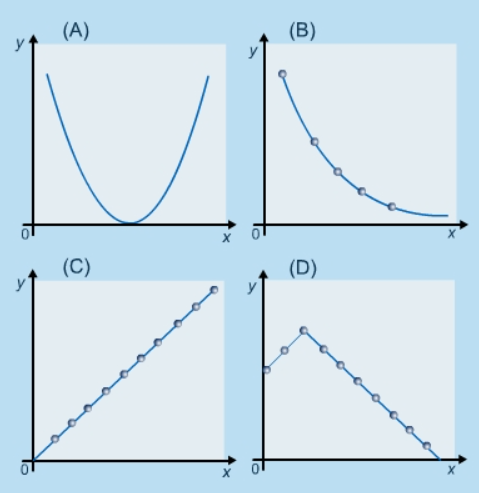
81 - 16Which graph is a quadratic graph? A. graph A B. graph B C. graph C D. graph DA.
graph A - 17The graph shows the distance (x) traveled by an aircraft traveling at constant velocity in corresponding time intervals (t). What is the form of the graph, and what is the approximate distance traveled by the aircraft in 7.5 seconds? A. linear, 770 meters B. linear, 825 meters C. linear, 660 meters D. inverse, 825 metersB.
linear, 825 meters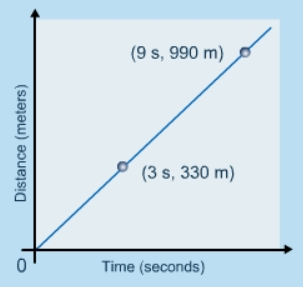
- 18An accelerometer is a device that uses the extension of a spring to measure acceleration in terms of Earth's gravitational acceleration (g). What is the approximate acceleration if this accelerometer spring is extended just 0.43 centimeters? A. 0.24 g B. 0.80 g C. 2.00 g D. 2.40 gB.
0.80 g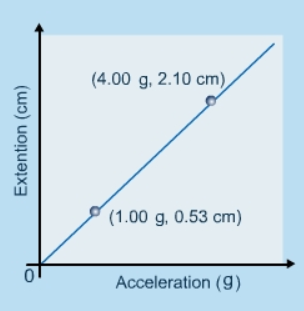
- 19A railroad track is being built on an inclined surface. What is the estimated height of the supporting pillar that will be erected at a horizontal distance of 200 meters from the start of the incline? A. 14 meters B. 16 meters C. 20 meters D. 24 metersC.
20 meters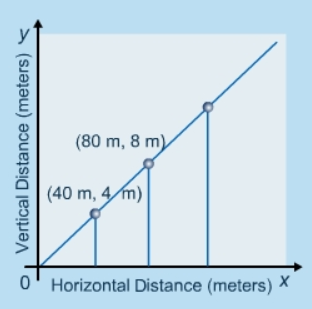
- 20The table lists the values for two parameters, x and y, of an experiment. What is the approximate value of y for x = 4? A. 11 B. 16 C. 24 D. 43B.
16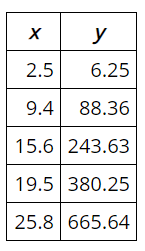
- 21The leaning tower of Pisa is about 56 meters tall. A ball released from the top takes 3.4 seconds to reach the ground. The final velocity of the ball before it hits the ground is 33 meters/second. Assuming that the ball experienced a constant acceleration throughout this descent, calculate the magnitude of the acceleration. A. 9.8 meters/second^2 B. 9.7 meters/second^2 C. 112.2 meters/second^2 D. 0.10 meters/second^2B.
9.7 meters/second^2 - 22The velocity of a car traveling in a straight line increases from 0 meters/second to 30 meters/second in 8 seconds. What is the average acceleration of the car? A. 3.75 meters/second B. 3.75 meters/second^2 C. 0.27 meters/second^2 D. 0.27 meters/secondB.
3.75 meters/second^2 - 23A satellite completes one revolution of a planet in almost exactly one hour. At the end of one hour, the satellite has traveled 2.0 × 10⁷ meters and is only 10 meters away from its starting point. What is the numerical value of the satellite's average velocity after that one hour? A. -3.77 × 10^–2 meters/second B. -2.77 × 10^–3 meters/second C. -2.62 × 10^–2 meters/second D. -5.55 × 10^3 meters/secondB.
-2.77 × 10^–3 meters/second - 24John traveled on a motorbike a distance of 1,500 meters north to get to the nearest shopping center. He then turned back south and rode another 1,450 meters to meet his friend. What was his displacement? A. 50 meters north B. 50 meters south C. 100 meters D. 50 metersA.
50 meters north - 25A boat moves 60 kilometers east from point A to point B. There, it reverses direction and travels another 45 kilometers toward point A. What are the total distance and total displacement of the boat? A. The total distance is 105 kilometers and the total displacement is 45 kilometers east. B. The total distance is 60 kilometers and the total displacement is 60 kilometers east. C. The total distance is 105 kilometers and the total displacement is 15 kilometers east. D. The total distance is 60 kilometers and the total displacement is 45 kilometers east.C.
The total distance is 105 kilometers and the total displacement is 15 kilometers east. - 26A ball at rest starts rolling down a hill with a constant acceleration of 3.2 meters/second^2. What is the final velocity of the ball after 6.0 seconds? A. –9.6 meters/second B. 9.6 meters/second C. –19 meters/second D. 19 meters/secondD.
19 meters/second - 27An airplane on a runway accelerates at 4.0 meters/second2 for 28.0 seconds before takeoff. How far does the plane travel on the runway before takeoff? A. 1.6 × 10^3 meters B. 1.7 × 10^3 meters C. 3.1 × 10^3 meters D. 3.3 × 10^3 metersA.
1.6 × 10^3 meters - 28What is the acceleration of a ball traveling horizontally with an initial velocity of 20 meters/second and, 2.0 seconds later, a velocity of 30 meters/second? A. 1.6 meters/second^2 B. 3.0 meters/second^2 C. 3.4 meters/second^2 D. 5.0 meters/second^2D.
5.0 meters/second^2 - 29If a stone dropped into a well reaches the water's surface after 3.0 seconds, how far did the stone drop before hitting the water? A. 1.4 meters B. 44 meters C. 49 meters D. 54.2 metersB.
44 meters - 30The average height of an apple tree is 4.00 meters. How long would it take an apple falling from that height to reach the ground? Given: g = –9.8 meters/second^2 A. 0.90 seconds B. 1.0 seconds C. 1.53 seconds D. 2.3 secondsA.
0.90 seconds - 31During which two time intervals does the particle undergo equal displacement? A. AB and BC B. AB and EF C. AB and DE D. CD and DFC.
AB and DE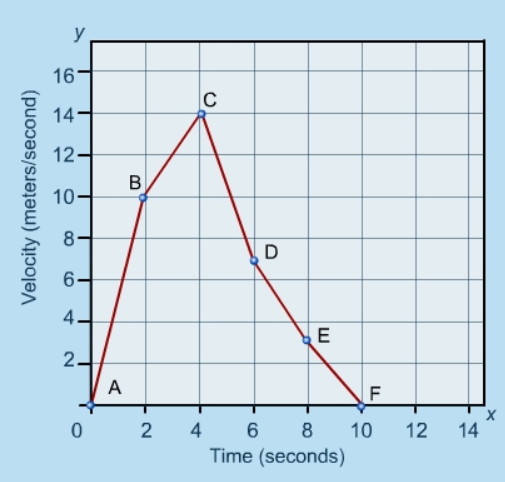
- 32In the graph, during which time period does the particle undergo the greatest displacement? A. AB B. BC C. CD D. All distances covered in the marked regions are the same.B.
BC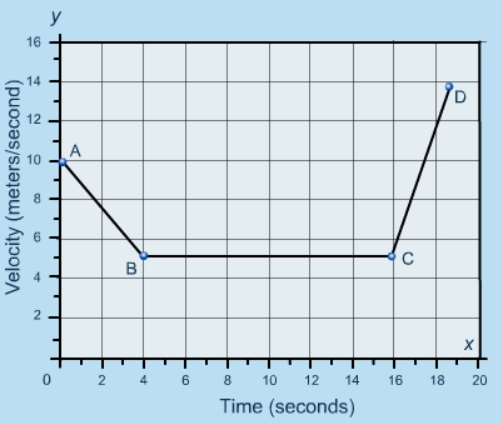
- 33This graph shows the velocity of particles A and B through time. The two lines intersect each other at point O. What is the acceleration of particles A and particle B at point O? A. It is -0.2 m/s^2 for particle A and -0.05 m/s^2 for particle B. B. It is 0.65 m/s^2 for both particles. C. It is 0.68 m/s^2 for both particles. D. It is -2 m/s^2 for particle A and -0.50 m/s^2 for particle B.D.
It is -2 m/s^2 for particle A and -0.50 m/s^2 for particle B.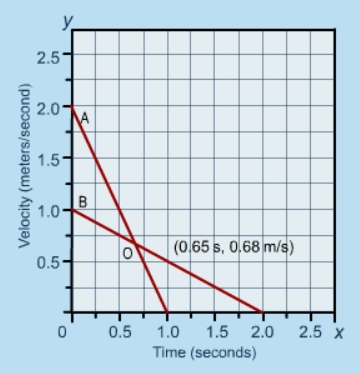
- 34What is the displacement of the particle in the time interval 7 seconds to 8 seconds? A. 0 meters B. 1.5 meters C. 3 meters D. 7 metersB.
1.5 meters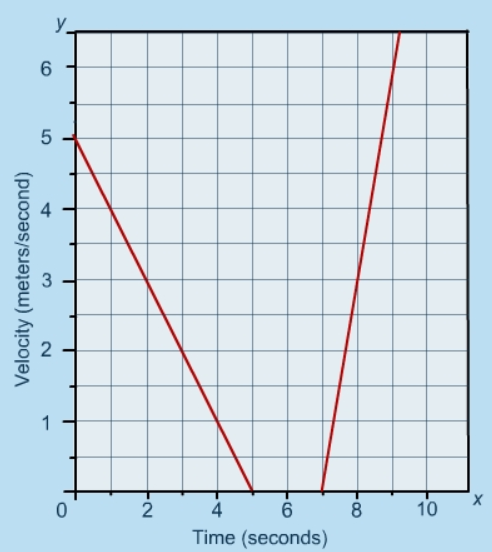
- 35In the graph, which region shows nonuniform positive acceleration? A. AB B. BC C. CD D. OAA.
AB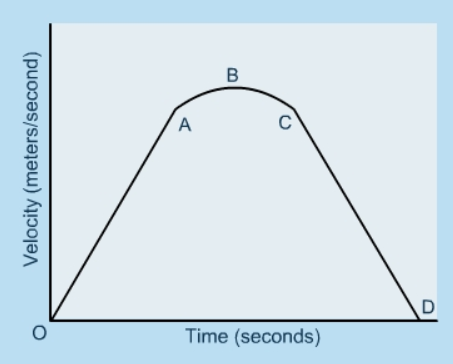
Información
- Descripción
- - Introduction to Physics - Describing Motion - Mathematics for Physical Sciences - Graphs and Relationships - Measures of Motion - Equations of Motion - Graphing Motion
- Creado por
- Elexali Olayvar
- Visitas
- 580
- Valoración