
Fichas
units
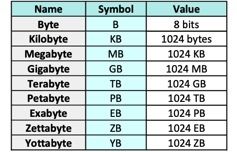
Fichas del conjunto (30)
- 1Shapes and attributes are stored ,for example ,a circle would store its radius, position on the page, line thickness and fill colour.Can be scaled and zoomed indefinitely with no loss of quality.Useful for maps ,blueprints and diagrams made from shapes .Cannot be used to store photos or anything not made of geometric shapesAudio waveform is sampled by measuring the amplitude at fixed intervals More samples per second(higher sample rate)or more bits per sample (higher sample resolution) results in higher quality sound, but higher memory and storage requirements Bitrate=sample rate×sample resolution o Size of a sample=bitrate×length of sound
- 2Data is stored as 1s and 0s, representing on and off. A single switch can store 1 bit of data a single 0 or 1Data can be compressed to save storage space and memory
Compression uses complex algorithms to store the same data using fewer bytes of data The compression ratio of a file is the ratio of the uncompressed file size to the compressed file size
o A 10MB file compressed to 2MB will have a compression ratio of 5:1
o A 4MB compressed file with a 2:1 compression ratio will decompress to 8MB - 3The data is compressed using algorithms that don't alter the contents. The compressed data can be restored to exactly how it was before compression oUsed for text, applications or other data that must be preserved exactlySlight alterations are made to the data during compression
The data cannot be restored exactly some information is lost
Lossy algorithms can have much higher compression ratios than lossless algorithms o JPEG is a widely used compression algorithm for images
In a typical photograph, it is hard to notice the small changes that are made
In a high-contrast image such as text, artefacts become visible - 4—1. The memory address in the PC is copied to the MAR
2. The instruction stored in the memory location contained in the MAR is transferred to the MDR 3. The instruction now in the MDR is copied to the CIR
4. The PC is incremented, ready for the next instruction
5. The instruction in the CIR is decoded and executed by the CU, potentially making use of the ALU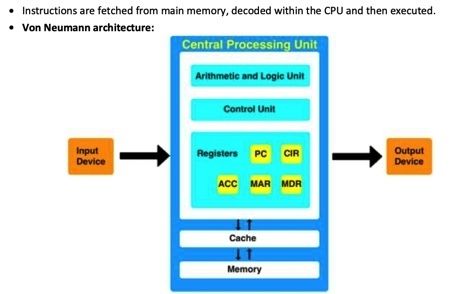
- 5small storage areas for use during execution of an instruction.stores the address of the next instruction to be fetched.
- 6stores the instruction currently being executed.stores values currently being processed
- 7stores the address to be read/written in main memorystores the data to be read/written to main memory
- 8performs mathematical and logical operations.decodes the program instruction in the CIR, selects machine resources and operations, and coordinates activation of those operations.
- 9used to allow the user to interface with the CPU examples include keyboard, mouse, speakers and monitorDuring the Fetch-Execute Cycle, the registers and components are used to fetch, decode, and execute instructions from main memory
- 10The faster the clock speed, the more instructions can be fetched and executed in a second More power is needed for higher clock speeds, which produces more heat and affects battery life Excessive heat can damage a processor Clock speed is measured in Gigahertz (GHz)A core is a complete processing unit, with its own ALU, Control Unit and Registers
Having multiple cores allows several instructions to be fetched and executed at the same time This results in a faster CPU, but is limited by instructions that must be executed in order Multiple cores on a CPU increases the cost of manufacturing - 11Cache memory is extremely fast memory, used to store frequently used instructions and data More cache memory improves performance as more instructions can be stored, meaning fewer instructions need to be fetched from RAM, which is slowerL1 cache 2-64KB smallest and fastest.
L2 cache 256-512KB if instructions are not present in L1, L2 is searched, some latency due to increased size. L3 cache 1-8MB, instructions are searched for in here if not present in L1 and L2. Largest and slowest cache but still faster than RAM. - 12A GPU has 100s or 1000s of specialised cores.Each core is designed to rapidly manipulate memory and perform specific mathematical operations.GPUs specialise in operations like vector calculations and image manipulation, allowing advanced graphical capabilitiesA sound card is hardware specifically for manipulating audio. It contains circuitry to sample an audio waveform into binary, and convert that binary back to an audio waveform for playing through speakers.Higher quality sound cards do a better job of recreating the original waveform from sampled audio.
- 13the circuit board that connects all the components a computer uses. Has connections for CPU, RAM, ROM, GPU, hard disk, sound card, network and other extensions.directly accessible by the CPU, and can be used for fetching of instructions
Primary Storage is generally faster and smaller than secondary storage - 14Random Access Memory - Primary Storage or Main Memory Used to store programs and data that is currently in use Fast but volatile (needs power to keep its data)Read Only Memory. Cannot be changed, only read.
Used to programs and data that does not change, such as the computer s boot-up instructions. - 15NAND memory Non-volatile (keeps its data without power) Can be changed.Small, but extremely fast memory on the CPU. Faster than RAM. Used to store frequently used instructions and data to speed up execution.
- 16A memory management technique that gives the illusion of large primary storage by swapping data to a slower secondary storage device when not in use. Allows systems to keep running when primary storage is full, but can cause considerable slow-downEmbedded systems are small, dedicated computers on a single chip, combining the CPU, main memory and other hardware
Embedded in devices such as washing machines, engine sensors and house alarms
Instructions are held in ROM or flash memory
Produced for a single purpose unlike desktop PCs or smartphones - 17much slower than main memory but is very large and used for long-term storage of programs and data. Secondary storage contents is copied to main memory when it needs to be used.tores data on a spinning magnetic disk.
High Capacity Drives available upward of 5TB
Slower than solid state
Cheap per MB
Can be fragile moving parts and low tolerances mean they can break easily
Suitable for main storage on a non-portable device - 18stores data on a long strip of magnetic material Very high capacity Very cheap per MB Data can only be read sequentially no random access. Suitable for backupsstores data on flash memory chips. Fast no moving parts, so access is instant
Durable data stored on chips, less to go wrong Portable can by physically small
Currently more expensive than magnetic drives, but getting
cheaper all the time - 19stores data on a spinning reflective disk Very cheap and portable still used by games consoles Slower than other types of storage Requires the computer to have a readerstores data on a remote server, accessible over the Internet
Highly secure and durable the company running it will keep backups
Highly portable can be shared to anyone with an Internet connection
Expensive usually requires a monthly paid subscription. - 20—
- 21—
- 22—
- 23—
- 24—
- 25—
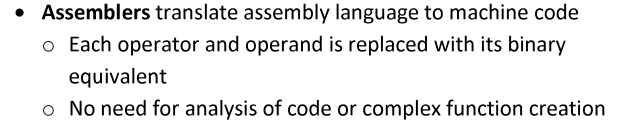

- 26—
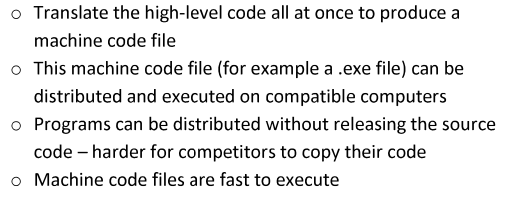
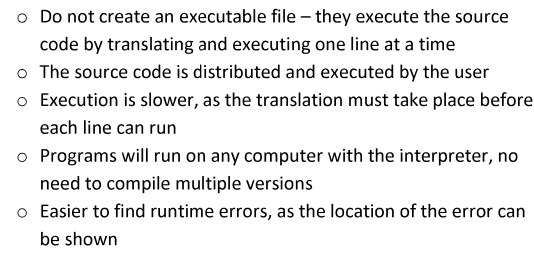
- 27—
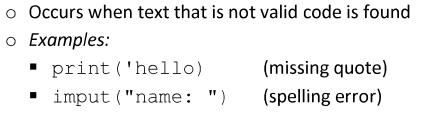
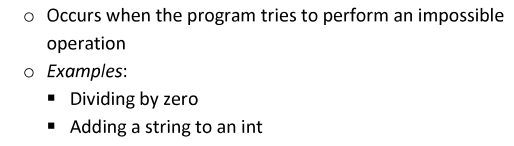
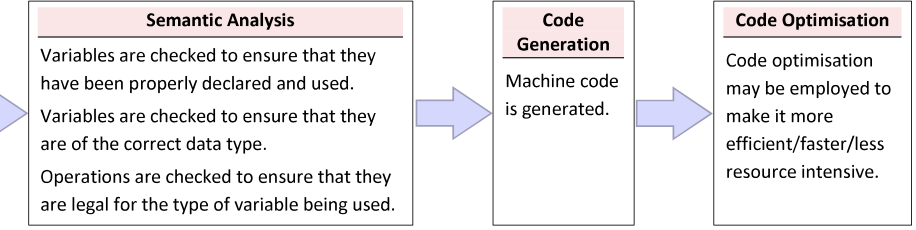
- 28—occurs when a program tries to import a function from a file that doesn't exist.
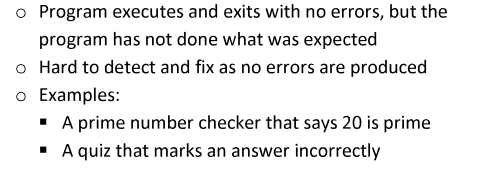
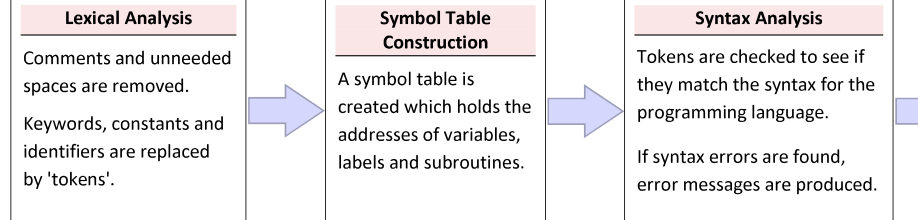
- 29occurs when a value is rounded and loses accuracyoccurs when data must be shortened(truncated) to fit. could result in a missing text or an inaccurate value
- 30—
Información
- Descripción
- Fichas sobre units , creado por Paige Cosstick el 06/01/2022.
- Creado por
- Paige Cosstick
- Visitas
- 1
- Valoración