
Fichas
Sin título
Fichas del conjunto (35)
- 1ComparativesWhat Are Comparatives?
A comparative is the form of adjective or adverb used to compare two things.
Just add er or more depends on the situation, - 2Example #1Mark is taller.
taller = comparative of the adjective tall, - 3Example #2Mark listens more attentively these days.
more attentively = comparative of the adverb attentively, - 4Example #3 In this example I will include the Than that we also use to compare but it is like an auxiliary or something like thatWhen you hire people who are smarter than you are, you prove you are smarter than they are.
smarter = comparative of the adjective smart. - 5Degrees of ComparisonEvery adjective or adverb can be written in one of three degrees:
- 6The Positive Degree.The positive degree offers no comparison. It just tells us about the existence of a quality.
- 7ExampleNice = Nicely.
- 8The Comparative Degree.The comparative degree (or comparative) compares two things to show which has the lesser or greater degree of the quality.
- 9ExampleNicer = More Nicely.
- 10The Superlative Degree.The superlative degree (or superlative) compares more than two things to show which has the least or greatest degree of the quality.
- 11ExampleNicest = most nicely
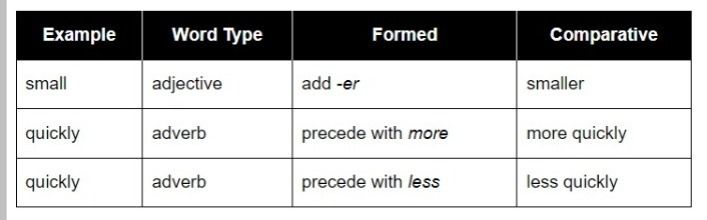
- 12Forming ComparativesOften, the comparative form of an adjective or adverb can be formed by adding the suffix -er or by placing more (or less) before.
- 13Here are some examples:However, it is a little more complicated than just adding -er or using more. There is more on this to come.
- 14Forming ComparativesA comparative is known as the second or the middle degree of comparison (for adjectives and adverbs).
- 15When an adjective or an adverb ends with a single consonant, add er:soon = sooner
- 16When an adjective or an adverb ends y, drop the y and add ier (for the comparative)silly = sillier
- 17When an adjective or an adverb ends e, drop the e and add er (for the comparative)pale = paler
- 18Examplefree = freer
- 19When an adjective or an adverb has more than one syllable (but beware exceptions like silly and early), place more in front (for the comparative)attractive = more attractive
- 20Exampleangrily = more angrily
- 21There are a few irregular ones too. You just have to learn these. It's worth it. Most of them are very common words:far = farther or further
- 22Why Should I Care about Comparatives?Below are the three most problematic issues related to comparatives.
- 23Issue 1Do not form double comparatives.
- 24The rules for forming a comparative are above. Only apply one of the rules for each adjective or adverb.In other words, do not apply two of the rules. If you do (e.g., by using "more" and adding "-er"), you will form a so-called double comparative, which is a serious grammar error.
- 25For exampleDavid is more taller. (x)
- 26As a comparative can also be formed by adding the word "less," this mistake can be made with "less" too.Example:
David was less smarter than John. (x)
Of note, forming double comparatives is far more common in speech than in writing - 27Issue 2Use the comparative degree not the superlative degree when comparing two things.
- 28Example.Of the two, select the most appropriate hat. (x
("More suitable hat" would be correct.) - 29Example.Of the two, select the most appropriate hat. (x)
("More suitable hat" would be correct.) - 30Issue 3Be careful with adjectives that already express the highest degree.
- 31Some argue that adjectives like dead and unique already express the quality to the highest degree and therefore should not have a comparative or a superlative form.So, if you write "deader" or "most unique," make sure you can justify it. The following four adjectives attract the most criticism:
- 32Single (Can something be more or most single?)Instantaneous (Can something be more or most instantaneous?)
- 33Key PointsDon't apply two rules for forming a comparative (e.g., more tastier, more better). That's a serious mistake
- 34Key PointsUse the comparative degree (not the superlative) when comparing just two things.
- 35Key PointsJanet is the cleverer out of Janet and John.
("Cleverest" would be wrong.)
Información
- Descripción
- Fichas sobre Sin título, creado por Maria Cabrera el 23/02/2022.
- Creado por
- Maria Cabrera
- Visitas
- 19
- Valoración