
Adjectives
3,048 resources created by 2,619 users
This Adjectives page on GoConqr gathers community-made quizzes, mind maps, flashcards, flowcharts and notes, from comparatives and superlatives to -ed and -ing endings, adjective order and extreme adjectives. It's built for school students practising their grammar, and for teachers after ready-made material. There are over 2,500 resources here, including more than 200 quizzes and over 1,500 mind maps, made by more than 2,200 contributors and mostly at secondary level. Pick a topic, try a quiz, then build your own set.
Select topic
- Types of adjectives79
- Descriptive adjectives55
- Adjectives to describe people and feelings97
- Adjective synonyms and antonyms56
- Adjective order and position95
- Adjective suffixes7
- -ed and -ing adjectives114
- Gradable and extreme adjectives61
- Adjectives and prepositions28
- Adjectives and adverbs35
- Comparatives and superlatives836
- Comparative adjectives386
- Superlative adjectives371
Top Adjectives resources
-
36 cards045 ADJECTIVES 36 BIASED /ˈbaɪ.əst/ The newspapers gave a very biased report of the meeting. I think she's beautiful but then...
-
Flowchart Comparatives and superlatives In this lesson i'm going to show you, what a comparative and superlative is, when to use them, and how crea...
-
5 questionsSESSION 1 Read Jenny’s description.She is Jenny Slate. She is an American actress. She is tall, thin and pretty. Jenn...
-
10 questionsCOMPARATIVES AND SUPERLATIVES QUIZ This is a quiz to check your understanding about comparatives and superlatives.
-
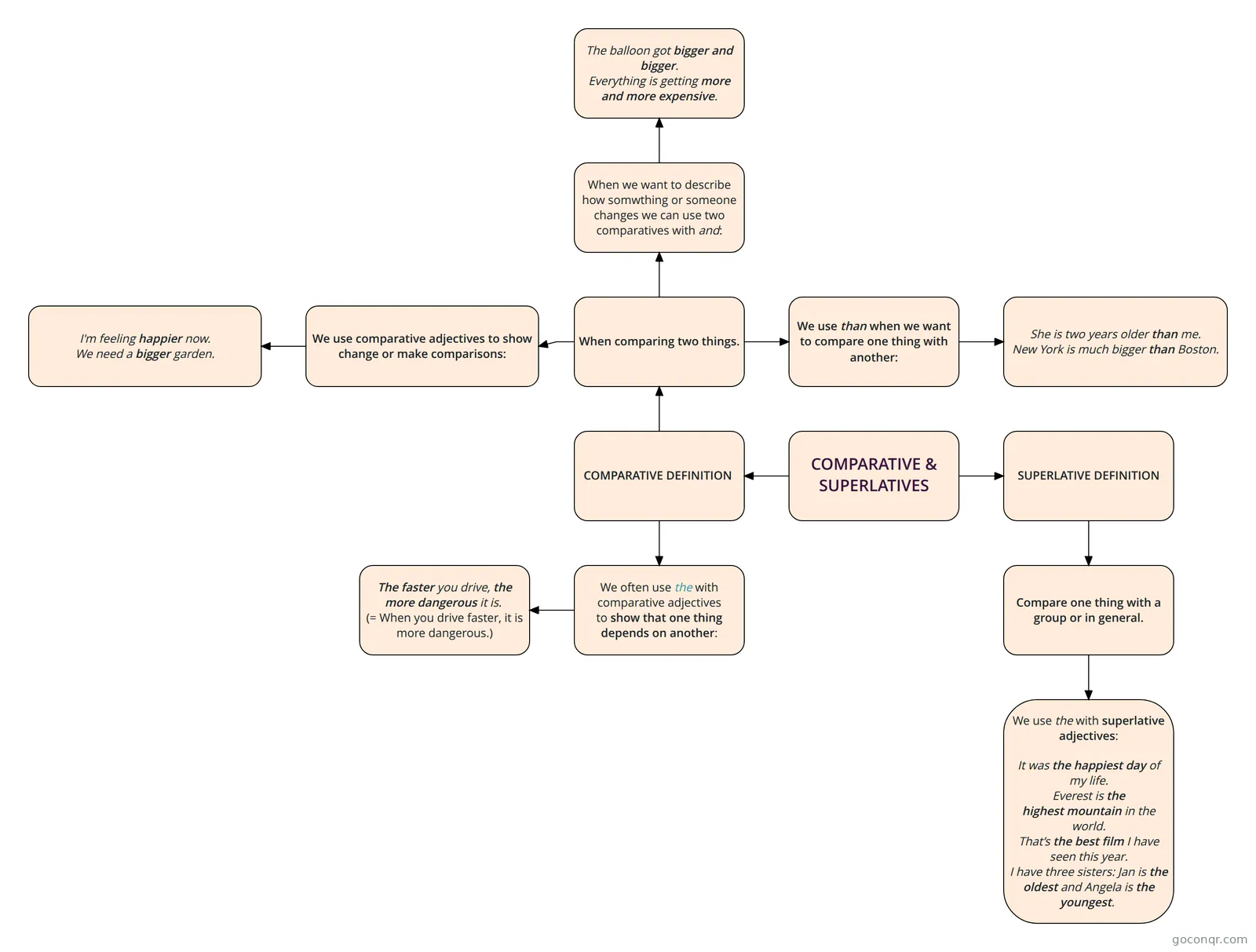 Flowchart COMPARATIVE AND SUPERLATIVE USE COMPARATIVE AND SUPERLATIVE IN THE CORRECT WAY.
-
6 cardsComparatives and Superlatives COMPARATIVES One way to describe nouns (people, objects, animals, etc.) is by comparing them to something e...
-
12 questionsFeeling & Emotion Fill in the Blanks feeling
-
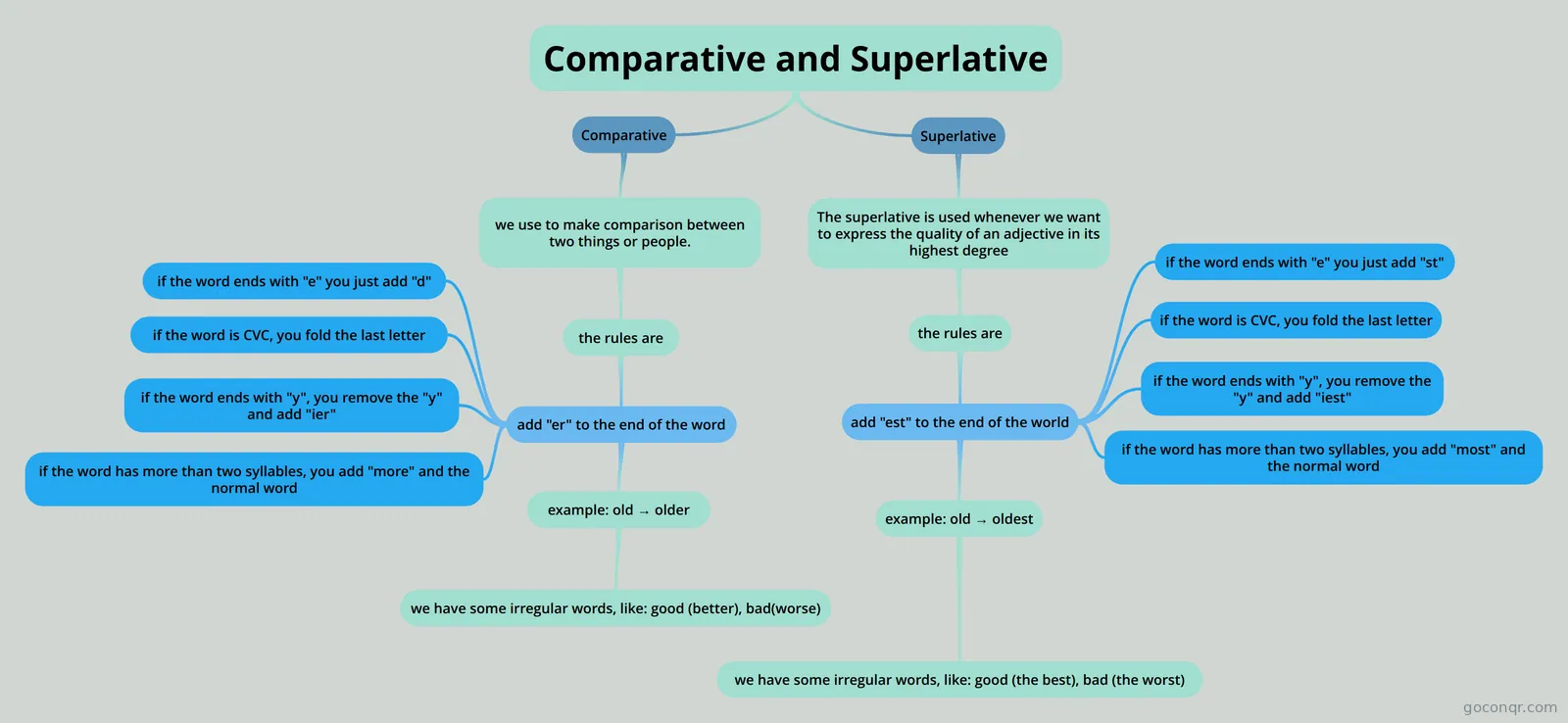
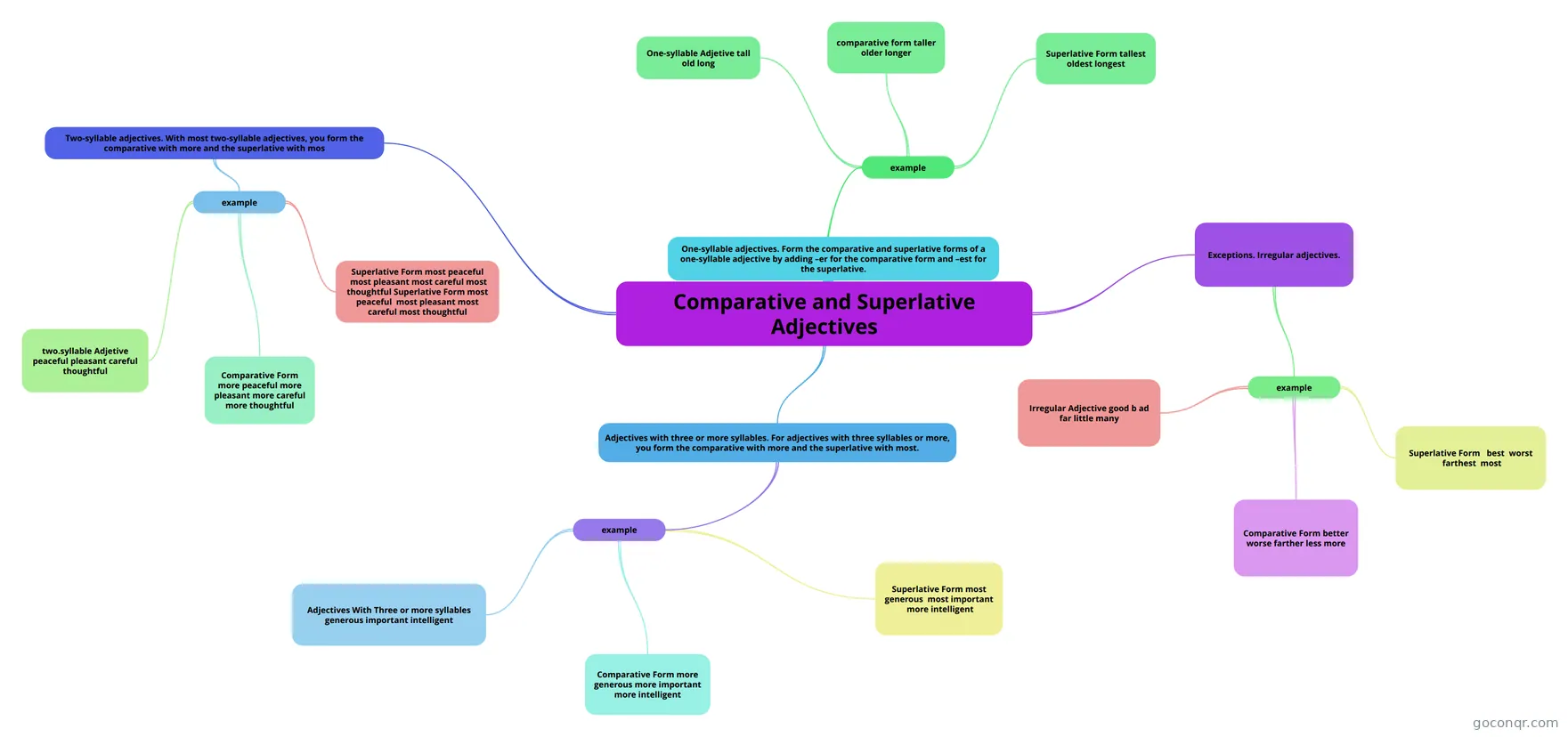 Mind map Comparative and Superlative Adjectives
Quizzes
See all 275 quizzes-
5 questionsSESSION 1 Read Jenny’s description.She is Jenny Slate. She is an American actress. She is tall, thin and pretty. Jenn...
-
10 questionsCOMPARATIVES AND SUPERLATIVES QUIZ This is a quiz to check your understanding about comparatives and superlatives.
-
12 questionsFeeling & Emotion Fill in the Blanks feeling
-
12 questionsPractice for adjectives Fortunately the surgeon was able to perform a ... operation
-
10 questionsAdjectives ending in -ed/-ing. Some of these sentences written by PET candidates have mistakes. Correct the errors.
-
8 questionsBASIC A1 - LESSON 29
-
37 questionsL3 U1-4 GRAMMAR & READING TEST
-
13 questionsMAKING COMPARISONS WITH ADJECTIVES I'm 18 and my brother is 20.
Mind maps
See all 1,756 mind maps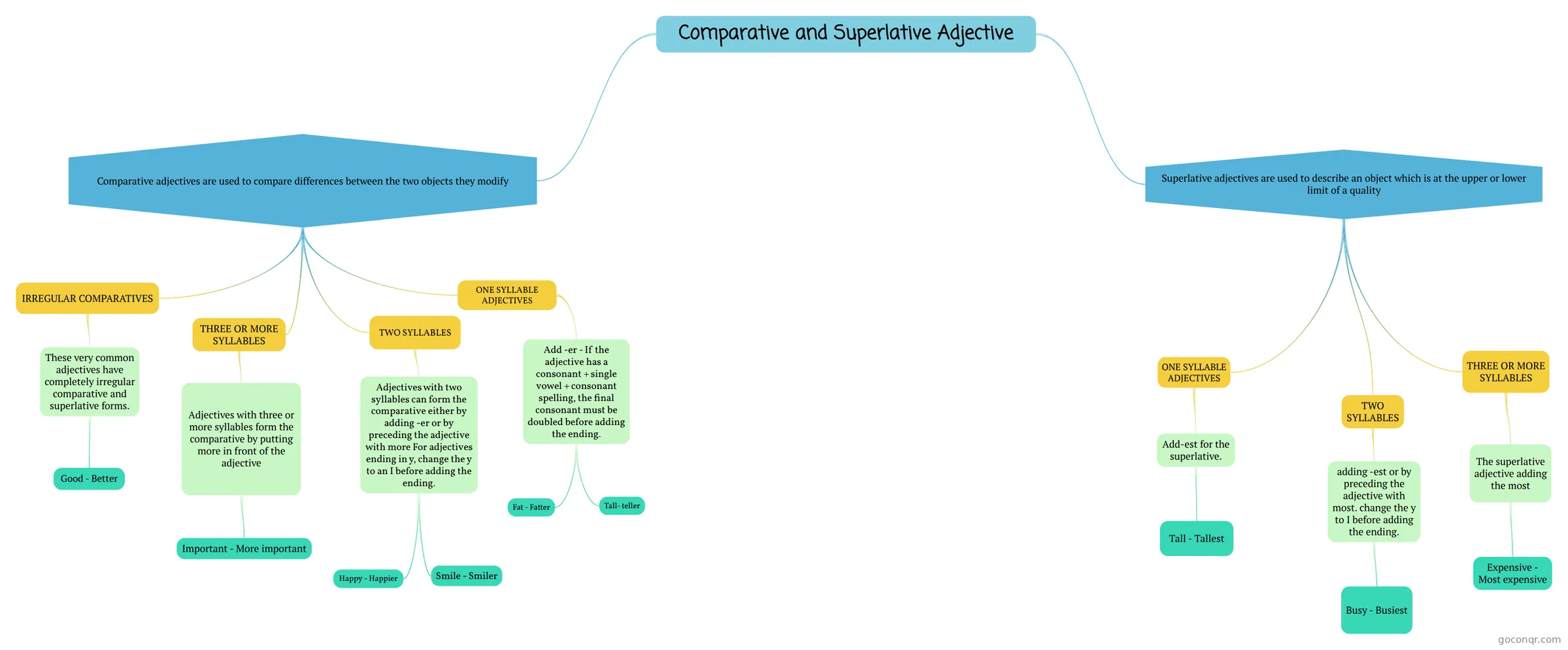
Flashcards
See all 840 flashcards-
36 cards045 ADJECTIVES 36 BIASED /ˈbaɪ.əst/ The newspapers gave a very biased report of the meeting. I think she's beautiful but then...
-
6 cardsComparatives and Superlatives COMPARATIVES One way to describe nouns (people, objects, animals, etc.) is by comparing them to something e...
-
20 cardsComparative or superlative?
-
12 cardsAdjectives ed/ing
-
19 cardsGRADABLE ADJECTIVES AND THEIR UNGRADABLE EQUIVALENT GRADABLE ADJECTIVES AND THEIR UNGRADABLE EQUIVALENT Gradable with adverbs: very, really, extremely Ungradab...
-
19 cardsNormal and Extreme Adjectives Some adjectives in English are gradable – that means you can have different degrees or levels of that quali...
-
9 cardsFlash Cards (Participial Adjectives) - Andres Limas Larrarte Do not overload power outlets. Plug the AC adapter into the appropriate voltage outlet.
-
61 cardsAdjectives and its Opposite Practice antonyms.
Flowcharts
See all 69 flowcharts-
Comparatives and superlatives In this lesson i'm going to show you, what a comparative and superlative is, when to use them, and how crea...
-
COMPARATIVE AND SUPERLATIVE USE COMPARATIVE AND SUPERLATIVE IN THE CORRECT WAY.
-
Adjectives Order Here you will find some adjectives and their order at the moment of describing.
-
Adjectives comparatives and superlatives
-
COMPARATIVES/ SUPERLATIVES
-
Untitled
-
Order of adejectives
-
1MM13_Act10_Superlatives_JorgeRiveroGomez
Notes
See all 57 notes-
Comparatives and Superlatives Adjectives can have degrees of comparison. They can be in the positive, the comparative and the superlative form. REMEMBER: add -er:With adjectives of 1 syllable*adjectives that end in -e we add only -radjectives that...
-
Lesson 3 What does she look like? Lesson 3 What does she look like? ESTE ES UN EJEMPLO DE TOMA DE NOTAS DEL VIDEO 3. HAGA CLICK AQUI PARA PODER VER LAS NOTAS COMPLETAS Adjectives Adjectives + noun - &nbs...
-
COMPOUND ADJECTIVES A single adjective made up of two or more words is called a compound adjective . The words in a compound adjective can be linked together by a Hyphen (or Hyphens) to show they are part of the same adjective. In t...
-
Untitled UNIVERSIDAD DISTRITAL FRANCISCO JOSÉ DE CALDAS &nb...
-
comparatives adjectives - created from Mind Map Rulers Superlative adjectives Comparative adjectives are used to compare differences between the two objects they modify (larger, smaller, faster, higher).
-
Adjectives -ed / -ing There are many adjectives that we have in English that end in -ED or -ING. Yes, that's correct, they are not only endings that we use for verbs! An adjective that ends in -ING is used to describe: the characteristic o...
-
ADJECTIVE: GRADABLE AND UNGRADABLE Gradable and ungradable As in Spanish, some adjectives (called gradable) allow degrees (and comparison), e.g.: quite big, very big, bigger than (But not: ) Other adjectives (called ungradable) do not allow degrees. We...
-
strong adjectives Adjectives are words that describe the qualities of something. Some adjectives in English are gradable – that means you can have different degrees or levels of that qu...
Slides
See all 51 slidesTopics in Adjectives
More English language topics
About Adjectives
GoConqr OriginalWhat this unit covers
The page sits in the Grammar: Words and Sentences strand of English language. Its resources fall into a few clear groups: comparatives and superlatives, adjectives ending in -ed and -ing, adjective order, gradable and ungradable adjectives, adjectives followed by prepositions, and vocabulary for feelings, character and places.
Where to start
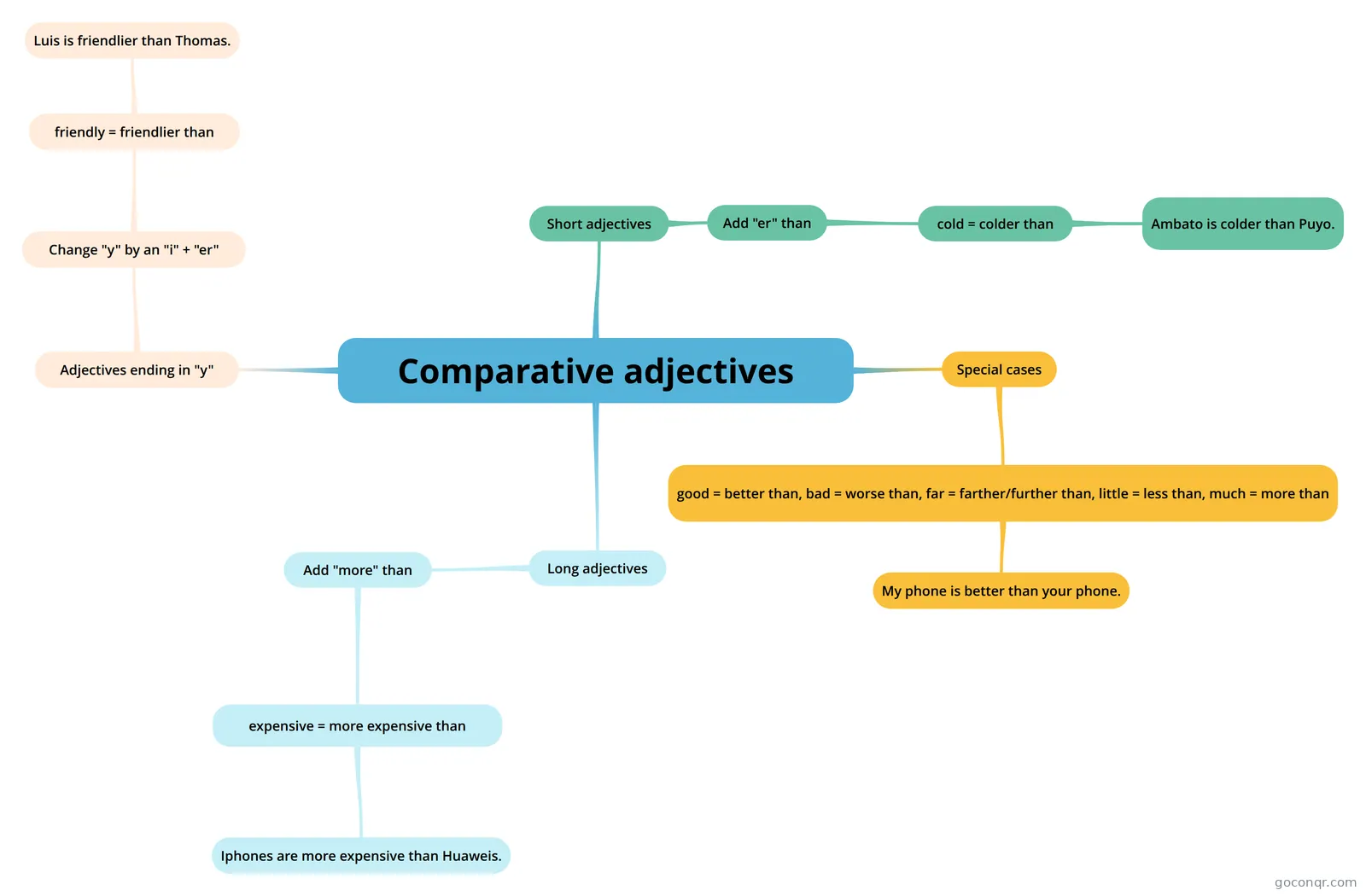
Begin with comparatives and superlatives, as they are the largest group. The mind map Comparative adjectives splits the rules into short adjectives, long adjectives and special cases such as good, better and bad, worse. The flashcards Comparatives and Superlatives explain when to use each form. The COMPARATIVES AND SUPERLATIVES QUIZ then asks you to complete sentences about animals.
Building vocabulary
Next, widen your range. The deck Normal and Extreme Adjectives pairs everyday words with stronger ones, such as angry and furious. The quiz Feeling & Emotion Fill in the Blanks lets you use feeling words in a short story. For -ed and -ing pairs, try Adjectives ending in -ed/-ing. as a quiz. There is also a flashcard deck aimed at FCE, called Adjectives - ending in -ing / -ed for FCE.
Using quizzes and maps together
Read a mind map first, so the rule is fresh. Then take a quiz on the same topic and note which answers you missed. Go back to the map or the flashcards for those points, and try the quiz again later. Teachers can set a map as a recap and a quiz as a quick check, or pick a flowchart for a visual summary.
- Read a map or notes.
- Take a quiz.
- Review the gaps with flashcards.
Make it your own
Nothing here covers exactly what your class needs? Use these resources as a starting point, then create your own maps, flashcards and quizzes for the adjectives you find hardest.
Frequently asked questions
Which resource should I start with?
Start with the mind map Comparative adjectives. It sets out the rules for short adjectives, long adjectives and special cases in a few branches. Then test yourself with the COMPARATIVES AND SUPERLATIVES QUIZ, which has you complete sentences about animals.
What do the mind maps cover?
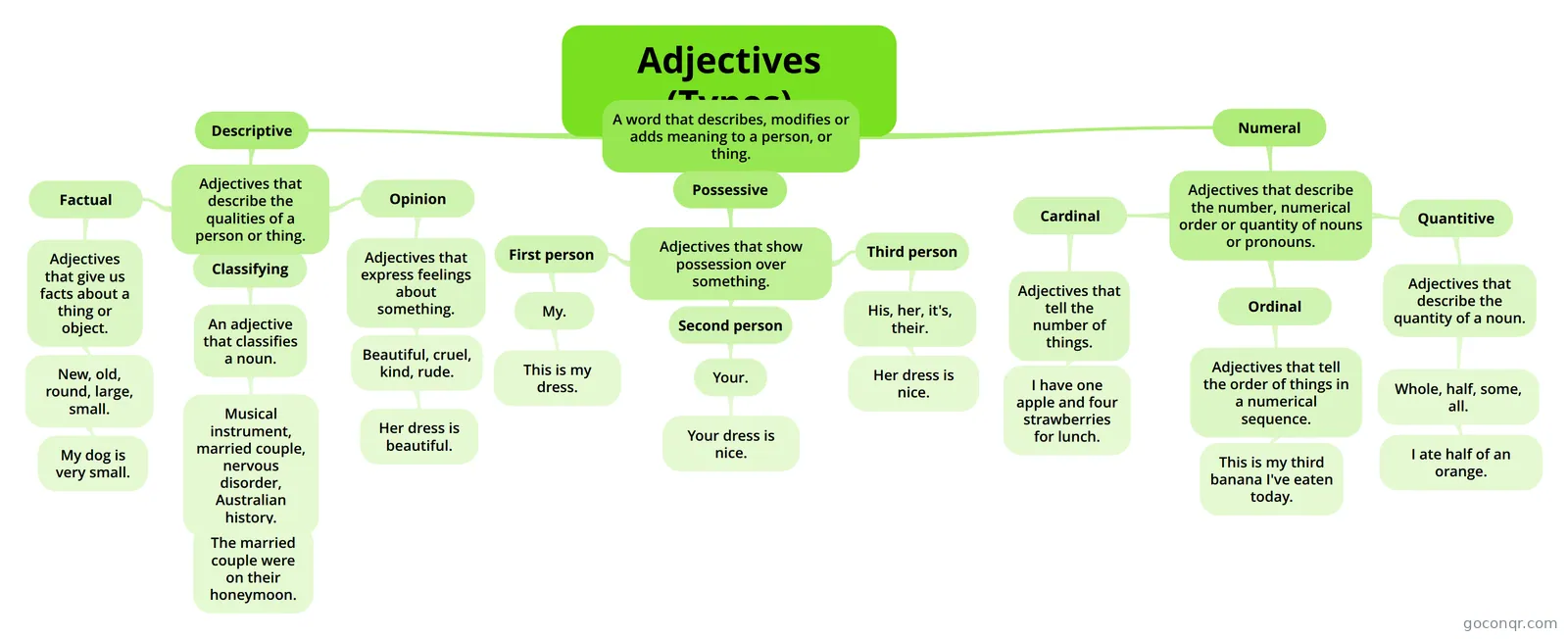
Most maps deal with comparatives and superlatives, setting out when to add -er or -est and when to use more or most. Others cover adjective order, adjective types and -ed and -ing endings. They are good for a quick recap before a quiz.
Are the resources free to use?
Yes. Every resource on this page is free to open, study and take, with no account needed. They were made by GoConqr users, not by GoConqr itself, so you will see different styles and approaches from one resource to the next.
Which levels do these resources suit?
The large majority are at secondary level, so they suit school students. Teachers can use them as ready-made material. One flashcard deck is aimed at FCE, covering adjectives ending in -ing and -ed.
Is there anything on adjectives with prepositions?
Yes. There are several flashcard decks on adjectives plus prepositions, and quizzes called Adjectives and Prepositions and Dependent prepositions AFTER ADJECTIVES. They help with pairs such as an adjective followed by a fixed preposition.
What if I can't find the topic I need?
Try the related topics nearby, such as extreme adjectives, gradable and ungradable adjectives or negative prefixes. A free account lets you make your own quizzes, mind maps, flashcards and notes, so you can fill any gap yourself.