
Fichas
Particle Physics
Fichas del conjunto (62)
- 1Names of lepton produced in each decay process: B- decayElectron and antineutrino
- 2Names of lepton produced in each decay process: B+ decayPositron and neutrino
- 3Proton's charge and massCharge: +1.6 x 10^-19 C
Mass: 1.67 x 10^-27 kg - 4B- particle's charge and massCharge: -1.6 x 10^-19 C
Mass: 9.11 x 10^-31 kg - 5Antineutrino's charge and massAntineutrino has no mass or charge.
- 6The name of the class or group of particles that includes B+ and B-Leptons
- 7Explain why sum of kinetic energies of carbon-13 nucleus and the B+ particle cannot be equal to the total energy released in decay processEnergy is used when electron neutrino is produced.
- 8Similarity and difference between B+ and B- particle.Similarity: Both have the same mass.
Difference: Both have opposite charges. - 9name of particle represented by this symbol: ̅νeantineutrino
- 10Which of the following are leptons? antineutrino, positron, proton, quarkantineutrino and positron
- 11One of the results of the alpha particle scattering experiment is that a very small minority of the alpha particles are scattered through angles greater than 90 degree. State what may be inferred about the structure of the atom from this result.The nucleus is charged. The mass in concentrated in a very small nucleus.
- 12charge of strange quark-1/3 e
- 13type of radiation that consists of leptons.Beta radiation
- 14type of radiation that consists of quarksalpha radiation
- 15type of radiation that cannot be deflected by an electric fieldgamma radiation
- 16type of radiation that has a continuous range of energies, rather than discrete values of energy.Beta radiation
- 17Name of the interaction (force) that gives rise to B+ decay.Weak nuclear forces
- 18Name of the group (class) of particles that includes: neutrons B- particlesneutrons - hadrons
B- particles - leptons - 19A proton in a nucleus decays to form a neutron and a B+ particle. The name of the other lepton produced in the decay.electron neutrino
- 20A proton in a nucleus decays to form a neutron and a B+ particle. Name of the interaction (force) that gives rise to this decay.Weak nuclear force
- 21A proton in a nucleus decays to form a neutron and a B+ particle. Which of the three particles (proton, neutron or B+ particle) has the largest ratio of charge to mass?B+ particle
- 22State and explain whether a proton is a fundamental particle.Made up of quarks so not a fundamental particle.
- 23Quark composition of a protonup up down
(uud) - 24Quark composition of a neutronup down down
(udd) - 25Quark composition of an alpha-particle2 proton, 2 neutron
6 up, 6 down - 26In an alpha particle scattering experiment, alpha particles were directed at a thin gold foil. What is inferred from the observation that most alpha particles pass through the foil?Most the atom is empty space.
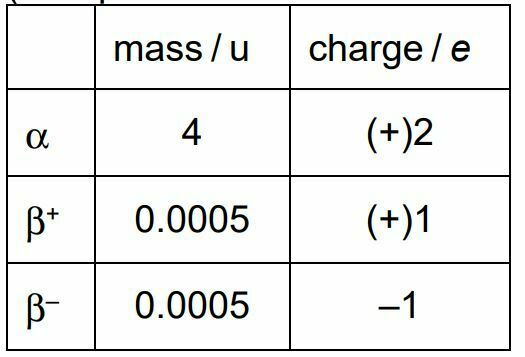
- 27mass in terms of 'u' and charge (e) of alpha particle, B+ particle and B- particle.
- 28Explain the origin of the B- particle that is emitted from the nucleus during B- decay.Neutron decays into an electron and proton.
- 29State the change in the quark composition of a carbon-14 nucleus when it emits a B- particle.down to up
- 30Suggest why the B- particles are emitted with a range of different energies.Electron antineutrino's emitted.
Energy released in decay. - 31Which statement cannot be deduced from alpha scattering experiment? (A) Atoms are mostly empty space. (B) Most of the mass of an atom is concentrated in the nucleus. (C) The nucleus of an atom contains protons. (D) The nucleus of an atom is small compared to the size of an atom.(C) The nucleus of an atom contains protons.
- 32A neutron is composed of one up (u) quark and two down (d) quarks. When a neutron decays to a proton, a beta-particle is emitted. What is the change in the quark structure of the neutron due to the emission of the beta-particle? (The symbol for a neutrino is ve and for an antineutrino is ve .)d --> u + B- + -ve
- 33State and explain which particle is a meson and which particle is a baryon.meson: Z, because consists of a quark and an antiquark
baryon: Y / ddd, because consists of three quarks - 34Describe the structure of an atom of uranium-238, 238 92U.92 protons and 146 neutrons (in nucleus).
92 (orbital) electrons - 35Two particles P and Q each consist of three quarks. These quarks are up (u) or down (d) quarks. Particle P has no overall charge. Particle Q has an overall charge of +2e, where e is the elementary charge. State the quark composition of: Particle P & Q.Particle P: udd
Particle Q: uuu - 36which out of three deflect in electric and magnetic field? (alpha, beta and gamma)Only alpha and beta. Gamma do not deflect in any field.
- 37electron's antimattterpositron
- 38What happens when a particle meets its antiparticle?They annihilate each other, leaving only photons of energy.
- 39when are beta minus electrons produced?They are expelled when a neutron changes to a proton in a nucleus. (n-->p)
- 40Is antineutrino a lepton or a hadron?Lepton
- 41What is a beta plus positron?It is an electron with a positive charge. It is expelled when a proton changes to a neutron in the nucleus. (p-->n)
- 42Beta plus positron has neutrino or antineutrino?Beta plus positron has electron neutrino and beta minus electron has electron antineutrino.
- 43Do gamma rays cause decays?No
- 44Formula for energyE=mc^2
m= mass deflect
c=speed of light - 45What are the fundamental particles?Quark and electrons (leptons)
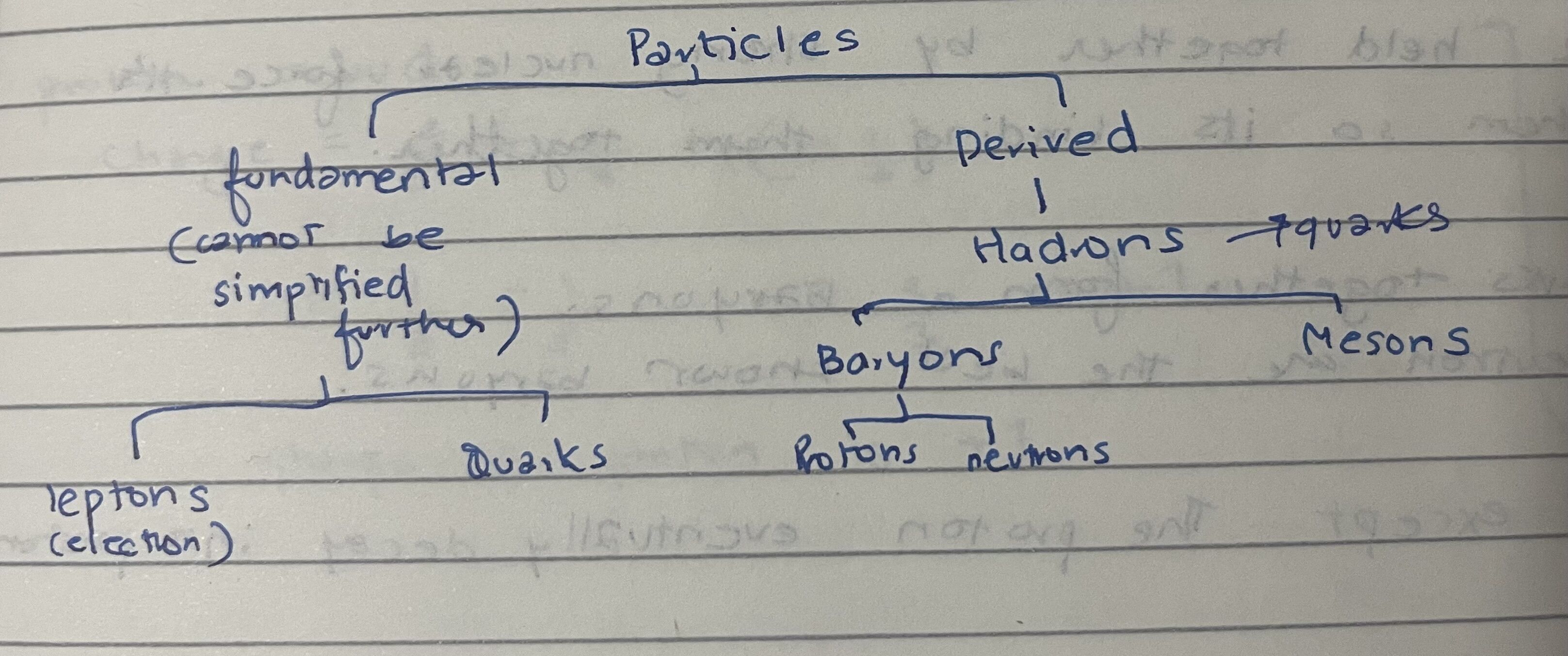
- 46Categorize into fundamental and derived particles.
- 47What are hadrons?Hadrons are those particles which are affected by strong nuclear forces. They are particles which are present inside the nucleus for eg: proton and neutron
- 48Differentiate between strong and weak nuclear forces.The forces which are holding the nucleus together are strong nuclear forces, forces which break them apart and weak nuclear forces
- 49Important types of hadrons?Baryons and mesons
- 50What are quarks?Hadrons are made of a few different particles called quarks. Quarks are fundamental particles which make hadrons.
- 51The important types of quarks?Up, down, strange, charm, top, bottom
- 52Which force are quarks held together by?Strong nuclear force
- 53What forms a baryon?Three quarks together form a baryons. Proton and neutron are the best known baryons.
- 54What forms a meson?Two quarks together form a meson. They are all unstable and of 2 types; the pion and the kaon.
- 55composition of proton and neutron.proton: uud
neutron: udd - 56charges of up, charm, top, down, bottom and strange.up, top, charm: +2/3 e
down, bottom, strange: -1/3e - 57What are leptons?They are like electrons, are not affected by strong nuclear forces, are fundamental particles found outside the nucleus.
- 58The six important leptons along with their antimatters.electron - positron (antiparticle)
electron - electron neutrino
muon - muon neutrino
tau - tau neutrino - 59Do leptons have baryon number and strangeness?No, they have zero baryon number and strangeness.
- 60Categorize the four into fundamental and derived particles. proton, neutron , electron, quarkderived: proton and neutron
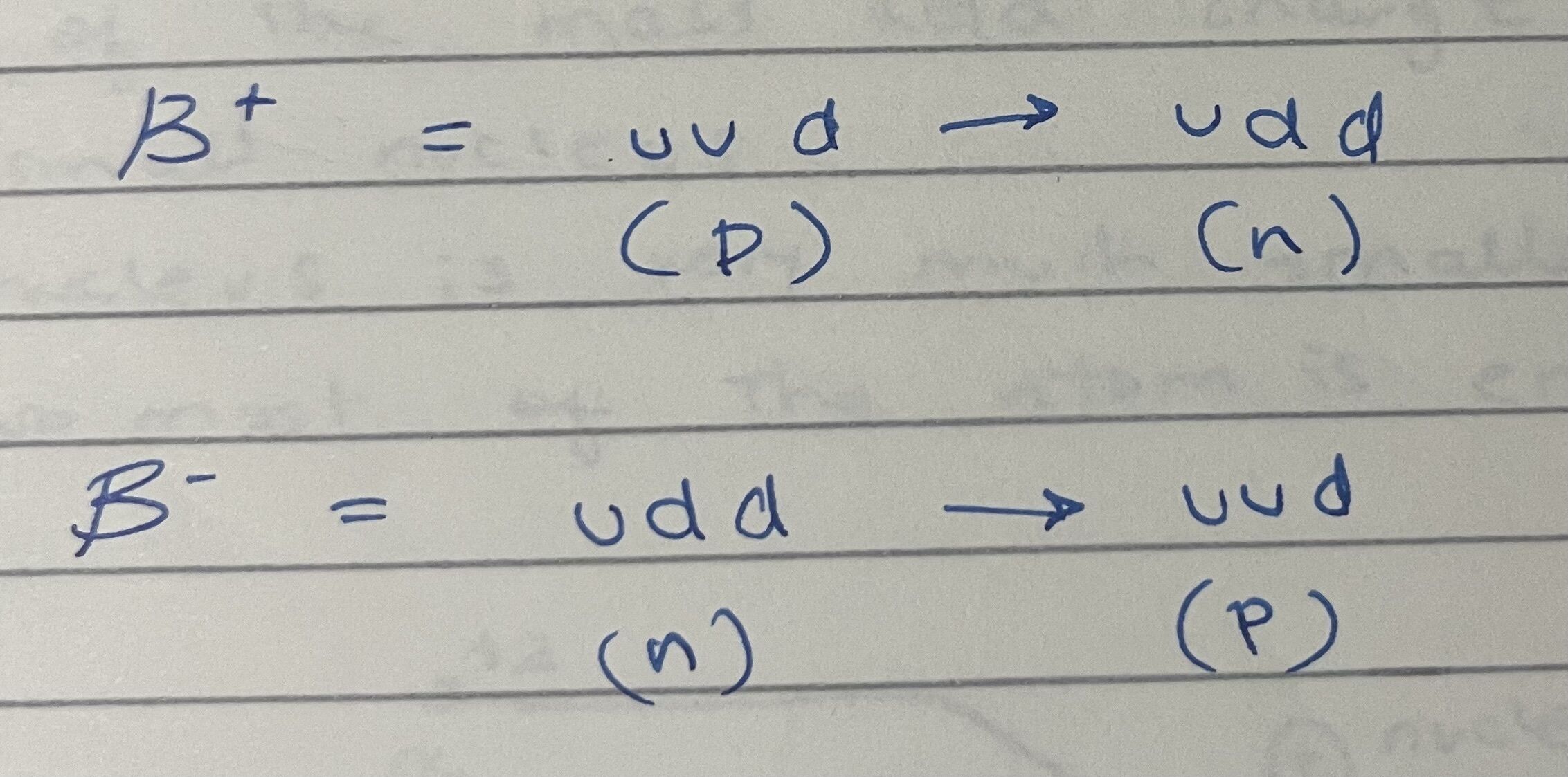
fundamental: electron and quark - 61B+ and B- decay in terms of simple quark model.
- 62Uses of radioactivityMedicine (radiotherapy and sterilization), agriculture, research and industry (quality control).
Información
- Descripción
- Definitions, Formula, Key Points, etc..
- Creado por
- Afrah Zeeshan
- Visitas
- 14
- Valoración