
Fichas
BIOLOGY 1 SCIENCE REVISION FLASH CARDS
Fichas del conjunto (91)
- 1What are the six types of fitness?- Strength
- Stamina / endurance or staying power
- Flexibility
- Agility / how easily someone moves
- Speed
- Cardiovascular efficiency / how well a persons circulatory system works - 2List the factors that increase the risk of heart disease- High blood pressure
- High leves of salt
- High levels of saturated fats
- Smoking - 3Why is blood in the arteries under pressure?-
- 4What is your BP? What is it measured in?Your BP (blood pressure) is measured in MMHG (millimetres of mercury)
- 5What is your Systolic pressure?The higher measurement when the heart beats, pushing blood through the atreries.
- 6What is your Diastolic Pressure?The lower measurement when the heart rests between beats.
- 7What does healthy mean?The absence of any disease.
- 8What does it mean if you are fit?The ability to perform physical activity.
- 9List the factors that increase blood pressure- Being overweight / lack of exercise
- Stress
- High alcohol intake
- Smoking
- High salt intake - 10Explain how smoking increases blood pressure1. Fatty plague deposits bulid up in the arteries.
2. A blood clot is formed
3 Heart mucle cells do not get the oxygen and nutrients they need.
TEST Q; oxygen, glucose, nutrients - 11How could you decrease blood pressure?- Regular exercise
- Balanced diet - 12What are carbohydrates made up of?Sugers, like glucose.
- 13What are proteins made up of?Amino acids
- 14What are fats made up of?Fatty acids and glycerol.
- 15The equation to calculate BMI is;Mass in KG
(Height in m) ^2 - 16What is your EAR? The equation to calculate EAR for protein is:Estimated average requirement
0.6 x body mass in kg - 17EAR QUESTION; Sue is 72.5KG. What is her EAR?72.5kg x 0.6 =
43.5g - 18BMI MEANINGS;- Under 18.5 = underweight
- Between 18.5 & 24.9 = normal
- Between 25 & 29.9 = overweight
- Between 30 & 39.9 = obese
- Over 40 = very obese - 19What is the name for protein deficiency and why is it common in developing countries?Kwashiorkor
- 20A women is 1.72m and 62kg 1. Calculate BMI 2. Calcuate EAR for protein1. 62kg / 1.72 ^2 = 20.96
2. 0.6 x 62kg = 37.2 - 21Explain how carbon monoxide reduces the carrying capacity of red blood cells.-
- 22What are the consequences of high blood pressure?- Heart disease
- Stroke
- Kidneys - 23What are the consequences of low blood pressure?- Dizziness
- Fainting - 24Give examples for when EAR for protein may vary;- Under 18.5 = underweight
- Between 18.5 & 24.9 = normal
- Between 25 & 29.9 = overweight
- Between 30 & 39.9 = obese
- Over 40 = very obese - 25What is the difference between first and second class protein?Proteins from plants are ‘second class’ proteins. Proteins from animals are ‘first class’ proteins – they provide all the essential amino acids, including those that the body can't make.
- 26Describe how the following are stored; 1. Carboydrates 2. Fats 3. Proteins1. In your liver
2. Underneath your skin, store in adipose tissue (girls have more)
3. Proteins are not stored, you clean them by your liver - 27For the following write the pathogen that causes the disease; 1. Athletes foot 2. Flu 3. Cholera 4. Malaria1. Fungi
2. Virus
3. Bacteria
4. Protoza - 28Name 4 ways that the body is defended from pathogens;1. Skin barrier - provides a physical barrier
2. Blood clot - prevents entry of pathogens
3. Mucus - pathogens trapped by mucus in airways
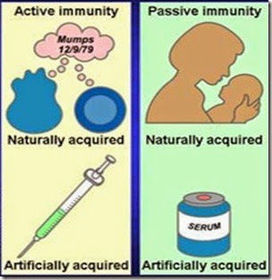
4. Stomach acid - hydrochlori acid in stomach kills pathogens - 29What is the difference between passive and active immunity?
- 30With reference to malaria: 1. The host is; 2. The parasite is; 3. The vector;1. Mosquitoes
2. Plasmodium
3. Malaria - 31Give two ways that white blood cells help fight disease:- Antibodies
- Antitoxins - 32Describe changes in lifestyle that reduce the risk of some cancers.- Diet
- Lifestyle
- Smoking - 33Explain how pathogens cause the symptoms of an infectious disease.They infect healthy area and cause weakness in your immune system.
- 34What is the difference between monocular and binocular vision?Monocular = can only see an object out of one eye. Usually has a range of vision.
Binocular = can see with two eyes and in 3D (Depth perspection) E.g. humans - 35What is the cause of the following; 1. Short sight 2. Long sight 3. Colour blindness1. Can see near objects clearly but cant further away (concave lense)
2. Can see long distance objects but not close up clearly (convex lense)
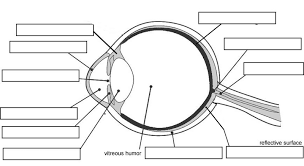
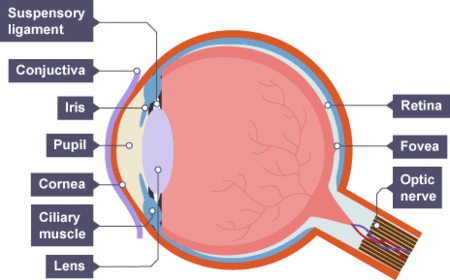
3. Deficency of when you see colour - 36Label the eye.
- 37Outline the process of immunisation.Immunisation for children. There are some diseases that can kill children or cause lasting damage to their health. Sometimes your child's system needs help to fight those diseases. Immunisation - also called 'vaccination', 'jabs' or 'injections' - provides that help.
- 38What is the difference between benign and malignantBenign - humour cells, such as in warts, are slow and harmless
Malignant - tumours are cancerous. Cells divide out of control and spread throughout the body - 39Explain why a double blind trial might be used to test new drugs (HSW)It can be more reliabe and therefore show a more accurate set of results.
- 40Explain the need for careful use of antibioticsThe pathogens will get used to the antibiotics and no react to it.
- 41Describe what happens at a synapseSynapse's send messages from one nerve to another. The neurotransmitters travel across them.
- 42How are motor neurones adapted to their function?They carry sgnals from the CNS to the effectors.
- 43Explain how the eye focuses lightThe rays of light are refracted ny your cornea, and the lens focusses light onto the retina.
- 44Describe the path of the reflex arc-
- 45What is the CNS?Central nevrous system
consists of your brain and spine - 46What are sensory neurones?Sensory neurones carry signals from receptors to the spinal cord and brain.
- 47What are relay neurones?Relay neurones carry message from one part of the CNS to another.
- 48What effect does depressants have on you? Example?It slows down brain activity.
E.g. Alcohol & Solvents. - 49What effect does stimulants have on you? Example?Increases brain activity
E.g. Nicotine & Caffeine - 50What drug category blocks nerve impulses?Painkillers.
- 51What are performance enhancers? E.g??- Improve muscle development
- Thought to be cheating
E.g. Anabolic Steroids - 52What drug category distorts what is seen or heard?Hallucingens
E.g LEC - 53Whats the effects of the following things that are in cigarettes; 1. Nicotine 2. Tar 3. Carbon monoxide 4. Particulates1. Addictive / affect BP
2. Irritate and cause cancers.
3. Oxygen can't get to red blood cells.
4. Deposits in the lung. - 54Give 4 short term effects of alcohol.- Impaired judgement
- Blurred vision
Increased blood flow to skin
- Slurred speed
- Balance and muscular control loss - 55Give 2 long term effects of alcohol.- Damages your liver
- Damages your brain - 56Why is there a legal limit for alcohol for drivers and pilots?Because blurred vision and impaired judgement can cause un-easiness and lack of concentration.
- 57What is the cause of 'smokers cough'?Cigarrette smoke stops the cilia from moving. Normally cilia hairs move to psuh mucus out of the lungs. Damaged cells cannot do this, leading to a build up of mucus and a smokers cough.
- 58Explain the basis of the legal classification system for drugs (A-C)A = most dangerous
higher consequence
C = least dangerous - 59What is the normal body temperature?37 degrees.
- 60What is homeostasis?Our way of controlling our internal environment.
Keeping your body th same. - 61List 3 things that the body needs to keep constant;- Body temp
- Water content
- Blood sugar level
- Carbon dioxide level - 62How could you control type 2 diabetes?- Excerise
- Keep check on diet - 63How could you control type 1 diabetes?Inject insulin.
- 64What are the effects on the body if temperature is too high?- Sweating
- Blood goes to the skin to try to lose heat
- Vasodilation (blood vessels become larger) - 65What are the effects on the body if temperature is too low?- Shivering
- Hair stand on end to trap air
- Vasocontsiction blood ( vessels near skin skin becomes narrow )
- Dehydration
- Hypothermia (pulse rate slows) - 66Explain why responses controlled by hormones are usually slower than responses controlled by the nervus system.-
- 67Explain how vasodilation and vasoconstriction increase or reduce heat transfer to the environmentVasodilation (blood vessels become larger)
- Vasocontsiction blood ( vessels near skin skin becomes narrow ) - 68Describe how the liver can be damaged as it removes alcohol.Toxins dont allow it to function.
- 69Describe how the action of depressants and stimulants differ on the nervous system.They effect the brain.
- 70Explain how negative feedback mechanisms help to maintain a constant internal environment.- Shivering warms you up, so you stop shivering
- Sweating cools you down so your temperature goes down - 71Growing towards light is called ............ phototropism. And away from gravity is called negative .......................... Growing towards gravity is called .................1. Positive
2. Geotropism
3. Posiitve geotropism - 72Give 4 commercial uses of plant hormones.- Weedkillers
- Controlling fruit riperning
- Rooting powder
- Dormancy - 73Plant hormones are called .................. - Move through the plant in ......... - Involved in the response to i........... - Involved in the response to g.................-
- 74Describe an experiment to prove that plants grow towards light.Auxin is a plant hormone responsible for controlling the direction of growth of root tips and stem tips in response to different stimuli including light and gravity.
- 75LIst characteristics that are as a result of both genes and environment- Body mass
- Height - 76How many chromosomes are thre in a skin cell?23
- 77How many chromosones in an egg cell?23
- 78How many chromosones in a sperm cell?23
- 79What are the sex chromosomes for a girl?XX
- 80What are the sex chromosomes for a boy?XY
- 81List 3 causes of variation.- Environmental
- Genetic
- - 82Name 4 inherited disorders- red-green colour blindness
- sickle cell anaemia
- cystic fibrosis. - 83Explain how auxin brings about shoot curvature in terms of cell elongation.In a shoot, the shaded side contains more auxin. This means that the shaded side grows longer, causing the shoot to bend towards the light.
- 84Define homozygous.An individual who has two alleles for an inherited characteristic
- 85Define heterozygousAn individual who has two different alleles for an inherted characteristics.
- 86Whats genotype?Your genotype is your complete heritable genetic identity; it is your unique genome
- 87What phenotype?Your phenotype is a description of your actual physical characteristics.
- 88Define dominant.Prominent and stronger gene.
- 89Define recessive.The weaker gene.
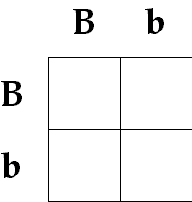
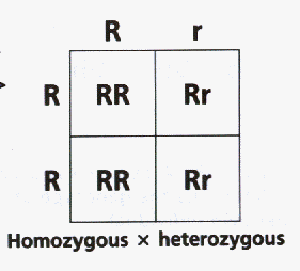
- 90Complete the monohybrid cross
- 91Define allele.Inherited characteristics are carried as pairs of alleles on pair of chromosomes.
Información
- Descripción
- Flash cards that can help to test your understanding of B1.
- Creado por
- Molly Bradbury
- Visitas
- 32
- Etiquetas
- Valoración