
5007912
Descripción

Fichas por Emily Sutton, actualizado hace más de 1 año
|
|
Creado por Emily Sutton
hace más de 10 años
|
|
| Pregunta | Respuesta |
| Biology - Cell Structure and Organisation: QnA | Questions on the front and model answers on the back. |
| 1) With the aid of a diagram, compare and contrast a mitochondrion and a chloroplast. | Mitochondrion has a double membrane, an inner and outer one, with narrow fluid filled inter-membrane space between. It has cristae which are infoldings of the inner membrane. The interior contains an organic matrix. DNA and ribosomes are present in both Mitochondrion and chloroplast and the organelles are self replicating. The function of Mitochondrion is energy release and ATP production. Chloroplast also has a double inner and outer membrane. Interior of the chloroplast is the gelatinous stroma. Flattened sacs, lamallae and thylakoids are present in the stroma, that are usually stacked to form grana. These are sites of photosynthetic pigments/chlorophyll. Starch grains may also be present. Chloroplasts function is photosynthesis. |
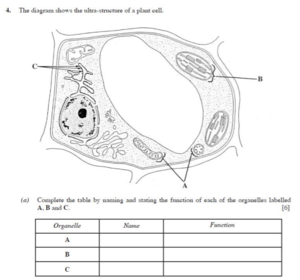
| A = Mitochondrion (cell respiration/ATP production) B = Chloroplasts (photosynthesis/light trapping) C = Ribosome (Protein synthesis) | |
| b) The structure layered B are identical. Explain why they differ in appearance in the diagram. | They have been cut in different places. |
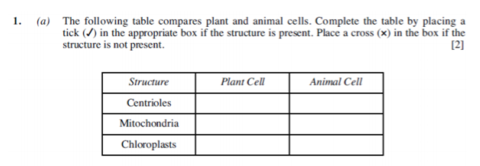
| c) State two ways an animal cell would differ from a plant cell. | Animal cells don't have chloroplasts or cell walls. They don't have a large central permanent vacuole either. |
| Plant = mitochondria, chloroplasts Animal = Centrioles, mitochondria | |
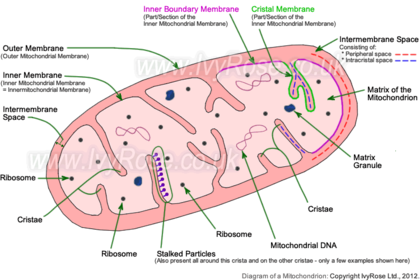
| bi) Draw and label a diagram to show a section through a typical mitochondrion. | |
| ii) What is the function of mitochondria cells? | Aerobic respiration and ATP production. |
| iii) Name a type of cell where you'd expect to find a large number of mitochondria. | Muscle cell/liver cell/sperm/pancreas/companion cell |
| iv) Explain why this cell has a large number of mitochondria. | Muscle cell = High requirement on energy for contraction. |
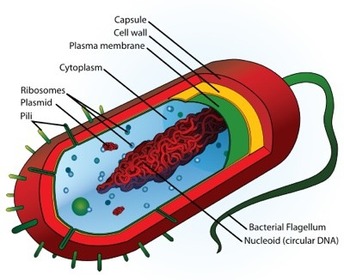
| a) Draw a labelled diagram to show the structure of a prokaryote cell. Explain how a typical eukaryote cell differs from a prokaryote. | The ribosomes are very much larger in eukaryote cells (70s). A prokaryote cell is 1-10 micro meters and a eukaryote cell is 10-100 micro meters. The cell wall of a eukaryote is made from cellulose/chitin and a prokaryote cell is murein. There is mitochondria in eukaryote cells but mesosomes in prokaryotes. Eukaryotes have a nucleus and nuclear membrane and so carries more genetic information, containing several paired chromosomes/ linear chromosomes. Eukaryotes are compartmentalised by membranes and contain organelles. Eukaryote chromosomes have protein/histones. |
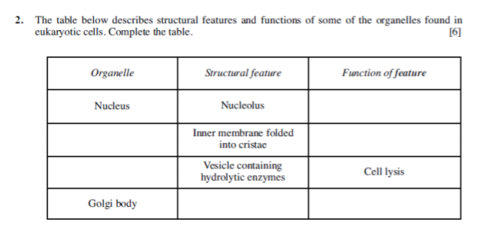
| Ribosome, manufacture/synthesis, rRNA. Mitochondrion - Increase surface area for enzyme attachment/ATP synthesis Lysosome Stack of cisternae/flattened, membrane bound sacks - Protein assembly/conjugation of proteins/secretion/lysosome formation/produces vesicles/packaging or modification molecules/stores and transports lipids. | |
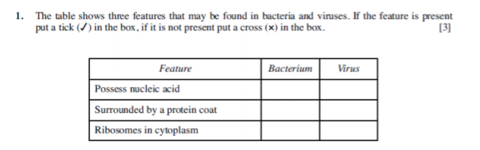
| Bacterium = yes, no, yes Virus = yes, yes, no | |
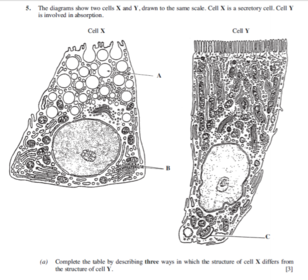
| X = Large number of vesicles, Y = Small number of vesicles. X = Large amount of RER/ribosomes, Y = Little RER/ribosomes. X = Few mitochondria, Y = Large number of mitochondria. X = No microvilli, Y = Microvilli X = More nuclear pores, y = fewer nuclear pores. | |
| b) Explain how the labelled structure help each cell to carry out its function. | A = Transport substances to plasm/cell membrane B = Protein synthesis C = ATP synthesis |
| c) For cell X, name and describe the process by which secretary products are passed out of the cell. | Exocytosis. A transport vesicle fuses with the plasma membrane. There is a break in the membrane to then allow the expulsion of the secretion. |
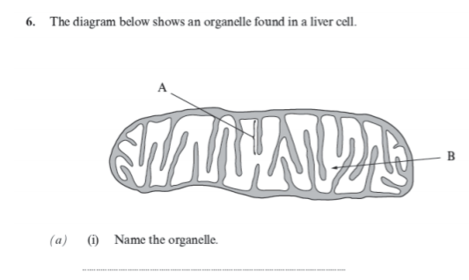
| Mitochondrion. | |
| ii) State the function of the organelle. | ATP production/ aerobic respiration. |
| iii) Name the structure labelled A and B in the diagram. | A = Cristae B = Matrix |
| b) Explain why liver cells have large numbers of these cells present. | They are metabolically active with many chemical reactions taking place, so a large amount of ATP is required. |
¿Quieres crear tus propias Fichas gratiscon GoConqr? Más información.