
Fichas
10.) Semantics 3
Fichas del conjunto (34)
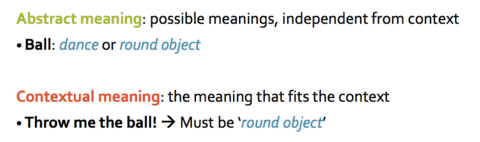
- 1Lexical ambiguity examplesCan cause misunderstandings
Multiple possible meanings:
• The priest married my sister (Did the priest conduct the ceremony? Or is he now the sister’s husband?)
• “You know, somebody actually complimented me on my driving today. They left a little note on the windscreen; it said, ‘Parking Fine.’ So that was nice.” (Tim Vine) - 2lexical ambiguity in terms of meaning?
- 3Mismatches of meaningNoun + Verb + Adverb
-Tigers run quickly
-*Advice drinks forgetfully.
-*Colorless green ideas sleep furiously. - 4Semantic role? Also called ___ or ___--> The role that a noun phrase plays in the event described by a
sentence
Also called thematic role or Theta role - 5Semantic role example The woman at the apple. The man took the food from the kitchen to the dining room.
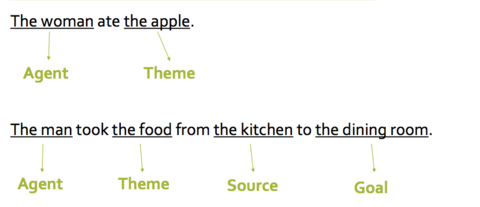
- 6Can we just say that the agent is the subject of the sentence and the theme is the object?no!!!
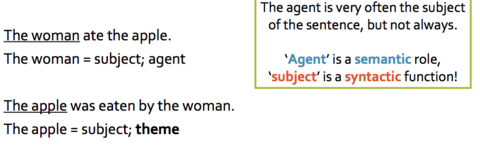
- 7Semantic rolesAgent, Theme, Experiencer, Instrument, Source, Goal, Location
- 8Agentthe ‘doer’ of the action
- 9Themethe thing being described or affected by the action
- 10Experiencerthe entity experiencing something (seeing, feeling...)
- 11Instrumentthe thing being used to carry out an action
- 12Sourcethe starting point of a movement
- 13Goalthe end point of a movement
- 14Locationwhere the entity is located / where the action takes place
- 15—
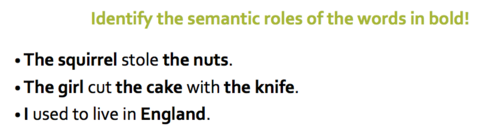
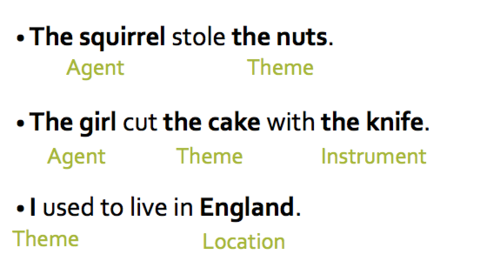
- 16—

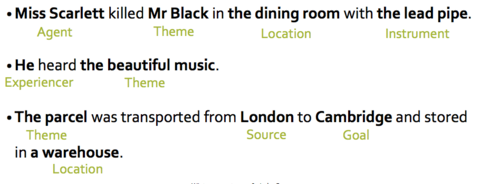
- 17semantic roles how many roles per entity?
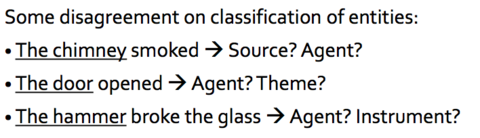
- 18What is a corpus?-a large and principled collection of natural texts (written
and/or spoken)
-typically based on a specific type of text, aimed at being
representative of the type under examination. - 19What is corpus linguistics? linguistic description based on the extensive accumulation of actually occurring language data and its analysis by computer
- 20Why are corpora relevant to semantics?• Frequency of words
• Frequency of different meanings for the same word
• Collocations with other words
• Associations with certain registers / dialects - 21Sentence meaning: What is a lexicon? finite or infinite?-Essentially the vocabulary of a language.
-Very large, but finite (i.e. there is a limited number of items of vocabulary per language) - 22Sentence meaning Sentences?-There is an infinite number of possibilities
-Meanings are compositional (i.e. put together using smaller parts, e.g. words)
-Words have a meaning on their own, but in combination (and in different combinations) create new meanings:
eg. Mike saw Susan. Susan saw Mike. - 23Syntactic/structural ambiguityThe relationship between the words can be misunderstood / interpreted in different ways

- 24sentence meaning vs. speaker meaningsemantics vs. pragmatics
- 25Semantics-Sentenece/word meaning
-What is coded in language
-What you would find in a dictionary (intrinsic meaning of words) - 26Pragmatics-speaker meaning
-What is intended/implied
-Not found in a dictionary
-Speaker intention often contradicts word meaning - 27sb opens the window and it's really cold outside what do you say?• Are you mad?!
• I think it’s a bit cold for that...
• What are you doing?
• Do you have to do that?
All you really mean is: CLOSE THE WINDOW - 28There is a conflict between sentence meaning (semantics) and speaker meaning (pragmatics)A: Are you mad?!
B: - No, I’m not, but thank you for your concern. B: - Oh, sorry, you’re right, I’ll shut the window. - 29representing sentence meaning propositionProposition: state of affairs described by the sentence
-->What is said about something
e.g. The small boy ate the delicious chocolate cake.
The boy was small / The cake was delicious / It was a chocolate cake / The cake was eaten (...) - 30Truth value?is the propositional content true or false? (truth-conditional semantics)
- 31Semantic relations among sentences What is a paraphrase?-The ‘same thing’ in ‘other words’
-Two sentences have the same proposition (and the same truth-value)
-We can liken it to synonymy
• Spain won against Croatia. / Croatia was beaten by Spain.
• Mr Jones is Gary’s teacher. / Gary is Mr Jones’ pupil.
• Many people attended the lecture. / The lecture was attended by many people. - 32Semantic relations among sentences What is entailment?-The truth of one sentence necessarily implies that of the other
-We can liken it to hyponymy
• My sister drove me to work.My sister can drive.
• Jenny quit smoking last year.Jenny used to smoke.
• Paul’s partner doesn’t like fishing.Paul has a partner. - 33What conclusions can we draw from the following sentences? (i.e. what is entailed in these sentences?) • Sandra dropped her phone in the pond. • This is Wendy, she is Jacob’s wife. • Sorry, I can’t talk, I’m running late for work!Sandra owned a phone.
Jacob is married.
Sorry, I can’t talk, I’m running late for work! - 34Semantic relations among sentences: What is contradiction?If one sentence is true, the other is false We can liken it to antonymy
• I am jobless. / I work at Billa.
• Fred is single. / Paula is Fred’s girlfriend. • Sam’s legs are hurting. / Sam is a snake.
Información
- Descripción
- (Semantics) Linguistics Fichas sobre 10.) Semantics 3, creado por Lisza Neumeier el 26/11/2016.
- Creado por
- Lisza Neumeier
- Visitas
- 37
- Valoración